No.4073
PET Bottle Recycling Market in Japan: Key Research Findings 2025
Domestic Annual Capacity for Bottle-to-Bottle rPET Set to Hit 417,000 Tons By 2025 Year-End
Yano Research Institute (the President, Takashi Mizukoshi) surveyed the trends across manufacturers of eco-friendly material in Japan, and analyzed trends by product segment and company, and evaluated the market outlook.
This press release denotes the future outlook on the domestic capacity for bottle-to-bottle rPET.
Market Overview
Guided by their ambitious sustainability goals, major brand owners (beverage manufacturers) are advancing environmentally friendly packaging designs. Their primary focus is to shift the material used in PET bottles, the industry’s core packaging format, from conventional virgin PET (vPET) to recycled PET (rPET) and bio-based alternatives. While bio-PE has yet to achieve full commercial scalability, the industry is currently prioritizing bottle-to-bottle recycling, whereby used PET bottles are recycled back into new PET bottles.
Major brand owners are expected to reach 50% bottle-to-bottle recycling between FY2025 and FY2026. As this milestone effectively fulfills their initial targets, companies may adopt a more cautious approach from FY2026 onward, particularly from a financial standpoint. As a result, the momentum behind the shift toward bottle-to-bottle recycling is likely to moderate.
Noteworthy Topics
Domestic Annual Capacity for Bottle-to-Bottle rPET
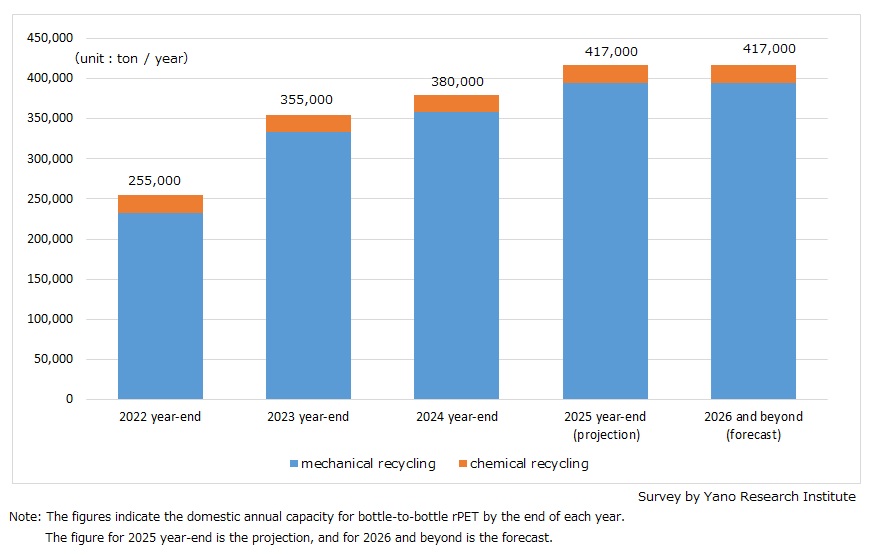
Japan's annual capacity for bottle-to-bottle rPET, as a total of mechanical recycling and chemical recycling, reached 380,000 tons by the end of 2024.
Furthermore, as new recyclers (recycling companies and rPET manufacturers) began operation in 2025, the annual capacity is projected to expand to 417,000 tons by 2025 year-end.
Nevertheless, as production facilities of bottle-to-bottle rPET have to go through periodic maintenance that require occasional shutdowns, net annual capacity is estimated at 355,000 to 375,000 tons.
Future Outlook
The capacity of bottle-to-bottle rPET does not necessarily match the actual output volume.
Bottle-to-bottle recycling extends beyond simple mechanical recycling. It necessitates advanced repolymerization to restore the resin’s intrinsic viscosity (IV), which typically degrades during thermal processing. This restoration is critical for maintaining the structural integrity required for blow molding. Furthermore, rPET intended for beverage applications must adhere to rigorous safety and hygiene protocols; consequently, manufacturers implement advanced alkaline washing to ensure the total removal of contaminants. Success also hinges on full process traceability, ensuring transparency across the supply chain—from the sourcing of bale and flakes to the final delivery of rPET resin.
Furthermore, even when rPET passes rigorous challenge tests—including surrogate contamination, dissolution, and sensory evaluations—brand owners may still reject the material if even a minute trace of discoloration is detected. This subjectivity complicates the adoption of rPET for beverage bottles. In fact, one established recycler spent years meeting a brand owner's stringent visual standards, despite having satisfied all technical and data-driven specifications long before.
Recyclers currently producing rPET for bottle-to-bottle applications need to stabilize production of rPET that meets brand owners’ visual appearance specifications, while complying with safety and hygiene standards for beverage containers.
Research Outline
2.Research Object: Manufacturers of eco-friendly materials
3.Research Methogology: Face-to-face interviews (including online) by expert researchers, and literature research
<What are Eco-Friendly Materials?>
In the market report Eco-Friendly Material Market 2025, eco-friendly materials refer to "sustainable plastic" and other materials that contribute to reducing the use of plastics (such as those used for paper cartons, metal cans, lightweight plastic containers).
- "Sustainable plastic" encompasses plant biomass fillers (natural reinforcing materials for polymeric composites), recycled plastics, and recycled carbon fiber (rCF) derived from CFRP scraps.
- "Recycled plastic" include bioplastics, which can be "biodegradable plastics (which may be fossil-based)" or "bio-based plastics (bio-based but non-biodegradable)."
- From marketing perspective, terms like "Sustainable PP" and "Sustainable PE" are also used. These may be broken down further into "rPP" "rPE" (r: using recycled materials), "bio-PP" and "bio-PE" (bio: biomass-based).
<What is the Domestic PET Bottle Recycling Market?>
The domestic PET bottle recycling market is the market for bottle-to-bottle recycled PET (rPET).
*The market landscape of recycling PET film, PET bottles, CRFP, paper cartons, paper cups, and aluminum cans are explored in the market report.
Published Report
Contact Us
The copyright and all other rights pertaining to this report belong to Yano Research Institute.
Please contact our PR team when quoting the report contents for the purpose other than media coverage.
Depending on the purpose of using our report, we may ask you to present your sentences for confirmation beforehand.