No.4066
Global Supercapacitor Market: Key Research Findings 2026
Global Supercapacitor Market to Exceed 630 Billion Yen by 2030
Yano Research Institute (the President, Takashi Mizukoshi) conducted a survey of the supercapacitor market. The survey revealed trends by category, trends among market players, and future outlook.
Market Overview
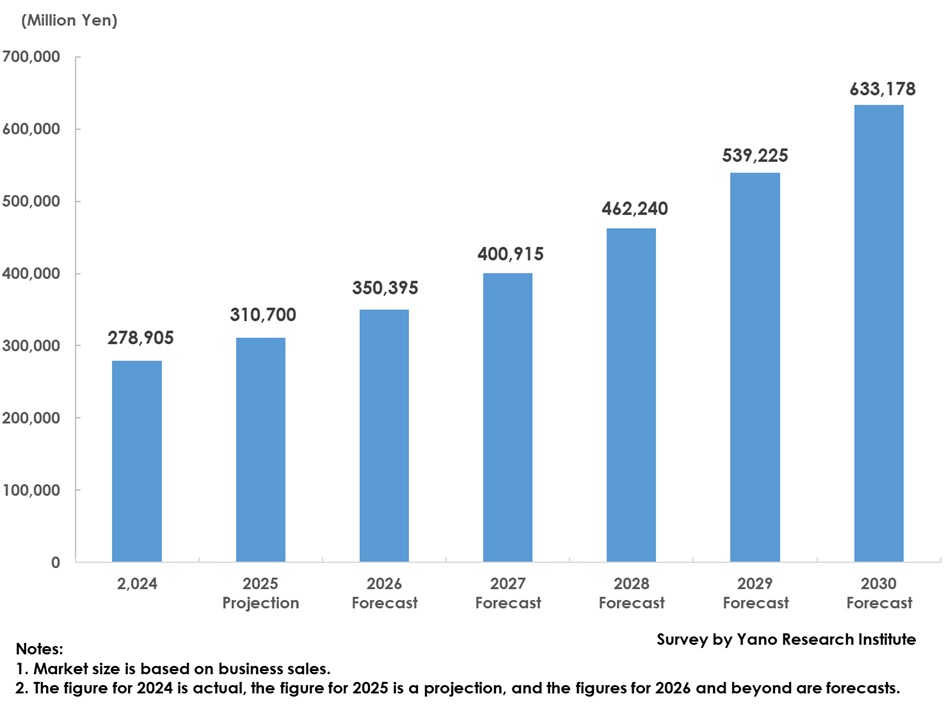
The global supercapacitor market size was worth 278.95 billion yen in 2024.
Supercapacitors are used as electrical energy storage devices that complement primary and secondary batteries in mobile electronics, such as personal computers, smartphones, and tablets.
Despite having a lower capacity than lithium-ion batteries (which are a typical type of secondary battery), supercapacitors can charge electricity faster, and are less likely to cause thermal runaway, making them safer to operate.
By combining them with batteries, supercapacitors contribute to the safe operation of electronic devices. The supercapacitor market is expected to grow, as supercapacitors are poised to become essential components underlying the growth of current digital devices.
Noteworthy Topics
Challenges in the National Support System for Japanese Monozukuri (Manufacturing) for Market Expansion
Since the inception of the market, Japanese manufacturers have developed supercapacitors and continuously improved their product technologies.
Meanwhile, overseas manufacturers have received strengthened support, measures, and funds from the national and local governments working together to advance technology in this field.
To counter these competitive pressures, the Japanese government must promote and fund manufacturers’ initiatives to develop these technologies as a national project.
The government should enhance its support measures by providing opportunities for collaboration and information exchange among companies, including competitors of product developers, as well as companies planning to enter the market. This collaboration and information exchange could lead to future technological development, even among competing companies.
Aligning with the government is important for companies to become global top players in this field.
Future Outlook
Due to ongoing research and development, as well as increased sales, the global supercapacitor market is expected to reach 310.7 billion yen by 2025.
The market is projected to grow to 462.24 billion yen by 2028 and 633.178 billion yen by 2030. Thus, the market size in 2030 will be 204% larger than in 2025.
By 2030, supercapacitors will have expanded their applications beyond automotive components to include rapidly growing AI applications. Demand is expected to increase due to growing attention on supercapacitors as a solution to energy efficiency issues, as well as battery-related environmental and technological concerns.
Research Outline
2.Research Object: Electric double layer capacitors (EDLCs), hybrid capacitors, supercapacitor components including pseudo-capacitors
3.Research Methogology: Face-to-face interviews by our expert researchers (including online interviews) and literature research
What are Supercapacitors?
Supercapacitors are electrical energy storage devices. They have two basic features: charging and discharging electricity and passing alternating current while blocking direct current. In Japan, capacitors are also called condensers. Recently, the term "capacitor" has come to refer to devices with larger capacities, while "condenser" refers to devices with smaller capacities. Examples of condensers include laminate ceramic condensers, which are also known as laminate ceramic capacitors. Supercapacitors can be broadly categorized by their energy storage mechanism as electric double-layer capacitors (EDLCs) or hybrid capacitors. EDLCs use electrostatic charge accumulation on the electrode surface (electric double layer), while hybrid capacitors exchange electrical charges through redox reactions. Pseudo-capacitors are electric energy storage devices that store electrical charges through quick, reversible redox reactions that occur on or near electrode materials.
<Products and Services in the Market>
Electric double-layer capacitors (EDLCs), hybrid capacitors, supercapacitor components including pseudo-capacitors
Published Report
Contact Us
The copyright and all other rights pertaining to this report belong to Yano Research Institute.
Please contact our PR team when quoting the report contents for the purpose other than media coverage.
Depending on the purpose of using our report, we may ask you to present your sentences for confirmation beforehand.