No.4074
Global Automotive Camera Market: Key Research Findings 2026
Global Automotive Camera Installations to Reach 909.07 Million Units by 2035, As ADAS Advances and Sensor Control Centralized
Yano Research Institute (the President, Takashi Mizukoshi) conducted a survey of the global automotive camera market. The survey revealed the market overview by region, technological trends, and business strategies of major manufacturers.
This paper forecasts global automotive camera installations by 2035.
Market Overview
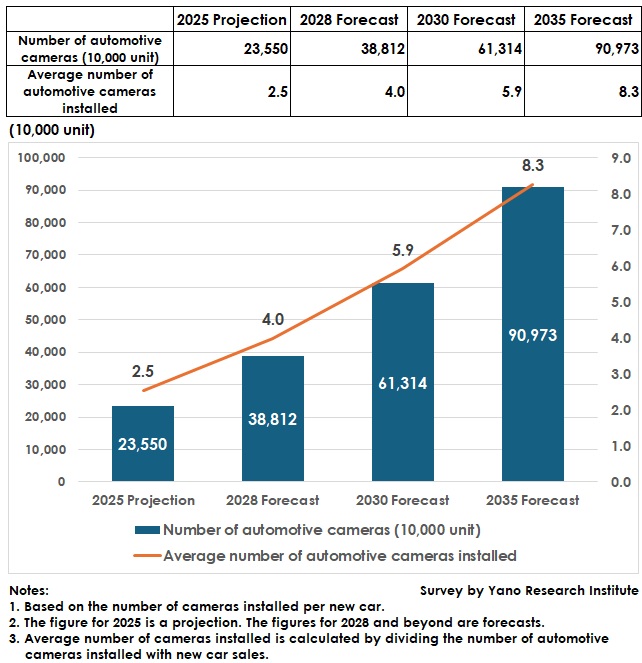
The global automotive camera market is expected to reach 235.5 million units by 2025. This growth is driven by advanced driver assistance systems (ADAS). Cameras used in Navigation on Autopilot (NOA) systems and other Level 2 vehicle autonomy systems have improved, offering higher resolution and 360-degree surround-view detection. Since the mid-2020s, there has been an increasing demand for cameras in auto parking assist (APA) systems, driver monitoring systems (DMS), and occupant monitoring systems (OMS).
China has formulated the largest market. Since 2024, even middle-class vehicles have adopted NOA systems comprising multiple cameras, notably increasing the number of cameras installed per vehicle.
Noteworthy Topics
Automotive Camera Systems Evolve by Offering Higher Resolution and Multiple Cameras, and by Responding to Safety Regulations
In China, the competition to differentiate ADAS has intensified among high-end battery electric vehicles (BEVs). Even middle-class vehicles have begun deploying APA systems as well as NOA systems that perform well on urban roads with a median strip and sidewalks. This has led to an increase in automotive models equipped with high-resolution 8-megapixel front-facing cameras. Additionally, the prevalence of domain-based electrical/electronic (E/E) architecture, in which electronic control units (ECUs) are centrally controlled by function, has led to centralized sensor control. Consequently, the number of automotive models equipped with synchronized multi-camera systems, in which cameras are located at the front, sides, and rear of the vehicle, has increased.
Camera-based interior monitoring systems are being adopted at a rapid pace in Europe, due to the EU's obligation to detect driver drowsiness and inattention, as stipulated in the EU’s general safety regulation and driver monitoring system (DMS) deployment assessment in Euro NCAP.
In the United States, in anticipation of the Federal Motor Vehicle Safety Standard (FMVSS) No. 127, which will require the inclusion of pedestrian automatic emergency braking (PAEB) systems in all passenger cars and light trucks by September 2029, automakers are improving the performance of ADAS cameras by increasing camera resolution and expanding viewing angles.
Future Outlook
The global automotive camera market is forecast to reach 909.73 million units by 2035. This growth is driven by the increased adoption of domain-based E/E architecture and ADAS, including NOA and APA systems in the U.S., Europe, and Japan, following China. This adoption requires sensor composition that provides 360-degree surround-view detection, including the sides and rear. This increases the maximum number of cameras installed per vehicle to 11 units. As countries continue to strengthen their safety regulations beyond 2030, driver monitoring systems that detect drowsiness and inattentive driving will be considered safe driving measures. Consequently, the demand for interior cameras for these systems is expected to remain robust.
By region, China continues to grow as the largest market. China’s average camera installations per vehicle are expected to exceed 10 by 2035. Europe and the U.S. follow China. Since the market launch for ADAS front cameras is expected in emerging markets, including ASEAN and India, the global average camera installations per vehicle are expected to reach 8.3 units.
Anticipating automakers’ initiatives in response to safety regulations in each country as well as the implementation and commercialization of their software-defined vehicles (SDVs) and ADAS, the automotive camera market is expected to experience sustainable growth, driven by both increased installations and improved performance.
Research Outline
2.Research Object: Automakers, Tier-1 suppliers, semiconductor manufacturers
3.Research Methogology: Face-to-face interviews by our expert researchers (including online interviews), survey via telephone, and literature research
What are Automotive Cameras?
This report defines in-vehicle cameras as image sensors and camera modules installed in vehicles to capture interior and exterior images, as well as collect data to recognize and determine the status of the vehicle and its surroundings. These devices serve various roles, including forward monitoring, surround view, rearview, driver monitoring, and occupant monitoring, thereby realizing advanced driver-assistance systems (ADAS) and autonomous driving (AD).
In recent years, as software-defined vehicles (SDVs) advance and as their features evolve through software, automotive cameras have become increasingly important as core sensors. They serve as the vehicle’s eyes, continuously obtaining data from within and around the vehicle. For AI-powered recognition processes, as well as end-to-end ADAS, AD, and auto parking assist (APA) systems, image data from these cameras is particularly crucial for enhancing software capabilities. Therefore, automakers are continuously improving the performance of these cameras, i.e., higher resolution, expanded viewing angles, and extended detection ranges. Automakers are also striving to apply next-generation products of these cameras.
<Products and Services in the Market>
Automotive cameras, CMOS Image Sensors (CIS) for automotive cameras
Published Report
Contact Us
The copyright and all other rights pertaining to this report belong to Yano Research Institute.
Please contact our PR team when quoting the report contents for the purpose other than media coverage.
Depending on the purpose of using our report, we may ask you to present your sentences for confirmation beforehand.