No.3964
Home Building Materials Market in Japan: Key Research Findings 2025
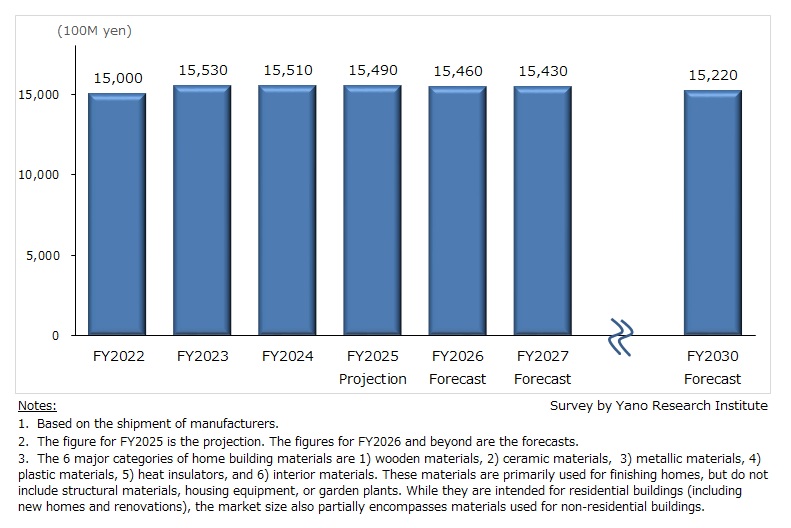
Home Building Materials Market (Six Major Categories) Declined to 1,551 Billion Yen for FY2024, 99.9% of Previous Fiscal Year
Yano Research Institute (the President, Takashi Mizukoshi) carried out a survey on the home building materials market in Japan, and found out the current market status by category and future perspectives.
Market Overview
The home building materials market (six major categories, mainly finishing materials; not including structural materials, housing equipment, and garden plants) is estimated at 1,551 billion yen in FY2024, down 0.1% from the previous fiscal year, based on the shipment value of manufacturers.
According to statistics from the Ministry of Land, Infrastructure, Transport, and Tourism, housing starts increased in FY2024. However, the growth was largely due to last-minute housing starts at the end of the fiscal year, in anticipation of the revised Building Standards Act (which imposes stricter compliance on houses regarding safety, earthquake resistance, and energy-saving standards) coming into force in April 2025. Meanwhile, materials contributing to higher housing performance—such as insulation, resin sashes, and double-glazed glass—showed steady performance. Alongside price revisions and value-adding efforts by manufacturers, the overall market size of home building materials remained flat.
Noteworthy Topics
Addressing Environmental Challenges
In consideration of the environmental impact at each phase of the building lifecycle, including material production, decarbonization initiatives are actively promoted in the home building materials market.
Various efforts are underway: energy conservation and utilization of renewable energy in building material manufacturing; utilization of recycled materials and materials previously considered difficult to reuse; establishment of collection schemes for recycled and unused materials through the Industrial Waste Wide-Area Certification System; and introduction of building materials that store CO2 from the atmosphere. Furthermore, manufacturers are pursuing third-party ecological certifications such as Science Based Targets (SBT), which accredit companies’ greenhouse gas reduction targets based on scientific evidence, and Environmental Product Declaration (EPD), which verifies that the companies evaluate and quantitatively disclose the environmental impact of products from raw material sourcing to disposal.
Future Outlook
The home building materials market (six major categories) is projected to diminish to 1,549 billion yen in FY2025 (down 0.1% year-on-year) and to 1,522 billion yen by FY2030 (down 1.9% compared to FY2024 market size).
The primary factor impacting the home building materials market —ultimately, the overall housing and construction market—is population and the number of households. Given the projected decline in population and number of households (source: National Institute of Population and Social Security Research), the housing and construction market and the home building materials market are forecasted to dwindle.
Research Outline
2.Research Object: Leading domestic manufacturers of home building materials
3.Research Methogology: Face-to-face interviews by our expert researchers (including online interviews), questionnaire, and literature research
What is the Home Building Materials Market?
In this research, home building materials market encompasses six major categories of materials for residential buildings, i.e., 1) wooden building materials, 2) ceramics building materials, 3) metallic building materials, 4) plastic building materials, 5) heat insulators, 6) interior.
The materials are primarily used for finishing buildings; structural materials, housing equipment, or garden plants are excluded. While the main application is the residential buildings (including new homes and renovations), the estimated market size includes some materials also used for non-residential buildings.
In detail, each category refers to following items:
1) Wooden building materials: wooden boards, composite wooden floors, wooden housing products
2) Ceramics building materials: plasterboards, ceramic siding panels, ALC, tiles, clay roof tiles
3) Metallic building materials: aluminum sashes, shutter doors, metal sidings, metal roofs, front door
4) Plastic building materials: Vinyl chloride floor materials, Tatami mats with chemical inner materials, plastic sashes
5) Heat insulators: glass wools, rock wools
6) Interior materials: wall papers, carpets, curtains, blinds/window screens
<Products and Services in the Market>
1) Wooden building materials, 2) ceramics building materials, 3) metallic building materials, 4) plastic building materials, 5) heat insulators, 6) interior materials
Published Report
Contact Us
The copyright and all other rights pertaining to this report belong to Yano Research Institute.
Please contact our PR team when quoting the report contents for the purpose other than media coverage.
Depending on the purpose of using our report, we may ask you to present your sentences for confirmation beforehand.