No.4030
Residential Thermal Insulation Materials Market in Japan: Key Research Findings 2025
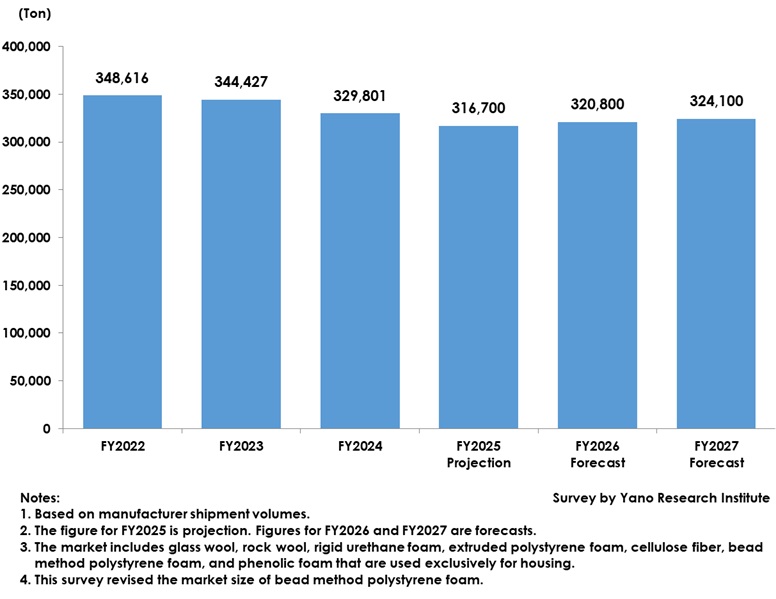
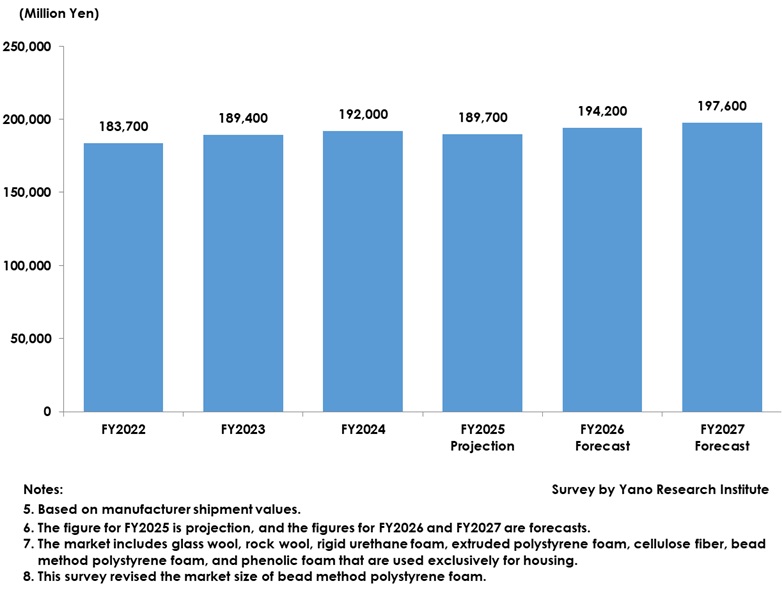
In FY2024, Residential Thermal Insulation Materials Market Declined by 4.2% in Volume at 329,801 Metric Tons, While Increased by 1.4% in Value at 192.0 Billion Yen
Yano Research Institute (the President, Takashi Mizukoshi) conducted a survey on the residential thermal insulation materials market in Japan. The survey revealed shipment volume, market size, the trend by sector, the trends of market players, and the future outlook. In here discloses the transition and forecast of the size of the residential thermal insulation materials market.
Market Overview
Based on manufacturer shipments, the estimated market size of residential thermal insulation materials in Japan reached 329,801 metric tons in volume in FY2024, which was a 4.2% decline from the previous fiscal year, and 192.0 billion yen in value, which was a 1.4% increase. The decline in shipment volume was due to decrease in new housing starts. The increase in shipment value was due to increased sales of high-performance thermal insulation materials as well as price hikes stemming from rising raw material and logistics costs.
Noteworthy Topics
Accelerated Heat Insulation for Housing
Major housing suppliers claim to have standardized their level of heat insulation at level 5, while introducing housing products and specifications for levels 6 and 7. In the context of soaring electricity prices and more extreme temperatures in summer and winter, end users appear to be showing greater interest in the heat insulation performance of residences. Additionally, residential subsidy programs, such as the Child-Rearing Green Housing Support Program (*), subsidize environmentally friendly residences, including long-term quality housing, net zero energy houses (ZEHs), and green transformation (GX)-oriented homes. Consequently, these programs have stimulated demand and increased awareness of thermally insulated homes.
However, building these homes incurs additional costs for thermal insulation, on top of rising construction and labor costs. Nevertheless, an increase in these homes is expected to further increase the demand for thermal insulation materials.
*) The application period for the Child-Rearing Green Housing Support Project has ended.
Future Outlook
The market size of residential thermal insulation materials is expected to reach 316,700 metric tons in volume in FY2025, marking a 4.0% decline from the previous fiscal year, and 189.7 billion yen in value, which is a 1.2% increase.
Although insulation material usage per house has increased, the number of new housing starts in FY2025 is expected to decrease significantly, due to a reactionary decline in demand following a surge in demand just before the enactment of amendments to the Act on the Improvement of Energy Consumption Performance of Buildings and the Building Standards Act. This decline is also due to delayed construction starts resulting from the amendments that complicated building confirmation processes and stalled these procedures. Hesitant purchases due to soaring housing prices also contributed to the decline. Together, these factors have reduced new housing starts, overwhelming the growth in thermal insulation demand per house needed to offset the loss. Consequently, the market for residential thermal insulation materials is expected to shrink in FY2025.
Research Outline
2.Research Object: Thermal insulation materials manufacturers, manufacturers of residential windows and window sashes, and industry organizations
3.Research Methogology: Face-to-face interviews (including online interviews) by our expert researchers and interviews via telephone
The Residential Thermal Insulation Materials Market
In this research, residential thermal insulation materials refers to the following seven items, which are used exclusively for housing: glass wool, rock wool, rigid urethane foam, extruded polystyrene foam, cellulose fiber, bead method polystyrene foam, and phenolic foam. Market size is calculated based on manufacturer shipment value and volume.
<Products and Services in the Market>
Thermal insulation materials (glass wool, rock wool, rigid urethane foam, extruded polystyrene foam, cellulose fiber, bead method polystyrene foam, and phenolic foam), windows, and window sashes
Published Report
Contact Us
The copyright and all other rights pertaining to this report belong to Yano Research Institute.
Please contact our PR team when quoting the report contents for the purpose other than media coverage.
Depending on the purpose of using our report, we may ask you to present your sentences for confirmation beforehand.