No.4115
The Solar Power Plant Repowering Market in Japan: Key Research Findings 2026
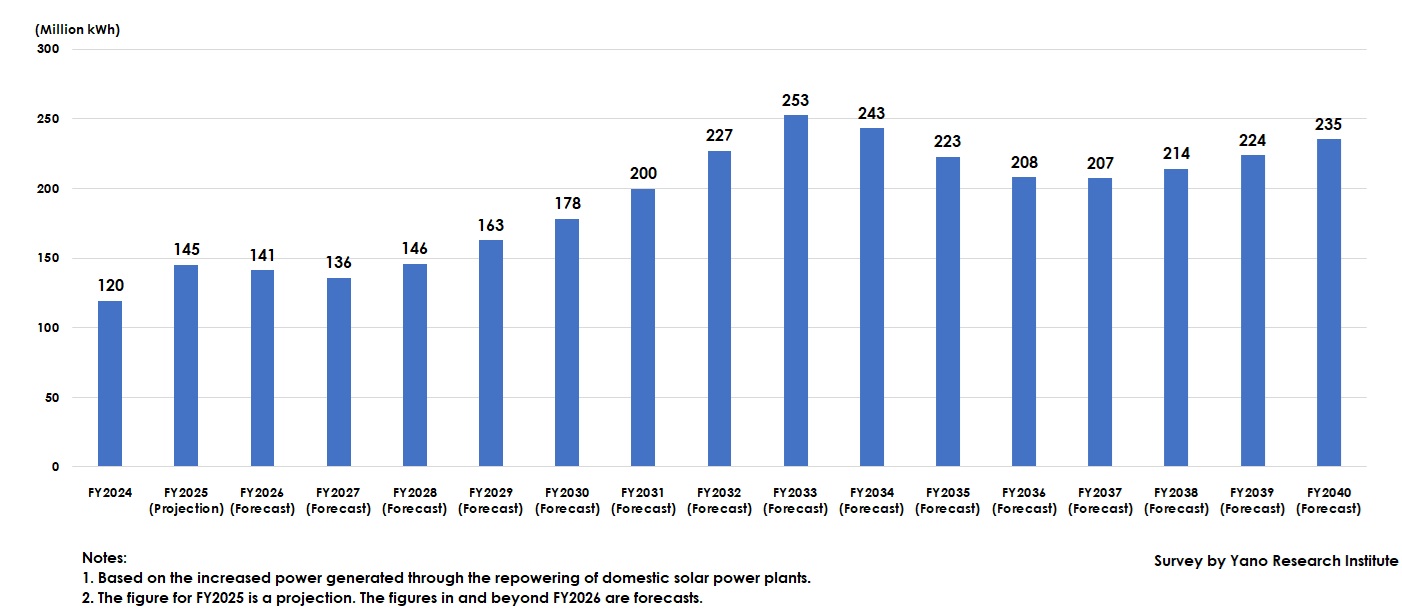
Increased Power Generation Resulting from Solar Power Plant Repowering Is Expected to Reach 253 Million kWh by FY2033
Yano Research Institute (the President, Takashi Mizukoshi) conducted a survey on the status of the domestic solar power plant repowering market. The survey revealed the projected power generation increase from repowered domestic solar power plants through FY2040.
Market Overview
The projected increase in electricity generated from repowering domestic solar power plants in fiscal year 2025 is 145 million kWh. Japan has spurred the widespread deployment of solar power plants since the feed-in tariff (FIT) program began in FY2012. Recently, the power conditioning systems (PCS) and other components of these facilities have reached the point at which upgrading should be considered.
In this context, repowering to maintain and improve the performance of existing facilities is garnering attention. Repowering methods include replacing PCSs and photovoltaic (PV) modules.
The Agency for Natural Resources and Energy's (ANRE) Seventh Strategic Energy Plan recommends expanding the deployment of PV systems through FY2040. To achieve this goal, constructing new plants and repowering existing ones to maintain power generation performance will be necessary for a long-term stable operation.
Noteworthy Topics
Replacing PCSs
Demand for replacing PCSs in solar power plants that have existed since the inception of the FIT program in FY2012 is growing. PCSs convert the direct current (DC) electricity generated by PV modules into alternating current (AC) electricity. PCSs also control and protect the connection to the commercial grid, enabling the sale and purchase of electricity. Generally, the useful life is ten to fifteen years.
Repairing out-of-order PCSs takes several months. The loss of income during this time impacts profitability of businesses that sell electricity through the FIT program. Depending on the durability of PCSs, commercial PV power generation businesses increasingly opt to proactively replace the PCS after approximately ten years since the system’s introduction or halfway through an entire procurement period, to avoid unexpected outages.
Future Outlook
The increased power generated by repowering domestic solar power plants is expected to reach 253 million kWh by FY2033. Although this figure will likely decrease temporarily, it will rebound in the latter half of the 2030s, reaching 235 million kWh by FY2040.
According to the February 2026 ANRE report, “Making Renewable Energy a Mainstay Power Source,” solar power plants generated over 460,000 cases of approximately 29 million kW from FY2012 to FY2016 under the FIT and Feed-in Premium programs. These facilities will have expired their procurement and delivery periods by FY2032 through FY2036. To ensure the long-term stable operation of these plants after the programs end, businesses are encouraged to consolidate and invest in upgrading the plants’ components and improving power generation. Consequently, the demand for repowering is expected to grow.
In terms of policy, the Long-Term Stable Qualified Solar Photovoltaic Power Business Operator System was established as a framework to qualify the entities responsible for consolidating existing solar power plants and their long-term stable operation. Applications for qualification began being accepted in April 2025.
After the mid-2030s, when solar power plants that have existed since the inception of the FIT reach 25 years of age, the demand for replacing solar panels is expected to gradually increase, which will likely boost further market growth.
Research Outline
2.Research Object: Power generation companies, EPC (engineering, procurement, and construction) contractors, operation and maintenance (O&M) providers, equipment manufacturers (including peripheral equipment), etc.
3.Research Methogology: Face-to-face interviews (including online interviews) by expert researchers, surveys by telephone, and literature research
Repowering of Solar Power Plants in Japan
Repowering domestic solar power plants involves improving and repairing existing plants, including residential ones. It aims to maintain or improve their power generation performance by replacing or deploying additional main components or modifying the configuration.
The increased power generated through the repowering of domestic solar power plants indicates an annual increase in power generated by means of repowering in each fiscal year.
<Products and Services in the Market>
PCS replacement, PCS configuration modification, optimizer deployment, photovoltaic (PV) module replacement, bifacial PV modules, PV modules with reflectors, and additional PV module implementation
Published Report
Contact Us
The copyright and all other rights pertaining to this report belong to Yano Research Institute.
Please contact our PR team when quoting the report contents for the purpose other than media coverage.
Depending on the purpose of using our report, we may ask you to present your sentences for confirmation beforehand.