No.4107
Global Olfactory Sensor Market: Key Research Findings 2026
Societal Implementation of Olfactory Sensor Starts in the Niche Application Fields
Yano Research Institute (the President, Takashi Mizukoshi) has recently announced a released of a market report “Olfactory Sensor Market 2026”, exploring the market size and market trends (product, technology, key players).
Market Overview
Odor management (control) today is primarily conducted through the measurement of odor intensity, and the resulting data is utilized to improve operational workflows.
Although these enterprises recognize that aroma identification may offer advantages in improving operational efficiency, the cost of introducing olfactory sensors is not considered viable from a return on investment (ROI) perspective.
Besides, there are significant technological limitations on the developers’ side:
1. Lack of standardized odor data sets
2. Complexity of identifying intricate chemical mixtures
3. Difficulty competing with the biological superiority of the human olfactory system
The absence of a universal sensing standard persists. While various methodologies have emerged, each presents specific trade-offs depending on the application. Coupled with the perception that manual sensory evaluation is a more cost-effective alternative, potential adopters frequently question the economic necessity of these systems.
Furthermore, deployment of an olfactory sensor system typically requires extensive calibration and specialized training, often necessitating direct and ongoing intervention from developers to ensure accuracy.
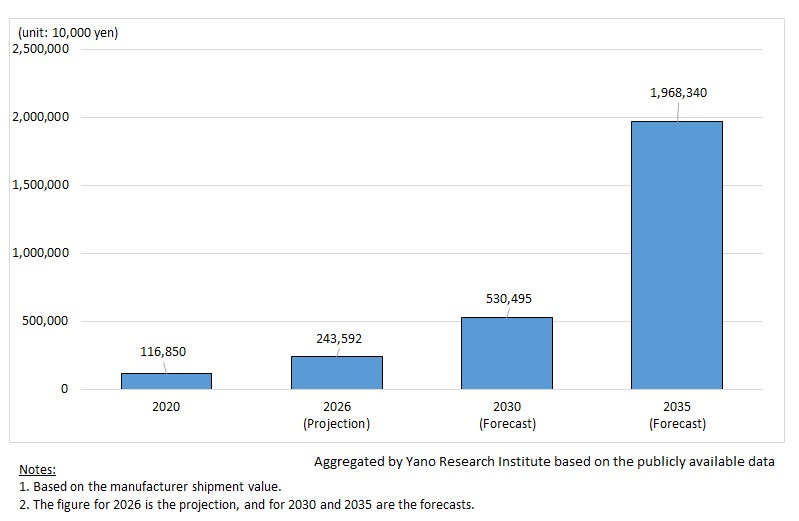
Given the circumstances, the global olfactory sensor market is projected to attain 2,435.92 million yen in 2026.
Noteworthy Topics
Olfactory Sensors for Agriculture and Healthcare
[Agriculture]
Crop growth is heavily affected by climate and weather conditions, making harvesting decisions highly dependent on farmers’ experience and intuition. The proliferation of AI has been enabling the development of visual, tactile, auditory, and olfactory sensing based on these human expertise as data.
Due to extremely low intensity of odor-producing compounds (often less than 0.01%), high-performance gas sensors featuring advanced chips are frequently used in agricultural odor evaluations. Nonetheless, identifying gases in farm produce that emits highly complex aroma compound, such as fruit, is too complicated without gas chromatography. For this reason, fruit odor evaluation is often conducted on overall odor concentration.
Additionally, there are cases where fruit odor evaluation is conducted by focusing on specific gas, such as ethylene to assess fruit ripening and volatile compounds like organic acids, alcohols, and ethyl acetate for evaluating postharvest decay. Application of this method is expected to expand to livestock farming, such as for the detection of malodors like ammonia.
[Healthcare]
Certain diseases are known to emit specific odors through breath, sweat, urine, or skin. Studies are underway to detect these odors with olfactory sensors for early diagnosis of medical conditions.
One example is the development of AI-supported breath tests for early detection of lung cancer. A Japanese research team has pioneered a method of using an olfactory sensor known as the Membrane-type Surface Stress Sensor (MSS). Pre- and post-surgery exhalations of cancer patients are used as training data for machine learning to construct a discriminative model. With additional experiments on various types of gas analyzers, the team expects to extend the application of the system for screening cancers of all kind, not just identifying molecules particular to lung cancer.
Another example is the development of highly sensitive gas sensors by the Japanese research institution. In addition to the development of gas sensor elements, researchers succeeded in the development of sensor allay with multiple sensors and data analytics technology, which combinedly enable tracing of acetone at very low concentrations. This allows for the early detection of diabetes, as diabetic patients emit elevated levels of acetone through their skin and breath. Once this sensor becomes widely obtainable, treatment of diabetes at early stage becomes feasible.
Future Outlook
Social implementation of olfactory sensors is expected to progress in niche application fields. Nevertheless, achieving commercial viability remains a major challenge for developers. To expand the olfactory sensor market, developers must create new uncontested markets (“blue oceans") while establishing robust organizational structures in both R&D and sales to respond to increasingly diverse market needs.
In addition, development of olfactory sensors incorporating multiple sensor elements that complement one another is gaining momentum. By accommodating a broader range of customer requirements, these next-generation sensors are expected to improve commercial viability.
Moreover, signs are emerging of businesses focused not only on odor identification (input) but also on aroma reproduction (output). Growing demand for scent reproduction technologies may, in turn, accelerate the social implementation of olfactory sensors as input devices.
Based on these outlook, the global olfactory sensor market is forecasted to reach 19683.4 million yen by 2035.
Research Outline
2.Research Object: Olfactory sensor developers, research institutions, universities, etc,
3.Research Methogology: Face-to-face interviews by our expert researchers (including interviews via web meeting)
The Olfactory Sensor Market
In this report, olfactory sensor indicates “a device consisting of an array of non-specific electronic sensors and a pattern recognition system.”
Olfactory sensor identifies odor (through pattern recognition of odor molecules) instead of measuring odor intensity.
In this report, olfactory sensor excludes a device for measuring odor intensity, gas detector (gas leak alarm, breathalyzer), and instrument that separate gas compounds for analysis, such as gas chromatograph (GC).
The global olfactory sensor market encompasses olfactory sensor systems, sensor elements (built-in devices), software (for dashboard and analytics), and consulting services utilizing all or some of these components, combined with expertise, advisory services, and implementation support.
<Products and Services in the Market>
Olfactory sensors, sensor elements, software, and consulting services
Published Report
Contact Us
The copyright and all other rights pertaining to this report belong to Yano Research Institute.
Please contact our PR team when quoting the report contents for the purpose other than media coverage.
Depending on the purpose of using our report, we may ask you to present your sentences for confirmation beforehand.