No.4061
Cold Chain Logistics Market in Japan: Key Research Findings 2026
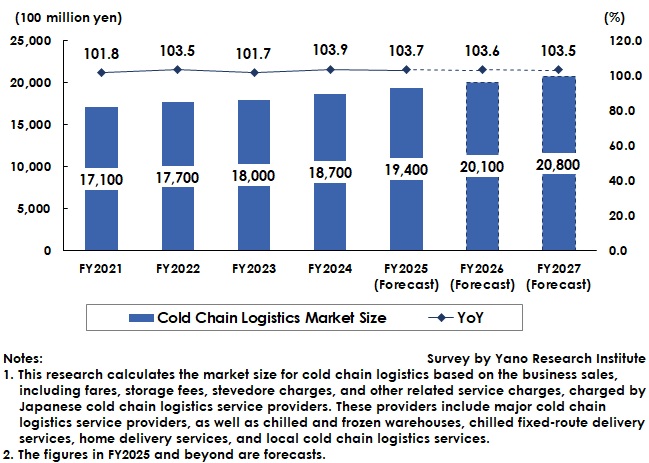
The Cold Chain Logistics Market Grew by 3.9% from Preceding Fiscal Year to 1.87 Billion Yen in FY2024
Yano Research Institute (the President, Takashi Mizukoshi) conducted a survey of the domestic cold chain logistics market. The survey revealed the market size, trends among market players, and the future market outlook.
Market Overview
Based on domestic sales, the estimated size of the cold chain logistics market reached 1.87 trillion yen in FY2024, marking a 3.9% increase from the previous fiscal year. The market has been growing since surpassing the pre-pandemic level in FY2022. This growth is primarily due to rising logistics unit prices rather than increased volumes.
The domestic consumption volume of frozen food, which is the most popular type of freight for cold chain logistics, has remained stable over the past three years. This has prevented significant increases in the capacity of cold storage warehouses during that period. However, rising transportation unit prices, which comprise labor, energy (e.g., electricity and fuel), and storage costs (withdrawal and deposit, as well as stevedore expenses), have increased logistics costs and appear to have driven the market growth.
Noteworthy Topics
Relationships Between Increased Cold Food Transactions and the Supply and Demand for Cold and Frozen Storage Warehouses
The increase in cold food transactions has tightened the capacity of cold and frozen storage warehouses. In recent years, high-quality frozen food, with larger volume per product, has increased in variety, limiting the number of products per storage area. Consequently, these warehouses are always operating at full capacity. Additionally, the increase in frozen product imports has led to a noticeable shortage of storage space, especially in coastal areas. While constructing new warehouses and expanding existing ones are necessary to meet storage demands, measures need to be figured out to secure new storage facilities, though difficult even in coastal areas. Since demand for frozen foods, including imports, is likely to continue growing, meeting the demand for warehouses is an important challenge in the cold chain logistics market.
Future Outlook
Based on domestic sales, the cold chain logistics market is forecast to reach 1.94 trillion yen in FY2025, marking a 3.7% increase from the previous fiscal year and indicating continued moderate growth. However, as in FY2024, this growth is price-driven rather than volume-driven. Overall food freight volume is highly likely to level off or moderately decline due to sluggish consumption resulting from increased commodity prices, as well as the long-term aging population and declining birthrate.
Research Outline
2.Research Object: Logistics companies, wholesalers, and manufacturers involved in cold chain logistics, and the competent authorities
3.Research Methogology: Face-to-face interviews (including online interviews) by our expert researchers, surveys via telephone and letters, as well as literature research
What is the Cold Chain Logistics Market?
Cold chain logistics is a system that maintains the temperature of products, primarily food products, throughout the supply chain, from production to consumption. The system controls the temperatures within fixed ranges: constant temperatures between 5°C and 18°C, chilled temperatures between -18°C and 10°C, and frozen temperatures at or below-18°C.
This research calculates the market size for cold chain logistics based on the business sales, including fares, storage fees, stevedore charges, and other related service charges, charged by Japanese cold chain logistics service providers. These providers include major cold chain logistics service providers, as well as chilled and frozen warehouses, chilled fixed-route delivery services, home delivery services, and local cold chain logistics services. However, sales from major trading companies, perishable food wholesalers, other food wholesalers, and commercial wholesalers are excluded. Small and medium-sized companies and sole proprietors in the cold chain logistics market that primarily provide contract transportation services (chartered vehicles) are also excluded.
<Products and Services in the Market>
Cold chain logistics primarily for food and partially for chemicals
Published Report
Contact Us
The copyright and all other rights pertaining to this report belong to Yano Research Institute.
Please contact our PR team when quoting the report contents for the purpose other than media coverage.
Depending on the purpose of using our report, we may ask you to present your sentences for confirmation beforehand.