No.4037
Macroalgae and Microalgae Market in Japan: Key Research Findings 2025
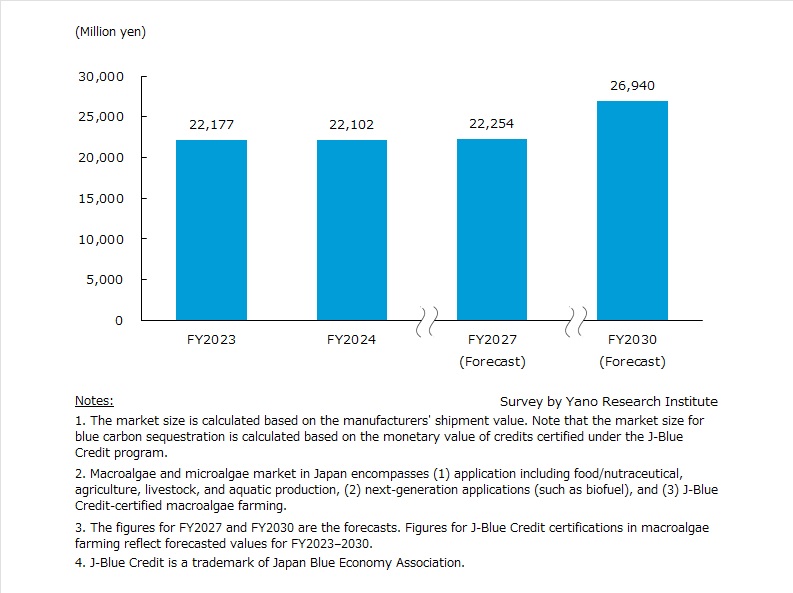
Domestic Macroalgae and Microalgae Market Valued at 22,177 Million Yen in FY2023
Yano Research Institute (the President, Takashi Mizukoshi) has conducted a survey of the macroalgae and microalgae market in Japan, examining current conditions, industry landscape, and future outlook.
Market Overview
In this research, macroalgae and microalgae market in Japan encompasses macroalgae or microalgae for applications including food/nutraceuticals, agriculture, livestock, and aquatic production, next-generation applications (such as biofuel), as well as J-Blue Credit*1-certified macroalgae and microalgae farming projects.
The size of the macroalgae and microalgae market in Japan was valued at 22,177 million yen in FY2023, with macroalgae or microalgae for food/nutraceutical products representing approximately 90 percent.
Macroalgae and microalgae are garnering attention from the aspect of carbon sequestration, as they are photosynthetic organisms just like terrestrial plants. Moreover, its use as renewable alternative to fossil fuels is promising as they produce and store natural oils within their cells (through photosynthesis).
*1. J-Blue Credit is a trademark of Japan Blue Economy Association.
Noteworthy Topics
Advancements in New Applications for Microalgae
Spurred by interest in next-generation biofuels, Japanese firms are aggressively pursuing R&D on microalgae as biofuel.
In addition, recent technological breakthroughs have paved the way for monetization in several high-value applications, including pharmaceuticals (as a sustainable feedstock for drug production), bioplastics (serving as a primary raw material for bio-based polymers), alternative pigments (utilizing as eco-friendly dyes), urban mining (leveraging the biosorption properties of algae to recover precious metals from waste), and wastewater management.
Future Outlook
Macroalgae and microalgae market in Japan is projected to reach 26,940 million yen by FY2030, driven particularly by new applications and agriculture.
Among new applications, while the market of algae-based biofuels continues to grow, R&D efforts are expected to intensify in pharmaceuticals, material manufacturing, and colorant manufacturing.
Agricultural application is on the rise, as the development of macroalgae-based biostimulants*2 is expanding. Although adoption of macroalgae-based biostimulants remains in the early stages among crop producers, there is significant growth potential as evidence of their efficacy gains wider recognition.
*2. Biostimulants are additives used in crop production, which may act on plants and soil to activate the plants’ own capabilities, improving crop’s nutrient uptake and tolerance to abiotic stress.
Research Outline
2.Research Object: Companies farming/cultivating macroalgae or microalgae, brand manufacturers of macroalgae and microalgae-related products, blue carbon sequestration projects, competent authorities, industry associations, research institutions, etc.
3.Research Methogology: Face-to-face interviews by our expert researchers (including online interviews), phone interviews, and literature research
What is the Macroalgae and Microalgae Market ?
In this research, macroalgae and microalgae market in Japan encompasses (1) macroalgae or microalgae for food/nutraceutical production, macroalgae- or microalgae-based products for agriculture, livestock production and aquatic production, (2) next-generation applications (such as biofuel), and (3) J-Blue Credit*-certified macroalgae farming. The market sizes for (1) and (2) are calculated based on the manufacturer’s shipment price. The market size for (3) is based on the monetary value of credits certified under the J-Blue Credit* program.
Generally speaking, algae is a blanket term for a diverse group of aquatic photosynthetic organisms (photosynthetic organisms excluding plants [e.g. bryophytes, ferns, and seed plants]). They are highly diverse, including large brown algae (e.g. kombu, wakame), red algae (e.g. nori [typically Pyropia species]), and microscopic green algae like chlorella, which is with a diameter of approximately 10 micrometers or less.
In this survey, “macroalgae” refer to large sized seaweeds with a diameter of 1 millimeters or more, and “microalgae” refer to microscopic algae that have a diameter of less than 1 millimeter.
* J-Blue Credit program is a system that quantifies blue carbon—an amount of carbon sequestrated by aquatic photosynthetic organisms, typically cultivated seaweeds in the context of this survey—and turns it into tradable credits. The system is operated by the Japan Blue Economy Association (JBE), and J-Blue Credit is a trademark of JBE.
<Products and Services in the Market>
(1) Food/nutraceutical products made of (composing) macroalgae or microalgae, macroalgae- or microalgae-based products for agriculture, livestock production, and aquatic production, (2) next-generation applications, (3) the monetary value of carbon credits certified under the J-Blue Credit program for macroalgae farming.
Published Report
Contact Us
The copyright and all other rights pertaining to this report belong to Yano Research Institute.
Please contact our PR team when quoting the report contents for the purpose other than media coverage.
Depending on the purpose of using our report, we may ask you to present your sentences for confirmation beforehand.