No.4005
Global Market for AGVs (Automated Guided Vehicles) & AMRs (Autonomous Mobile Robots): Key Research Findings 2025
Total Shipment Volume of AGVs and AMRs Projected to Reach 1.38 Million Units Worldwide by 2030
Yano Research Institute (the President, Takashi Mizukoshi) carried out a survey on the global AGV & AMR market and found out the relevant policies, introduction support systems, trend of market players and future perspectives in major countries.
Market Overview
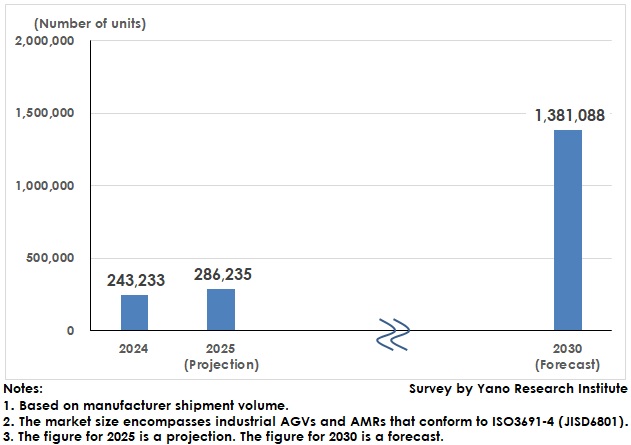
Based on manufacturer shipment volumes, the total market size of automated guided vehicles (AGVs) and autonomous mobile robots (AMRs) is projected to reach 286,235 units worldwide in 2025, marking a 17.7% increase from the previous year.
Capital investment in automotive and semiconductor manufacturing is growing globally. In Japan, labor shortages and increased labor costs caused by a declining and aging population, as well as the need to improve work efficiency and safety, have accelerated the shift toward smart factories. In this context, AGV and AMR deployments are increasing to support logistics automation.
Additionally, the growing importance of carbon neutrality and environmental, social, and governance (ESG) initiatives is prompting more companies to adopt electric forklifts over those driven by internal combustion engines. These trends illustrate a steady worldwide shift toward automation and eco-friendliness in industrial settings.
The following are the demand trends by industry. The manufacturing industry prefers AGVs to AMRs for safety reasons. Food factories have growing demand for models with freezer and refrigerator specifications, as well as waterproof features. Semiconductor manufacturers require cleanroom specifications, while automotive plants need models that can handle heavy loads, have multi-induction systems, and outdoor specifications. In the logistics industry, where driving environments change significantly due to shifting pallet and shelf layouts, there is a growing preference for AMRs that offer flexible deployment.
It is estimated that manufacturing accounts for approximately 80% of demand, while logistics accounts for the remaining 20%. Consequently, the majority of AGV and AMR manufacturers provide products and services intended primarily for the manufacturing industry. The deployment in manufacturing is progressing among large- and medium-sized companies with financial flexibility in the automotive and electronics industries. Deployment is also expanding in logistics warehouses for the ecommerce, apparel, and food industries. Other sectors include infrastructure-related industries, such as construction, cargo container handling at airports and harbors, and parking lot management.
Noteworthy Topics
Accelerated Smartification of Production and Logistics in Major Global Countries’ Industrial Sites
In recent years, there has been an increase in capital investments in automotive and semiconductor manufacturing, primarily in Japan, China, Europe, and North America. These investments aim to refine manufacturing processes and increase production capacity. Demand for automation is growing at production sites, due to labor shortages and increased labor costs caused by a declining and aging population, as well as the need to improve work efficiency and safety.
As ecommerce transactions increase globally, ecommerce companies are building logistics warehouses across international borders. For these companies, improving warehouse efficiency through automated logistics is crucial to achieving swift delivery to consumers and increasing competitiveness. These motivations are driving the demand for AGVs and AMRs.
Additionally, governmental support for automation, including the deployment of robots, has strengthened in each country, prompting not only large companies but also small- and medium-sized enterprises (SMEs) to accelerate the smartification of production and logistics through AGV and AMR deployment.
Future Outlook
Based on manufacturer shipment volume, the global AGV and AMR market is expected to reach 1,381,088 units by 2030. This growth is driven by the anticipated expansion of automated logistics among SMEs, as well as large companies.
Company promotions for digital transformation, initiatives to address labor shortages, and investments in carbon neutrality and ESG are supporting this growth. The acceleration of automation and streamlining in industrial settings is projected to continue globally.
Research Outline
2.Research Object: Domestic and overseas manufacturers of AGVs and AMRs, peripheral device and equipment manufacturers, system integrators, RaaS (Retail as a Service) companies, user companies deploying AGVs/AMRs, government agencies, universities and R&D institutions, and business organizations
3.Research Methogology: Face-to-face interviews (including online interviews) by expert researchers, and literature research
The AGV (Automated Guided Vehicle) and AMR (Autonomous Mobile Robot) Market
This research defines automated guided vehicles (AGVs) autonomous mobile robots (AMRs)* as vehicles that: 1) run autonomously within a certain area with a function of delivering cargo and freight (meaning they are not intended for human transportation), 2) are designed to improve the efficiency of logistics carriage and transportation within factories and warehouses, 3) are not for use on roads as defined by the Road Traffic Law, and 4) conform to ISO 3691-4 (JIS D 6801)*1. Note that those AGVs & AMRs made by Amazon Robotics that Amazon.com has introduced in-house are not included.
The global market size of AGVs and AMRs is calculated based on manufacturer shipment volumes in Japan, China, South Korea, Americas, Europe, and other regions.
*1) This research includes AGVs and AMRs that do not require tracks. While AGVs need guiding paths (e.g., magnetic bars, magnetic tapes, optical tapes, QR codes *2, laser light reflectors, etc.) to travel, AMRs do not. AMRs travel by determining their location by using environmental maps of their operational area and external environmental information read from sensors while traveling.
*2) QR Code is a registered trademark of Denso Wave Incorporated.
<Products and Services in the Market>
AGVs and AMRs
Published Report
Contact Us
The copyright and all other rights pertaining to this report belong to Yano Research Institute.
Please contact our PR team when quoting the report contents for the purpose other than media coverage.
Depending on the purpose of using our report, we may ask you to present your sentences for confirmation beforehand.