No.4025
Sports Apparel Market in Japan: Key Research Findings 2026
Sports Apparel Market in Japan Estimated to Reach 61442.3 Billion Yen in 2025, Up 3.1% YoY
Yano Research Institute (the President, Takashi Mizukoshi) carried out a survey on the domestic sports apparel market, and found out the market size by sports category, the trend of market players and of logistics, and future perspectives.
Market Overview
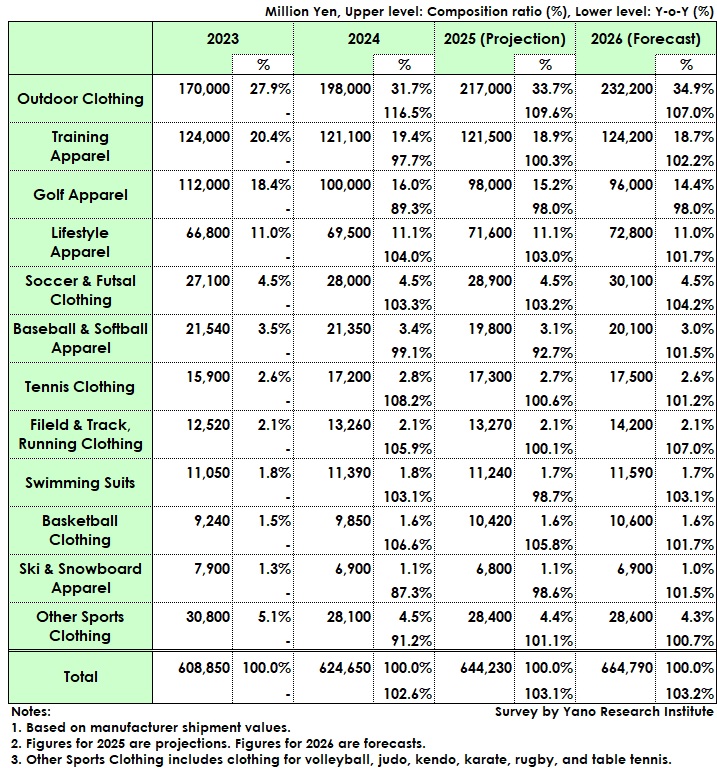
Based on manufacturer shipment values, the domestic sports apparel market is projected to reach 644.23 billion yen in 2025, a 3.1% increase from the previous year. Eight of the twelve sports categories are expected to grow. This growth is driven primarily by three factors: strong outdoor clothing sales, product price hikes by manufacturers, and increased demand from foreign tourists.
Outdoor clothing is expected to contribute the most to the overall market, with an estimated sales increase of 19 billion yen all by itself from the previous year. Although price hikes by manufacturers have impacted sales to some extent, the increase in unit selling price has had greater impact on market expansion. According to the Japan National Tourism Organization (JNTO), the number of foreign arrivals to Japan exceeded 42 million in 2025. This, too, supported market growth.
Meanwhile, climate fluctuations are impacting the market more prominently. The recent prolonged summers, with high temperatures persisting into September, have slowed the fall/winter product sales. This has led many retailers to reduce supplies of these products in many sports categories.
Noteworthy Topics
Outdoor Clothing Continues to Drive the Sports Apparel Market in 2025
The outdoor clothing market has experienced a high growth rate in recent years, and this trend is expected to continue through 2025. The market is projected to grow by 9.6% from 2024, reaching 217.0 billion yen. This growth is expected to drive the overall market.
The increased popularity of wearing outdoor clothing for everyday use is the main driver of this growth. Mountaineering and trekking clothing is also comfortable as town attire due to its high performance. This trend is becoming more common.
Another reason is the expanded sales channels. In addition to brand-operated stores, specialty outdoor stores, and volume sporting goods stores, specialty fashion apparel stores have also started selling products from outdoor brands, including exclusive store items.
As consumers become more familiar with outdoor clothing, brand awareness improves, encouraging people to buy it for everyday wear and creating a virtuous cycle.
Additionally, product development has increased the variety and target customers, such as clothing for expecting mothers and workers in the primary industry, contributing to increase the customer base.
The high growth rate of the outdoor clothing market in 2025 is expected to outweigh the negative impact of fluctuating weather on fall and winter products.
Future Outlook
Based on manufacturer shipment values, the sports apparel market is forecast to reach 664.79 billion yen in 2026, marking a 3.2% increase from the previous year. All sports categories except for golf are expected to grow. Outdoor clothing is highly likely to remain the market leader among them. Supported by demand for casual wear, the outdoor clothing market is expected to grow 7.0% from the previous year.
However, according to retailers, many sports categories have excess stock of fall and winter items in distribution centers. This discourages retailers from planning aggressive supply strategies for 2026. Consequently, shipments may stall in the overall market.
Additionally, the continuation of growth factors during 2025, such as price hikes and inbound demand effects, is uncertain for 2026. As various commodity and service prices continue to rise, it is unclear how much the price of sports apparel can increase before consumers reject it. To avoid overreliance on highly uncertain inbound demand, it is crucial for the market to generate and increase domestic demand.
Research Outline
2.Research Object: Sports related enterprises (manufacturers, suppliers/wholesalers, and retailers)
3.Research Methogology: Face-to-face interviews (including online interviews) by our expert researchers, survey via phone or email, and mailed questionnaire.
The Sports Apparel Market
This research defines the sports apparel market as clothing for the following 12 sports categories: training, lifestyle, golf, outdoor activities, soccer & futsal, baseball & softball, tennis, track & field and running, swimming, basketball, and skiing & snowboarding. “Other sports clothing” includes clothing for volleyball, judo, kendo, karate, rugby, and table tennis.
<Products and Services in the Market>
Products (Clothing for training, lifestyle, golf, outdoor, soccer and futsal, baseball and softball, tennis, track and field, running, swimming (swimsuit), basketball, skiing and snowboarding, and other sports), sports apparel brand ranking, shipment value by retailer (volume sporting goods stores, sports specialty stores, the shops directly operated by manufacturers, department stores, ecommerce, outlet mall stores directly owned by brands, casual clothing stores, shops within commercial facilities)
Published Report
Contact Us
The copyright and all other rights pertaining to this report belong to Yano Research Institute.
Please contact our PR team when quoting the report contents for the purpose other than media coverage.
Depending on the purpose of using our report, we may ask you to present your sentences for confirmation beforehand.