No.3965
Global Wireless Power Transfer (WPT) Modules Market: Key Research Findings 2025
Global WPT Modules Market Expected to Reach 626.9 Billion Yen in 2025
Yano Research Institute (the President, Takashi Mizukoshi) has surveyed the global wireless power transfer modules market and found out the trends by application, trend of market players, and future perspectives.
Market Overview
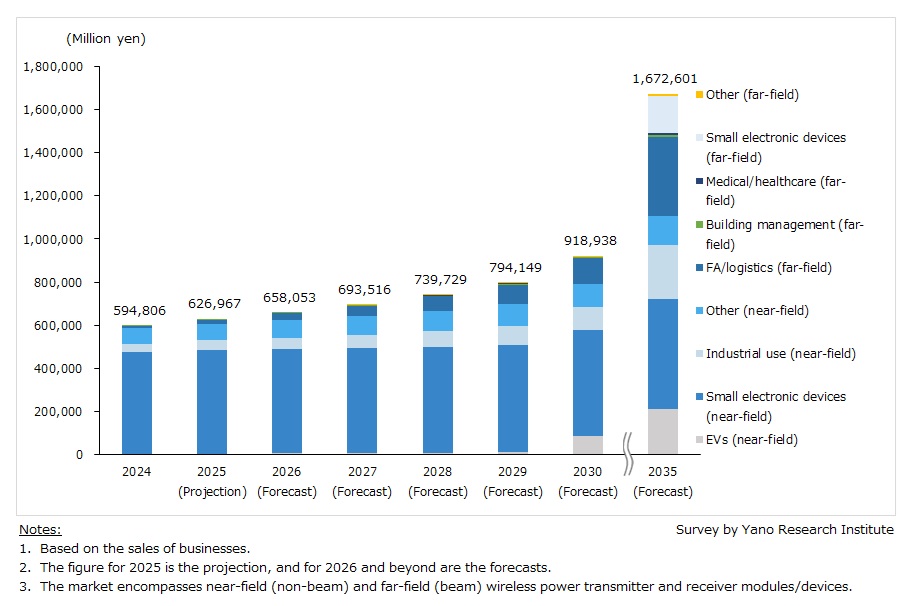
The global market size of wireless power transfer modules (non-beam [near-field] and beam [far-field] systems) in 2025 is estimated at 626.9 billion yen, based on the sales of businesses.
At present, the market is predominantly driven by near-field systems, with small electronic devices representing the core application area. Industrial use cases—such as Automated Guided Vehicles (AGVs), Autonomous Mobile Robots (AMRs), home appliances, and small mobility solutions—are also experiencing steady growth. However, the long-anticipated commercialization of WPT systems for electric vehicles (EVs) is not expected to materialize at scale until around 2030 for static charging and approximately 2035 for dynamic charging.
Meanwhile, far-field WPT transmitter and receiver modules are broadening their application scope. Following the easing of regulations in 2022, several manufacturers proceeded with soft launches in 2023. As of 2025, modules intended for factory automation (FA), logistics equipment, and building management systems have already entered mass production at these companies.
Noteworthy Topics
Adoption of WPT Advances in Commercial Vehicles
WPT systems for electric vehicles (EVs) currently remain in the research and development phase, or demonstration stage. The global market of WPT systems for EVs is estimated at approximately 4.9 billion yen.
Worldwide adoption in passenger vehicles is not yet feasible, as automakers continue to pursue differing development strategies. However, similar to the earlier transition from diesel to EVs, the introduction of WPT is expected to advance first in commercial vehicles, ahead of passenger cars. In Japan, the Ministry of the Environment is leading pilot projects, and similar initiatives are emerging in other countries as well.
Future Outlook
Despite strong momentum, several challenges still constrain the expansion of the global wireless power transfer (WPT) modules market, irrespective of powering type (near-field or far-field). Current WPT technologies offer limited transmission range, and further gains in power-transfer efficiency are required. The coexistence of numerous international standards also hampers interoperability across devices. Additional hurdles are emerging in areas such as safety (both human exposure and interference with surrounding equipment), capital investment (for infrastructure deployment), and regulatory frameworks.
Even so, the long-term outlook for WPT technology remains highly promising. Small electronic devices, including mobile devices, are expected to become fully wireless over time. Once supporting infrastructure is in place, EV adoption is projected to accelerate, and the integration of WPT into urban environments—where roads and buildings function as an “energy network”—may become feasible. With applications poised to expand from mobile devices to vehicles and broader social infrastructure, WPT stands out as a transformative technology field for the coming decade. Based on these projections, the global WPT modules market is forecasted to reach 1,672.6 billion yen by 2035.
Research Outline
2.Research Object: Manufacturers of wireless power transfer modules (non-beam/near-field or beam/far-field systems)
3.Research Methogology: Face-to-face interviews by our expert researchers (including online interviews) and literature research
Wireless Power Transfer (WPT) Systems
Wireless power transfer (WPT) can be broadly classified into two categories based on the underlying power-beaming mechanisms: near-field and far-field systems.
Near-field (non-beam) WPT encompasses technologies such as electromagnetic induction, magnetic resonance coupling (MRC), and capacitive coupling, typically operating in the 10–100 kHz to several-MHz range.
In contrast, far-field (beam) WPT transmits electrical energy via microwaves or lasers through air or space, enabling significantly longer transmission distances than near-field methods.
For this survey, the market size of the WPT modules is calculated based on the sales of near-field (non-beam) and far-field (beam) wireless power transmitter and receiver modules/devices.
<Products and Services in the Market>
Transmitter and receiver modules/devices for wireless power transfer (near-field and far-field systems)
Published Report
Contact Us
The copyright and all other rights pertaining to this report belong to Yano Research Institute.
Please contact our PR team when quoting the report contents for the purpose other than media coverage.
Depending on the purpose of using our report, we may ask you to present your sentences for confirmation beforehand.