No.4212
Beverage Market in Japan: Key Research Findings 2026
Beverage Market Expanded to 5.38 Trillion in 2025 as Higher Prices Offset Volume Declines
Yano Research Institute (the President, Takashi Mizukoshi) has conducted a survey on the beverage market in Japan, and found out the trends by category, the trends by distribution channel, the trends of market players, and future perspective.
Market Overview
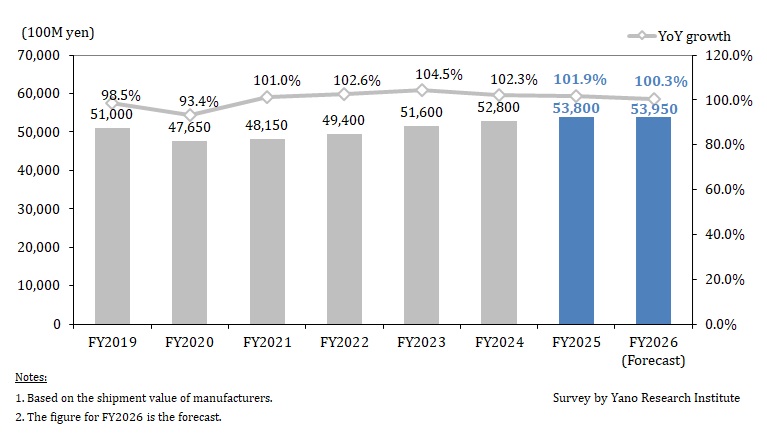
The domestic beverage market reached 5.38 trillion yen in FY2025, representing 101.9% of the previous fiscal year, based on the manufacturer shipment values. Increase in unit price more than offset lower sales volumes.
Driven by growing concerns about the cost of living amid rising prices, consumers have been holding back on buying large-size bottled products, reducing the number of items to purchase, buying minimally, and/or switching from national brands (NB) to private label (PB) products. Amidst the cooling of consumer sentiments, it has become even more important to show the product is worth the value and provide consumers with compelling reasons for them to buy the products.
Noteworthy Topics
Driving Consumer Purchases Through Focused Value Messaging
In the mineral water and RTD tea categories, the rise in the price of large PET bottles has led consumers to switch to PB products. Amid the situation, emphasizing purchase decision drivers (such as water source, flavor, eco-friendliness, and caffeine-free) has become increasingly important.
Among tea beverages, barley tea and blended teas are favored as hydration drinks, while caffeine-free options like rooibos tea and corn tea also saw growth. In the black tea category, products incorporating international tea cultures, aromas, and fruit flavors attracted the interest of younger consumers.
Future Outlook
Japan’s beverage market is expected to attain 5,395 billion yen in FY2026 (up by 0.3% from the previous fiscal year). In value terms, the market is expected to expand as average selling prices rise following price increases implemented by leading manufacturers. However, sales volumes are projected to decline from the previous year, as higher prices discourage purchases among price-sensitive consumers. In this environment, manufacturers will need to capitalize on demand for health and hydration beverages while delivering functionality, quality, and convenience that clearly justify premium pricing.
Toward FY2030, the market is expected to sustain modest growth, as higher average selling prices and an increasing share of value-added products offset the decline in sales volumes driven by population decline.
Research Outline
2.Research Object: Beverage manufacturers, retailers, etc.
3.Research Methogology: Face-to-face interviews by our expert researchers (including online interviews), surveys via telephone, questionnaire, and literature research
Beverage Market
In this research, beverages refer to drinks with less than one percent alcohol content, sold in ready-to-consume packages such as PET bottles, cans, and paper cartons.
The beverage market covered here includes carbonated soft drinks (soda), ready-to-drink (RTD) coffee, bottled mineral water, fruit and vegetable juices, RTD teas (such as Japanese tea, black tea, and Oolong tea), sports and functional drinks, nutritional drinks (including energy drinks), dairy milk, flavored milk, lactic-acid drinks, drinkable yogurt, and soy milk.
<Products and Services in the Market>
Carbonated soft drink (soda), fruit and vegetable juices, RTD coffee, RTD tea, bottled mineral water, functional drinks, milk based drinks (excluding ground coffee, instant coffee, and teas intended for brewing)
Published Report
Contact Us
The copyright and all other rights pertaining to this report belong to Yano Research Institute.
Please contact our PR team when quoting the report contents for the purpose other than media coverage.
Depending on the purpose of using our report, we may ask you to present your sentences for confirmation beforehand.