No.4190
Global Market for Water Electrolysis Technology and Components 2026: Key Research Findings 2026
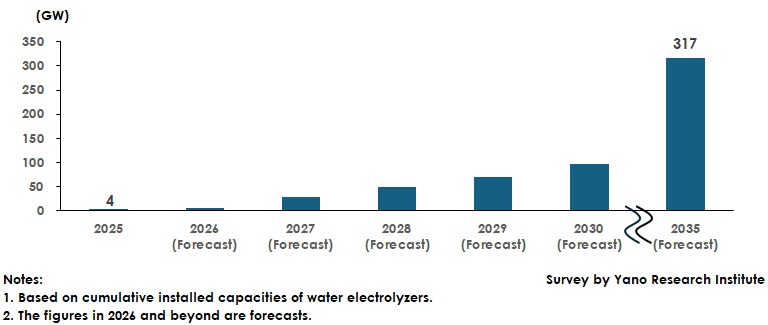
Global Cumulative Installed Capacity of Water Electrolyzers Predicted to Exceed 300GW in 2035
Yano Research Institute (the President, Takashi Mizukoshi) conducted a survey of the global water electrolysis technology market. The survey revealed the trends in the global market for water electrolyzers and components, trends among market participants, and future market prospects.
Market Overview
Water electrolysis is a technology that uses electricity to split liquid water into its constituent gases, hydrogen and oxygen. This technology is garnering attention as a sustainable method of producing green hydrogen using electricity from renewable energy sources. Green hydrogen, a next-generation energy source, is expected to play a key role in achieving a decarbonized society, because it can be stored long-term and does not emit CO2 when used or produced.
Amid global decarbonization trends, the water electrolyzer market is growing alongside steady adoptions of green hydrogen. In 2025, the global water electrolyzer market was estimated to have reached 2.6GW based on newly installed capacity and 4.2GW based on cumulative installed capacity. However, global inflation and higher interest rates have increased initial investment costs. Additionally, hydrogen production costs have risen due to grid connection constraints, including persistently high electricity prices and prolonged grid interconnection processes. These factors have delayed plans to implement the use of green hydrogen in high-demand sectors such as chemicals and steel. This has resulted in postponement and suspension of hydrogen-related projects. Consequently, the growth of the water electrolyzer market has been slower than the scenario forecasted by market participants in around 2020.
Noteworthy Topics
Trends in the Water Electrolysis Market by Region
As of 2025, China accounted for approximately 60% of water electrolyzer adoption based on cumulative installed capacity. Europe and North America followed behind. While China and Europe are expected to continue leading the market, the Middle East and India are expected to increase their market shares due to the accelerated adoption of renewable energy sources.
China has a significant presence in terms of both demand and supply. A series of green hydrogen, ammonia, and methanol manufacturing plants that use renewable energy sources at the gigawatt (GW) level have been constructed, many of which are in the northwest regions with ample wind and solar power. Meanwhile, Chinese water electrolyzer manufacturers have strengthened their supply capacities, leading to fierce price competition due to mass production. Consequently, China is not only meeting domestic demand but also propelling exports to the Middle East, Southeast Asia, and Europe.
Future Outlook
The ambitious initial scenario of the water electrolyzer market, which was based on a projection setting “decarbonization” as the goal, has been abandoned. The market is shifting to a more realistic phase that prioritizes economic rationality. Nevertheless, green hydrogen reduces CO2 emissions during production and facilitates the decarbonization in industrial sectors, such as chemical and steel, where electrification is difficult. Green hydrogen also contributes to the effective use of surplus electricity by powering water electrolyzers, thereby addressing the sharp power fluctuations caused by weather conditions in renewable energy systems. Without dramatic changes in global decarbonization trends, the adoption of water electrolyzers for producing green hydrogen is anticipated to grow in the medium to long term. Consequently, the global water electrolyzer market size, based on cumulative installed capacities, is expected to exceed 300GW by 2035.
Research Outline
2.Research Object: Companies involved in water electrolysis technologies and components
3.Research Methogology: Face-to-face and online interviews conducted by our expert researchers, and literature research
What is the Water Electrolysis Technology and Components Market?
This research defines the water electrolysis technology and component market as devices and related components that use one of the following four water electrolysis technologies: 1) alkaline (ALK), 2) proton exchange membrane (PEM), 3) solid oxide electrolyzer cell (SOEC), and 4) anion exchange membrane (AEM). Electrolyzers fall into one of these four categories. Of these, alkaline and PEM electrolyzers have reached the commercialization phase, while AEM electrolyzers and SOEC systems are transitioning from the demonstration phase to commercialization.
Market size is calculated based on newly installed water electrolyzer capacity (power consumption) and cumulative installed capacity (power consumption). This article discloses the transition of cumulative installed capacities.
<Products and Services in the Market>
Water electrolysis devices and related components (Alkaline: separators and electrodes; PEM: electrolyte membranes, electrode catalysts, and porous transport layers; SOEC: electrolytes; AEM: electrolyte membranes, electrode catalysts, etc.)
Published Report
Contact Us
The copyright and all other rights pertaining to this report belong to Yano Research Institute.
Please contact our PR team when quoting the report contents for the purpose other than media coverage.
Depending on the purpose of using our report, we may ask you to present your sentences for confirmation beforehand.