No.4020
Microgrid Construction Market in Japan: Key Research Findings 2025
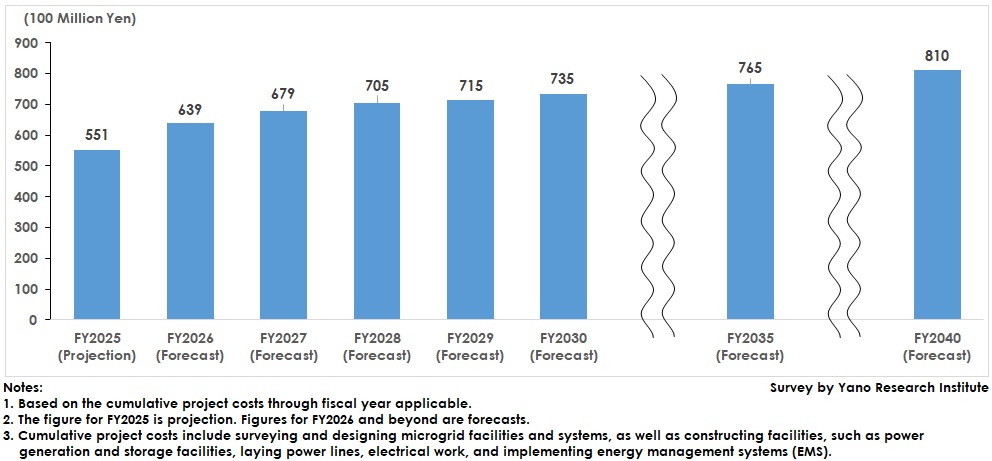
Based on the Cumulative Project Cost, the Microgrid Construction Market in Japan is Expected to Reach 55.1 Billion Yen by FY2025
Yano Research Institute (the President, Takashi Mizukoshi) conducted a survey of the domestic microgrid construction market. The survey revealed the market trends, trends of leading market players, and the future market outlook. In here discloses the forecast of cumulative project costs in the domestic microgrid construction market through FY2040.
Market Overview
A microgrid is a group of interconnected grids and electrical facilities (systems) that can supply power independently within a specified region or facility. Microgrids have their own power lines as well as systems to generate and store power. This allows them to disconnect from the main power supply in case of an emergency. Microgrids are classified as either self-operated or regional, according to ownership of the power lines within the specified area.
Currently, most self-operated microgrids in Japan are small-scale projects that combine photovoltaic power and storage batteries, with a photovoltaic power capacity of 500 kW or less. These projects account for approximately 70% of the total. Most of these projects aim to increase resilience against disaster-related outages within specific facilities and areas. Adoption of regional microgrids is increasing, primarily through subsidy programs from the Ministry of Economy, Trade and Industry (METI)’s Agency for Natural Resources and Energy. Over 70% of regional microgrids have power generation facilities with a capacity of 500 kW or less.
In this research, the size of the microgrid construction market in Japan is calculated as the accumulated project costs, which include surveying, designing, and constructing microgrid facilities and systems. The estimated cumulative project costs through FY2025 are 55.1 billion yen.
Noteworthy Topics
Trend of Constructing New Microgrids
Microgrid projects under construction or in the planning phase are larger in scale than previously, because they are based on models from the “Decarbonization Precedence Areas” and the “Accelerated Regional Decarbonization” projects. Rather than relying solely on solar power, these projects have diversified their power sources to include biomass, wind, and small-scale hydropower.
Additionally, microgrids are being considered for applications involving renewable power sources, including those that have completed the Feed-in Tariff (FIT) program. Consequently, microgrids have evolved into electrical systems that can significantly reduce the carbon footprint of power consumption during normal operation, rather than merely serving as emergency power sources.
Future Outlook
The microgrid construction market emerged based on the subsidy programs from METI and the Ministry of the Environment. The market is expected to experience stable growth, driven by municipalities aiming for “Decarbonization and Enhancement of Regional Resilience.”
Going forward, some microgrid construction projects will be led by the private sector and will generate revenue from businesses involving battery energy storage systems (BESS).
Based on cumulative project costs, the domestic microgrid construction market is expected to reach 73.5 billion yen by FY2030 and 81.0 billion yen by FY2040.
Research Outline
2.Research Object: Microgrid businesses, municipalities, heavy electrical equipment manufacturers, system vendors, etc.
3.Research Methogology: Face-to-face interviews (including online interviews) by expert researchers and corporate questionnaire survey
What is a microgrid?
A microgrid is a group of interconnected grids and electrical facilities (systems) that can supply power independently within a specified region or facility. Microgrids have their own power lines as well as systems to generate and store power. This allows them to disconnect from the main power supply in case of an emergency.
What is the Microgrid Construction Market?
In this research, the size of the microgrid construction market in Japan is calculated as accumulated project costs. These costs include surveying and designing microgrid facilities and systems, as well as constructing facilities, such as power generation and storage facilities, laying power lines, electrical work, and implementing energy management systems (EMS).
*Reference:
Battery Energy Storage System (BESS) Business Market in Japan: Key Research Findings 2025
https://www.yanoresearch.com/en/press-release/show/press_id/4006
<Products and Services in the Market>
Surveying and designing, constructing power generation and storage facilities, laying power lines, electrical work, and implementing energy management systems (EMS)
Published Report
Contact Us
The copyright and all other rights pertaining to this report belong to Yano Research Institute.
Please contact our PR team when quoting the report contents for the purpose other than media coverage.
Depending on the purpose of using our report, we may ask you to present your sentences for confirmation beforehand.