No.4171
Rent Guarantor Market in Japan: Key Research Findings 2026
The Rent Guarantor Market Expected to Expand to 365.7 Billion Yen by FY2030
Yano Research Institute (the President, Takashi Mizukoshi) surveyed the domestic rent guarantor market. The survey revealed the market trends and outlook.
Market Overview
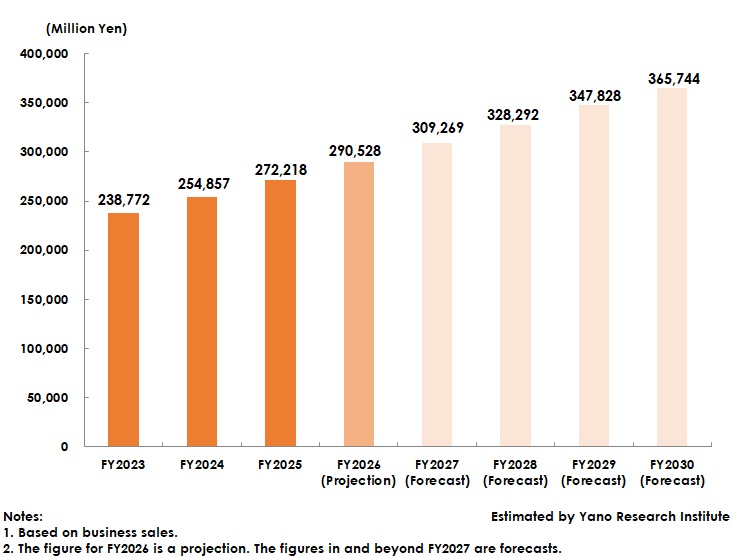
The rent guarantor market (a total of residential and nonresidential sectors) grew to 272.218 billion yen in FY2025, which is equivalent to 106.8% of the previous fiscal year’s size. It is projected to expand to 290.528 billion yen in FY2026, which is 106.7% of the previous year's size.
The nonresidential sector is expected to expand from 33.7 billion yen in FY2025 (117.1% of the previous fiscal year's size) to 37.9 billion yen in FY2026 (112.5%), surpassing the residential sector's growth rate. As the residential market transitions to the maturity phase, the nonresidential market is becoming a more prominent driver of growth.
Market growth stems from amendments to the Civil Code in April 2020, which led to the widespread adoption of professional rent guarantors. Changes in the social structure, such as an increase in single-person, elderly, and foreign-resident households, have also contributed to market growth. Rent guarantors have become the social infrastructure that supports lease agreements. Consequently, continuous robust growth is anticipated.
Although rent guarantor services have become widespread, the residential sector is experiencing slower relocation demand due to rising rents and commodity prices. To overcome this challenge, rent guarantors are exploring new growth opportunities by expanding into the nonresidential sector, improving services for foreign residents, investing in artificial intelligence (AI) and digital transformation (DX) to increase work efficiency, and strengthening their business bases through mergers and acquisitions.
Noteworthy Topics
AI Utilization and Digital Transformation Contributing to Credit Screening
Rent guarantor companies have implemented digital transformation for the whole work process from application acceptance, screening, and contracting to credit management.
These companies are particularly keen on advancing their screening processes by using AI to analyze their accumulated screening and debt collection data. Their efforts to reduce screening time while improving accuracy and productivity have become more prevalent, as they accept online, smartphone-based applications, adopt AI-powered screening support and electronic contracting, and automate dunning and debt collection.
AI and DX will likely be more important in establishing a work structure that functions in labor shortages and in improving risk management accuracy.
Future Outlook
From FY2026 to FY2030, the rent guarantor market is expected to grow at a compound annual growth rate (CAGR) of around 6%, continuing the current growth trend. Based on the total business sales in the residential and nonresidential sectors, the market size is projected to reach 365.744 billion yen by FY2030.
The nonresidential sector is expected to reach 60 billion yen by FY2030, maintaining a higher growth rate than the residential sector. While the residential sector market continues to grow moderately, the nonresidential sector will likely remain a market driver with its high growth rate.
The rent guarantor market is predicted to transition from its current growth stage towards improvements in productivity, profitability, and added value. Key drivers for future growth include leveraging AI to streamline operations, enhancing life support services to provide more than just guarantees, expanding into new markets such as logistics and healthcare facilities, increasing revenue from existing guaranteed updates, and reorganizing the industry through mergers and acquisitions (M&As) and capital alliances.
Rent guarantor services will likely expand their role as the social infrastructure that supports safe and secure lease contracts. Rent guarantors are at the turning point, poised to evolve from providers of rent payment guarantees to comprehensive service providers that combine life support and digital technology. Companies that achieves this transformation will likely lead the next-generation market.
Research Outline
2.Research Object: Leading Rent Guarantors
3.Research Methogology: Face-to-face interviews by our expert researchers as a main source, with literature research
What is the Rent Guarantor Market?
In this research, the term “rent guarantor market” refers to a system in Japan where lessees or tenants (whether individuals, companies, or self-employed individuals) are required to sign a contract with a guarantor company. Under this agreement, property owners (landlords) receive stable monthly rental income because the guarantor company makes the payments if tenants default. The lessees pay service fees to guarantor companies for this coverage.
Traditionally, Japanese lease agreements required a joint guarantor (typically a family member or friend with stable employment). However, amendments to the Civil Code in April 2020 tightened the legal restrictions such as capping co-guarantors’ debt limits. This has increased the use of professional rent guarantors. Currently, the usage of rent guarantors are standard practice when leasing houses. The market size is calculated based on the combined business sales of both residential and non-residential applications.
<Products and Services in the Market>
Rent Guarantee services
Published Report
Contact Us
The copyright and all other rights pertaining to this report belong to Yano Research Institute.
Please contact our PR team when quoting the report contents for the purpose other than media coverage.
Depending on the purpose of using our report, we may ask you to present your sentences for confirmation beforehand.