No.4165
Online Retail Market in Japan: Key Research Findings 2026
The Survey Revealed that 70% of Businesses Feel B2C Ecommerce to be Promising
Yano Research Institute (the President, Takashi Mizukoshi) conducted a survey of the domestic online retail market, focusing primarily on the consumer merchandising sector. The survey revealed market trends by product and service, as well as trends among market players. This article discloses part of the analysis on the status of overall B2C ecommerce businesses, as seen through the sales, profitability, and growth potential of domestic ecommerce website operators who responded to the corporate questionnaire about their operations.
Summary of Research Findings
According to the "Results of FY2024 E-Commerce Market Survey"* compiled by the Ministry of Economy, Trade and Industry (METI), the size of the domestic B2C ecommerce market, including the merchandising, service, and digital sectors, was estimated to be valued at 26.1225 trillion yen in 2024, which was equivalent to 105.1% of the previous year’s size. The merchandising sector amounted to 15.2194 trillion yen, representing 103.7% of the previous year’s size. This indicated that the ecommerce ratio for merchandising reached 9.78%, marking a 0.4-point year-over-year increase and showing a stable increase in the use of ecommerce among consumers, though growth slowed down from 2020 and 2021. The service sector flourished, with double-digit growth in travel, food, and financial services. The digital sector, including online gaming and electronic publishing, showed mixed results: a continued decline in online gaming and stable growth in paid music and video streaming services. In 2024, all three sectors of the B2C ecommerce market surpassed the previous year’s results. The service sector experienced the most significant growth, closing in on double-digit growth with a 9.4% increase from the previous year.
*Source: Results of FY2024 E-Commerce Market Survey Compiled by Ministry of Economy, Trade and Industry
Noteworthy Topics
B2C Ecommerce Businesses Expanding Overall, as Evidenced by Many Businesses' Feelings of Having Tangible Results
From April to May 2026, a corporate questionnaire was administered to 47 ecommerce website operators in Japan to gain insight into their business operations and consumer-oriented initiatives. These operators included manufacturers and retailers of clothing and fashion accessories, food, cosmetics, sporting goods, daily necessities, and household goods. This article discloses part of the analysis of the status of B2C e-commerce businesses from the perspectives of the sales, profitability, and growth potential of the respondents.
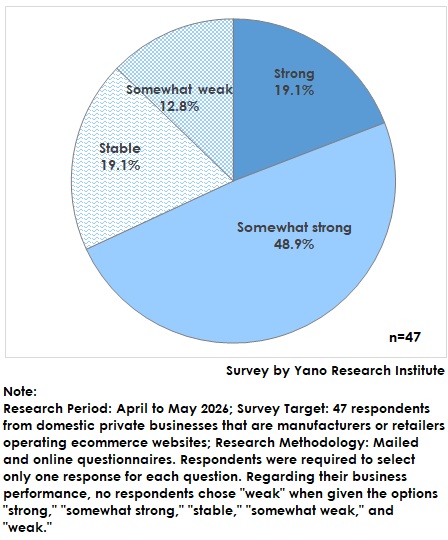
When asked about the performance of their B2C ecommerce businesses, 48.9% of respondents chose “somewhat strong.” This was followed by “strong” and “flat” responses, which accounted for 19.1% each. The combined percentage of “strong” and “somewhat strong” responses was 68.0%, indicating that approximately 70% of companies were somewhat satisfied.
The questionnaire results show that B2C ecommerce businesses are experiencing stable growth, with many businesses achieving satisfactory results. The fact that “somewhat strong” was the most popular response suggests that many businesses appear to have achieved satisfactory results through various measurements since the beginning rather than experiencing rapid growth.
However, a certain number of companies have experienced flat performance. To achieve further growth, these companies seem to have entered the next strategic phase, which requires enhancing customer attraction capabilities, reviewing product and pricing strategies, and optimizing information delivery for each customer.
Research Outline
2.Research Object: Companies operating ecommerce businesses
3.Research Methogology: Face-to-face interviews (including online interviews) by expert researchers, survey via telephone, a questionnaire, and literature research
What is the Corporate Questionnaire on the Online Retail Market and the Ecommerce Website Operations?
For this research, a corporate questionnaire was conducted with 47 ecommerce website operators in Japan from April to May 2026 to understand their business operations and consumer-oriented initiatives. These operators included manufacturers and retailers of clothing, fashion accessories, food, cosmetics, sporting goods, daily necessities, and household goods. This article focuses on the analysis of the B2C ecommerce business status by examining the sales, profitability, and growth potential of the respondents.
<Products and Services in the Market>
For this research, a corporate questionnaire was conducted with 47 ecommerce website operators in Japan from April to May 2026 to understand their business operations and consumer-oriented initiatives. These operators included manufacturers and retailers of clothing and fashion accessories, food, cosmetics, sporting goods, daily necessities, and household goods. This article focuses on the analysis of the B2C e-commerce business status by examining the sales, profitability, and growth potential of the respondents. The merchandising sector includes: 1) Ecommerce retailer sales (mail order, catalog, TV, department stores, general merchandisers, and convenience stores); 2) Home electric appliances, PCs, and peripheral products; 3) Books, films, and music; 4) Food, beverages, liquor, alcoholic drinks, and health foods; 5) Medicine and cosmetics; 6) Furniture, interior decoration, miscellaneous goods, and daily necessities; 7) Apparel and fashion accessories; 8) Sports gear; and 9) Bicycles, two-wheel vehicles, parts, etc. The service sector includes: 10) Accommodation, travel services, and transportation; 11) Food services; 12) Box office ticket reservation; 13) Financial services (online banking and online brokerage); 14) Online life insurance; 15) Haircare-related services; and 16) Food delivery services; The digital sector includes: 17) Electronic publishing (books and magazines); 18) Paid music streaming; 19) Paid movie streaming; and 20) Online gaming.
Published Report
Contact Us
The copyright and all other rights pertaining to this report belong to Yano Research Institute.
Please contact our PR team when quoting the report contents for the purpose other than media coverage.
Depending on the purpose of using our report, we may ask you to present your sentences for confirmation beforehand.