No.4163
Carbon Accounting & Emissions Management Software and Services in Japan: Key Research Findings 2026
Carbon Accounting and Emissions Management Software and Services Market in Japan Forecast to Reach 22 Billion Yen by FY2030
Yano Research Institute (the President, Takashi Mizukoshi) conducted a survey on the carbon accounting and emissions management software and services market in Japan. This press release denotes the market size projection for FY2030.
Market Overview
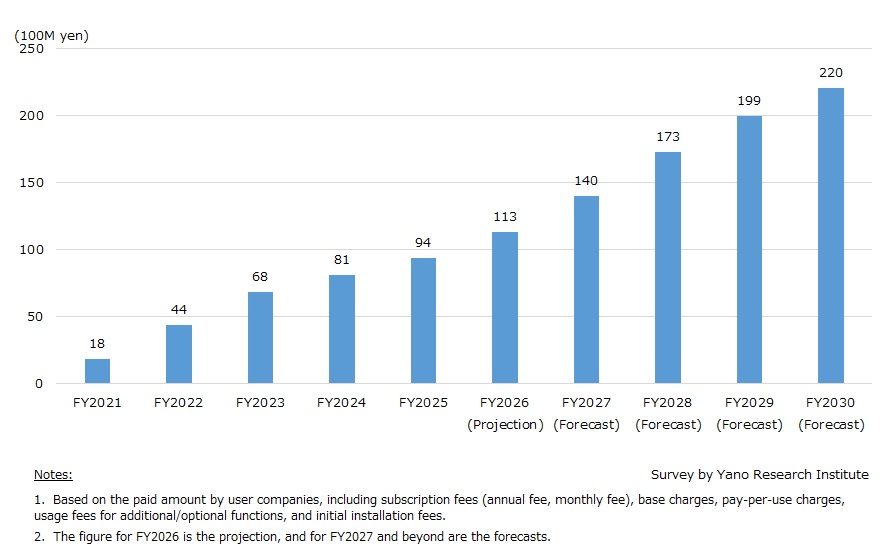
The carbon accounting and emissions management software and services market in Japan is projected to reach 9.4 billion yen in FY2025, based on the paid amount by user companies.
During the early 2020s, spanning fiscal years 2021 to 2025, Japan's carbon management market experienced significant expansion, driven primarily by the national push toward decarbonization. As enterprises sought to reduce their greenhouse gas emissions, the demand for tools capable of calculating and visualizing direct, indirect, and supply chain emissions rose sharply. This momentum was further amplified in June 2021 by the revision of the Corporate Governance Code, which compelled companies, particularly those listed on the Tokyo Stock Exchange Prime Market, to align with stringent climate disclosure requirements. Compounding these regulatory pressures, the introduction of a mandatory sustainability section in securities reports starting in March 2023 forced organizations to establish formal management systems for tracking vital environmental data.*1 In addition, market growth is driven by self-assessment questionnaires (SAQs) that enable collection and management of suppliers’ GHG emission data and ESG (Environment, Social, and Governance) data.
By fiscal year 2025, the adoption of these carbon calculation and visualization tools has been led predominantly by large enterprises. To meet evolving corporate needs, the market has expanded well beyond basic emissions tracking to encompass carbon footprint calculations, sustainability disclosures, third-party assurance compliance, and alignment with global evaluation standards such as CDP. Furthermore, continuous market growth is being heavily driven by the use of self-assessment questionnaires (SAQs), which empower companies to seamlessly collect and manage vital ESG (environmental, social, and governance) data across their entire supply chains.
*1. Source: Financial Services Agency, “Information on the Disclosure of Corporate Sustainability Information In Securities Reports”
(https://www.fsa.go.jp/policy/kaiji/sustainability-kaiji.html)
Noteworthy Topics
Sustainability Disclosure in Compliance with SSBJ Standards
In March 2025, the Sustainability Standards Board of Japan (SSBJ) published its domestic sustainability disclosure standards. Starting with the fiscal year ending March 2027, TSE Prime Market companies with an average market capitalization of three trillion yen or more over the past five fiscal years must align their securities reports with these standards. This requirement extends to companies capitalized between one and three trillion yen beginning the following fiscal year. *2 Additionally, third-party assurance will become mandatory for sustainability data included in these reports starting one year after each group's initial compliance deadline. *2
Compliance with the SSBJ Standards requires the disclosure of information regarding sustainability-related risks and opportunities. In line with these regulatory trends, there is a growing need to enhance carbon management tools and services.
*2. Source: Financial Services Agency, “Explanation” (May 25, 2026)
(https://www.fsa.go.jp/singi/singi_kigyou/siryou/hoshou/20260525/02.pdf)
Future Outlook
The domestic market size for carbon management tools and services is projected to reach approximately 22 billion yen by FY2030, based on the paid amount by user companies. A key market driver from the latter half of the 2020s (FY2026-2030) will be the sustainability disclosure requirements compliant with the SSBJ standards, which increases the needs to systematize the process of calculating GHG emissions, managing data, and archiving calculation documents for disclosure and third-party assurance.
Furthermore, the need to collect and manage GHG emissions and ESG-related information from business partners in the supply chain using a self-assessment questionnaire (SAQ) format (mainly among large corporations) is expected to contribute to market growth. When tracking the Scope 3 emissions, collection of data from suppliers, customers, and other parties is required for relevant categories.
In addition, in the manufacturing sector, demand may rise for integrating data—such as component composition information at affiliated companies—for the purpose of calculating carbon footprints (CFP). Market growth in FY2030 will be driven by the rise in use charges resulting from the enhanced offerings, as well as by the increase in the number of companies adopting these solutions.
Research Outline
2.Research Object: Businesses pertaining to carbon accounting and emissions management software and services
3.Research Methogology: Face-to-face interviews by our expert researchers (including online), telephone interviews, and literature research
Carbon Accounting & Emissions Management Software and Services
The market for carbon accounting and emission management tools and services encompasses carbon accounting tools and services for calculating/visualizing greenhouse gas (GHG)*, carbon footprint (CFP), sustainability disclosure/third-party assurance compliance, compliance with evaluation bodies such as CDP, and self-assessment questionnaire (SAQ) for whole supply chain. The market includes SaaS/cloud-based services and features incorporated into legacy systems like ERP. However, proprietary systems built from scratch are excluded.
The market size includes subscription fees (annual fee, monthly fee), base charges, pay-per-use charges, usage fees for additional/optional functions, and initial installation fees. Consulting fees and other fees not relevant to software subscription are excluded.
* Greenhouse gas (GHG) emissions are defined as below, based on the definitions provided by the Ministry of Environment:
Scope 1: Direct emissions from owned or controlled sources (burning fuel, industrial processing)
Scope 2: Indirect emissions from purchased electricity, heat, and steam
Scope 3: All other indirect emissions across the value chain
(Ref. https://www.env.go.jp/earth/ondanka/supply_chain/gvc/estimate.html)
<Products and Services in the Market>
Carbon accounting and emissions management software and services
Published Report
Contact Us
The copyright and all other rights pertaining to this report belong to Yano Research Institute.
Please contact our PR team when quoting the report contents for the purpose other than media coverage.
Depending on the purpose of using our report, we may ask you to present your sentences for confirmation beforehand.