No.3969
Global Trends in Automotive E/E Architecture: Key Research Findings 2025
Global Number of Vehicles with Centralized E/E Architecture Expected to Reach 47.81 Million Units by 2035, Due to Advancements in AD/ADAS and OTA Updates
Yano Research Institute (the President, Takashi Mizukoshi) conducted a survey of the global for automotive electrical/electronic (E/E) architecture market. The survey revealed the status of the software-defined vehicle (SDV) market by region, the technological trends in E/E architecture and system-on-chips (SOCs), and the business strategies of major manufacturers in the market. This paper forecasts the number of E/E architecture-adopted vehicles by type.
Market Overview
The shift to software-defined vehicles (SDVs) has been driven by vehicle electrification. SDVs enable the updating of automotive functions through software. Technological innovation is underway for electrical/electronic (E/E) architecture, the infrastructure for these electronics.
Traditional internal combustion engine vehicles (ICEVs) and hybrid electric vehicles (HEVs) use distributed E/E architectures, which organize one ECU per device. However, centralized E/E architectures, which enable over-the-air (OTA) software updates and centralized vehicle control, are primarily found in battery electric vehicles (BEVs).
A shift is underway from distributed to centralized E/E architectures, beginning with a domain-based structure. This allows multiple ECUs—previously organized by feature—to be grouped by domain. Each domain handles a specific set of related vehicle functions. Examples of these domains include the advanced driver-assistance systems (ADAS), cockpit and infotainment, powertrain, and chassis. Additionally, the development of a zonal structure is progressing, leading to business alignments among automakers, Tier 1 suppliers, and semiconductor manufacturers. This zonal-based centralized architecture allows components to be organized by their physical location (zone) within the vehicle. In this architecture, ECUs or zonal controllers are placed at the front, rear, right, left, and center of the vehicle. These controllers manage nearby sensors and actuators, aggregating and sending the information to a central, high-performance computer (HPC) for processing.
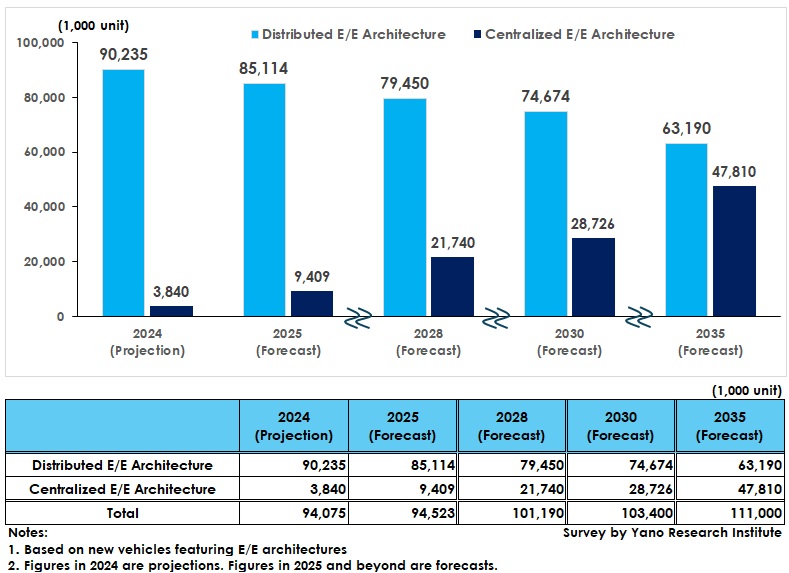
Tesla and emerging Chinese manufacturers are leading the adoption of domain-based architecture in their large, high-end BEVs. The number of new cars with centralized E/E architecture worldwide reached 3.84 million units in 2024. Between 2025 and 2027, major automakers in Japan, the United States, and Europe plan to release new models featuring domain-based architecture. Consequently, the global market size for centralized E/E architecture is forecast to reach 21.74 million units by 2028, based on the number of new cars implementing it.
Noteworthy Topics
Centralized E/E Architecture and System-on-Chips (SoCs)
The increase in vehicles with centralized E/E architecture has improved the performance of automotive system-on-chips (SoCs).
In a traditional distributed architecture, each ECU primarily controlled components using microcomputers (MCs).
However, in a domain-based structure, which is a type of centralized E/E architecture, SoCs are used in domain controllers to consolidate and control multiple ECUs. SoCs have higher processing capacity than MCs and can process multiple controls simultaneously. Since domain controllers, especially those for autonomous driving (AD), ADAS, and the cockpit, require significant computational power, the demand for high-performance SoCs is growing. Consequently, competition is intensifying. New entrants like NVIDIA and Qualcomm are challenging traditional manufacturers such as Renesas Electronics and NXP Semiconductors.
Future Outlook
The global market size for centralized E/E architecture is forecast to reach 47.81 million units by 2035. The growth of ADAS has driven an increase in the number of BEVs featuring centralized E/E architecture, particularly in vehicles with Level 2+Navigation on Autopilot (NOA) ADAS technology in the Chinese market.
Level 2+NOA technology provides Level 2 driving assistance on both highways and general streets. It uses a combination of locational information from a navigation map and multiple ADAS sensors. To ensure safe driving, Level 2+NOA technology provides 360-degree (the front, sides, and rear) detection capabilities around the vehicle, requiring a maximum of 30 sensors. Controlling multiple cameras, radars, and LiDAR simultaneously is difficult in a traditional distributed architecture. Therefore, a centralized, domain-based architecture featuring ADAS domain controllers with high-computing processing SoCs is necessary.
After 2026, the adoption of centralized E/E architecture using domain controllers is expected to increase among Japanese, American, and European automakers to implement Level 2+NOA in their large and high-end models. After 2030, adoption is likely to expand to mid-range models.
Research Outline
2.Research Object: Automakers, Tier 1 manufacturers, and semiconductor manufacturers
3.Research Methogology: Face-to-face interviews (including online interviews) by specialized researchers, survey by telephone, and literature research
What is an Electrical/Electronic (E/E) architecture?
An electrical/electronic (E/E) architecture refers to the configuration of a vehicle's electronic control system. This configuration determines how the vehicle’s electrical and electronic systems are arranged.
Traditionally, each function, such as the engine, brakes, steering, lights, air conditioning, air bags, and dashboard, was controlled by one dedicated electronic control unit (ECU). This configuration is called distributed E/E architecture and requires over a hundred ECUs for luxury cars.
However, rapid advancements in electronic controls have complicated this arrangement in recent years, which has led to issues regarding ECU space, wiring harness costs and weight, and control efficiency. This has initiated the adoption of centralized E/E architecture primarily among battery electric vehicles (BEVs) starting in the early 2020s. This architecture allows one ECU to manage a set of multiple functions.
A centralized E/E architecture can be categorized into domain-based and zonal structures.
In a domain-based architecture, ECUs are organized by functional domain, with each domain handling a specific set of related vehicle functions. Examples of these domains include driving assistance (including parking assistance and airbags), the cockpit and infotainment, powertrain, chassis (including steering, brakes and accelerator), and body (including lights, doors, and air conditioners). This structure consolidates the control of ECUs. This consolidation creates “domain controllers,” which coordinate activities within their respective domains, including over-the-air (OTA) software updates.
Meanwhile, zonal architecture organizes components by their physical location (zone) within the vehicle. ECUs or zonal controllers are placed at the front, rear, right, left, and center of the vehicle. Each zonal controller manages nearby sensors and actuators, aggregating and sending the information from them to a central, high-performance computer (HPC) for processing. This structure consolidates ECU control by location and reduces wiring among ECUs, contributing to lighter weight and lower costs.
<Products and Services in the Market>
Electrical/Electronic (E/E) architecture, electronic control unit (ECU), automotive system-on-chips (SOCs)
Published Report
Contact Us
The copyright and all other rights pertaining to this report belong to Yano Research Institute.
Please contact our PR team when quoting the report contents for the purpose other than media coverage.
Depending on the purpose of using our report, we may ask you to present your sentences for confirmation beforehand.