No.3421
IT Market for Public Infrastructure and Public Safety in Japan: Key Research Findings 2023
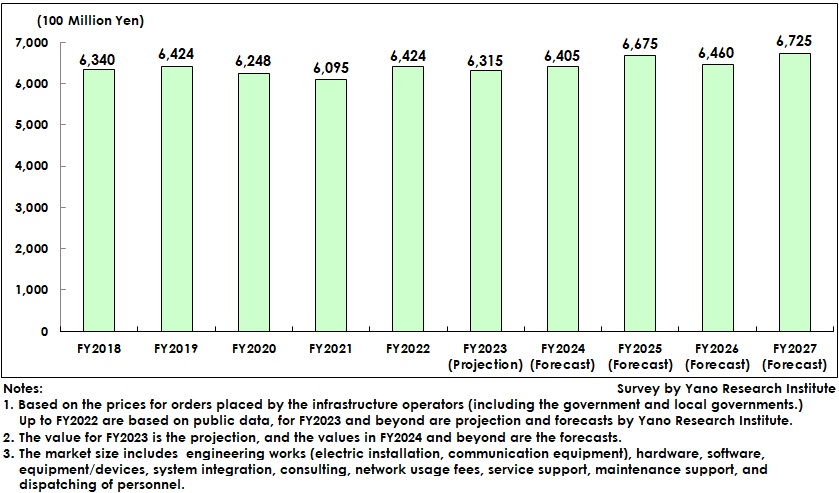
Domestic IT Market for Social Infrastructure for FY2022 Valued at 642,400 Million Yen, Up 5.4% YoY
Yano Research Institute (the President, Takashi Mizukoshi) has conducted a survey of the information technology (IT) market for public infrastructure and public safety in Japan. The survey revealed the market size, trends by segment/region, trends in bidding and IT solution business for public infrastructure and safety, and future perspectives. This paper highlights the IT market size transition and forecast for public infrastructure and public safety.
Market Overview
The research highlights the IT business in the following eight segments of public infrastructure and public safety: 1) Roads, 2) Railways, 3) Airports, 4) Ports, 5) Rivers, 6) Dams, 7) Water-related, and 8) Disaster prevention/police. Market size was calculated based on order amounts placed by the infrastructure operators.
The market declined in FY2020 and FY2021 because of postponement and discontinuation of IT projects for public infrastructure and safety amid the pandemic crisis during those years. Notable declines were observed in railways and disaster prevention/police, with a total shrinkage of both segments totaled 30,000 million yen from FY2019.
The market experienced a rapid upturn, reaching 642,400 million yen in FY2022, which was a 5.4% increase from the previous fiscal year. This increase stemmed from increased IT investments in railways, airports, and water-related segments, including waterworks, rural water systems, sewage systems, purification plants, effluent treatment, and irrigation systems.
Noteworthy Topics
IT Solutions for Public Infrastructure and Public Safety
The current IT market for public infrastructure and public safety is dominated by legacy type IT.
However, since the 2010s, major companies, including expressway businesses such as the NEXCO Group, the Metropolitan Expressway Company, the Hanshin Expressway Company as well as railway businesses, including JR passenger businesses (East Japan Railway Company, Central Japan Railway Company, and West Japan Railway Company), Tokyo Metro and private railway companies in the metropolitan area, have started using digital technologies for facility inspections, remote supervision, and condition-based monitoring. Since the second half of 2010, applications of advanced technologies for infrastructure maintenance have been promoted by the Ministry of Land, Infrastructure, and Transport (MLIT) which resulted in the implementation of the internet of things (IoT), cloud technology, 5G/local 5G, Low Power Wide Area (LPWA), AI (image analysis, speech recognition, and data analysis), 3D, AR/VR & smart devices, sensor networks, drones, and robots.
These IT solutions using these advanced technologies for public infrastructure applications have been implemented since the beginning of the 2020s. Based on clients’ order amounts, this IT solutions market, which is part of the IT market for public infrastructure and public safety, is expected to surpass 10 billion yen by FY2024, entering the proliferation phase. This owes to advances in IT, reduced system prices, and social circumstances such as engineer shortages, an aging engineer population, and restrictions on overwork.
Future Outlook
The IT market for public infrastructure and public safety is expected to decline by 1.7%, reaching 631.5 billion yen in FY2023. This decline is partly due to downturn from the surge in the previous fiscal year.
Legacy IT still dominates the market in FY2023, with only 1.2% of IT solutions using digital technologies for public infrastructure. The public infrastructure IT solutions market will have to wait until FY2024 to reach a size exceeding 10 billion yen and enter the prevalence stage.
The advent of next-generation communication standards, such as Wi-Fi HaLow and 6G, in addition to 5G and local 5G telecommunication networks, as well as low-power wide-area networks (LPWAN) operating in the 920 MHz band, will highly likely create new solutions for public infrastructure applications. Additionally, the use of satellites for imaging and radar, drones for disaster prevention, infrastructure facility inspections, and monitoring, and robots for inspections and safety operation support in dangerous places is expected to increase.
Research Outline
2.Research Object: Public offices (MLIT, METI, MIC etc.,) local governments, public institutions (AIST, PWRI, NILIM, other industrial organizations), IT solution providers/system integrators, telecommunication carriers, construction businesses, heavy electric machinery manufacturers, construction consultants, etc.
3.Research Methogology: Face-to-face interviews (including online) by expert researchers, survey by telephone, and literature research
What is the IT Market for Public Infrastructure and Public Safety?
This research defines the information technology (IT) market for public infrastructure and public safety as the IT sector used to manage the following eight segments: 1) roads (expressways, national highways, regional highways, traffic control, etc.,) 2) railways (JR Group, Tokyo Metro, private railways, and publicly owned railways), 3) airports (hub airports [class 1], regional airports [class 2], military-civilian airports, and other airports), 4) Ports (strategic international ports, central international ports, major ports, regional ports, and ports not designated as port zones [as defined in Port and Harbor Act Article 56]), 5) rivers, 6) dams, 7) water (waterworks, rural water systems, sewage systems, purification plants, effluent treatment, and irrigation water systems), and 8) disaster prevention/police. The market size includes engineering works, such as electrical installations and communication equipment, as well as hardware, software, equipment and devices, system integration, consulting, network usage fees, service and maintenance support, and personnel dispatch. These amounts are calculated based on orders placed by infrastructure operators, including government and local agencies.
What are IT Solutions for Public Infrastructure and Public Safety
In this research, IT solutions for public infrastructure refer to services provided by IT vendors that use technologies, including IoT, cloud systems, 5G and local 5G, LPWA, AI (image analysis, speech recognition, and data analysis), 3D, AR/VR & smart devices, sensor networks, drones, and robots. These solutions differ from traditional manual public infrastructure services, such as manual monitoring, maintenance, and repair of electrical devices, power transformers, telecommunications and data transfer networks, information processing facilities, and traffic control systems.
<Products and Services in the Market>
IT for public infrastructure and public safety is categorized into 1) Roads, 2) Railways, 3) Airports, 4) Ports, 5) Rivers, 6) Dams, 7) Water-related, and 8) Disaster prevention/Police
Published Report
Contact Us
The copyright and all other rights pertaining to this report belong to Yano Research Institute.
Please contact our PR team when quoting the report contents for the purpose other than media coverage.
Depending on the purpose of using our report, we may ask you to present your sentences for confirmation beforehand.