No.3229
Hair Salon and Barber Shop Cosmetics Market in Japan: Key Research Findings 2023
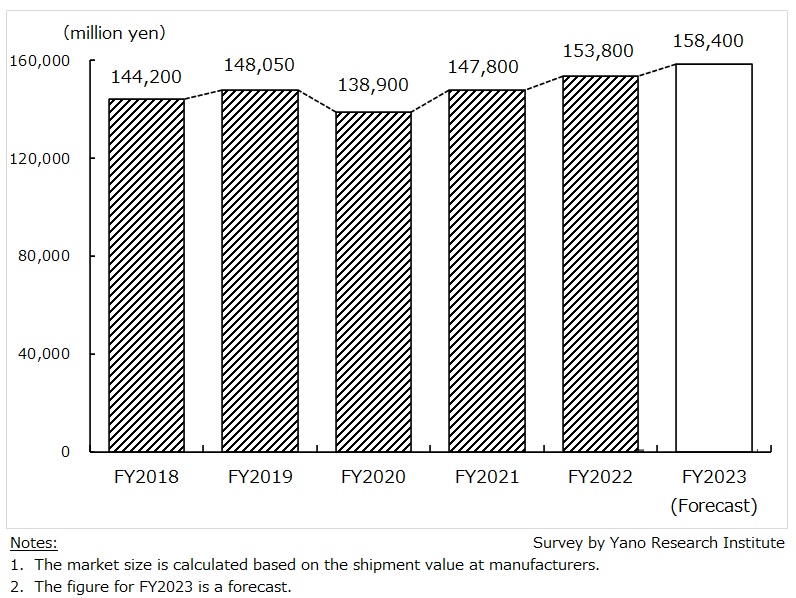
Hair Salon and Barber Shop Cosmetics Market Grew to 153,800 Million Yen in FY2022, 104.1% of Preceding Fiscal Year
Yano Research Institute (the President, Takashi Mizukoshi) has completed a comprehensive study of the domestic market for hair salon and barber shop cosmetics, identifying current market size and trends across prefectures, product categories, and key players. The study culminates in an analysis of the market’s future outlook.
Market Overview
The market size of professional use cosmetics for hair salons and barber shops attained 153,800 million yen for FY2022, 104% of the previous fiscal year, based on the shipment value at manufacturers. Owing to the ease of activity restrictions including so-called 'quasi-emergency coronavirus measures' that requested people to stay home to avoid infections, the number of customers and visit frequency have recovered.
Given that the lifestyle to avoid spread of infections (wearing facial masks, refraining from going out) continues, the market will not be the same as pre-pandemic years. Still, the demand for haircare and barbering is increasing (especially coloring), and the sales of salon exclusive products (offline and online) are also growing steadily.
Noteworthy Topics
Manufacturers' Strategy to Manage Rising Costs of Raw Materials
Affected by the soaring market prices of ingredients widely used in haircare cosmetics due to global demand expansion, manufacturers have raised product prices several times. Although they tried to manage material price hike by cutting other expenses, significan increase in the cost of packaging, energy, logistics, and human resources have neccessitated domestic manufacturers to raisee product prices in the latter half of 2022.
Quite a few companies have confirmed that they will raise prices in FY2023 and beyond for new brands and products, as well as for renewals. However, there are also manufacturers that keep price at current level for fear of losing market share.
To mitigate the negative impact of price revisions, manufacturers are bringing forward customer retention ideas for hair salons and barber shops, with a focus on sales activities which may have ripple effect on an increase of customer LTV and higher salary for salon staffs.
Future Outlook
In responce to the return of pre-pandemic lifestyle, propelled by the government decision to downgrade COVID-19's category to Class 5 Infectious Disease, coupled with the increase in prices of professional use haircare cosmetics anticipated, the hair salon and barber shop cosmetics market is projected to expand in FY2023. However, consumer spending will diversify across entertainment, hobbies, leisure, and fashion. Amid the shrinking demographics, the market trend the may turn to worse thereafter.
Research Outline
2.Research Object: Manufacturers and wholesalers of professional haircare cosmetics (haircare cosmetics used by/sold at hair salons and barbershops), related businesses and associations
3.Research Methogology: Face-to-face interviews by the expert researchers (including online interviews), survey by telephone and email, and literature research
What is the Hair Salon and Barber Shop Cosmetics Market?
In this research, hair salon and barber shop cosmetics refer to products classified as ‘haircare cosmetics’, under the Japanese Pharmaceuticals and Medical Devices Act, that are specifically used or sold by barbershops and hair salons.
The hair salon and barber shop cosmetics market encompasses backbar products (professional hair color, perm solutions, wet goods, haircare solutions, styling aids, etc.) and salon retail products (salon-grade products for client home-care).
As a general rule, hotel amenities and backbar products used in beauty salons are excluded.
<Products and Services in the Market>
Hair salon and barber shop cosmetics (hair coloring products, perm solutions, hair care products, hair styling products, and other related cosmetic products)
Published Report
Contact Us
The copyright and all other rights pertaining to this report belong to Yano Research Institute.
Please contact our PR team when quoting the report contents for the purpose other than media coverage.
Depending on the purpose of using our report, we may ask you to present your sentences for confirmation beforehand.