No.4174
Global Market for Carbon Neutral Automotive Fuels: Key Research Findings 2026
Global Automotive Bioethanol Consumption Expected to Reach 186.218 Million Kiloliters by 2035, Marking a 44.7% Increase from 2025
Yano Research Institute (the President, Takashi Mizukoshi) conducted a survey of the global automotive industry, which is affected by decarbonization movements. The survey provided an overview of the global carbon-neutral automotive fuels market, including trends among market players and the future market outlook. This article focuses on global automotive bioethanol consumption and average blending rates through 2035.
Market Overview
In recent years, the global market landscape for carbon-neutral automotive fuels has undergone dramatic changes. Four factors have primarily driven this shift in market structure: 1) a shift in energy and trade policy following the inauguration of the second Trump administration; 2) increased demand for carbon-neutral fuels in the aviation and maritime sectors, 3) revisions to automotive policy from focusing solely on battery electric vehicles (BEVs) to embracing other technologies, and 4) the selective implementation of low-carbon, profitability-focused hydrogen and synthetic fuel (e-fuel) projects.
In the United States, the second Trump administration is propelling domestic oil and natural gas production, while encouraging the use and export of bioethanol and biodiesel in hopes of developing agriculture, ensuring energy security, and reducing the trade deficit. As the aviation and maritime sectors impose mandatory deployments of sustainable aviation fuels (SAFs) and low-carbon marine fuels, competition for raw materials and their various uses—including used cooking oil, vegetable oil, and bioethanol—is intensifying. Additionally, recent escalating tensions in the Middle East, including the blockade of the Strait of Hormuz amid the conflict between the US and Iran, underscore the importance of energy security.
The automotive industry has begun to shift toward a realistic electrification path of combining hybrid and plug-in hybrid electric vehicles (HEVs and PHEVs) with biofuels, while maintaining the BEV-focused path. Meanwhile, large-scale projects for low-carbon hydrogen and e-fuels have been postponed, downsized, or canceled due to high manufacturing costs and shortfalls in long-term purchase contracts. Consequently, more companies are prioritizing feasible projects with actual demand and profitability.
Noteworthy Topics
Global Bioethanol Market Trends
The global market for carbon-neutral automotive fuel is policy-driven. Demand is determined not only by fuel prices and consumer choices, but also by the mandatory blending rate, the supply of obligated renewable energy-based fuels, and tax and subsidy programs. Assuming demand for petrol remains stable, the required amount of bioethanol will increase proportionately as the average blending rate rises. Key factors influencing fluctuations in market projections include the timing of increases to the mandatory blending rate, the types of fuels subject to the mandate, the regions where the mandate applies, and the exemption provisions.
As of 2025, there were significant differences in policy intensity among countries. In Brazil, for example, the average blending rate has risen to 50.7%, primarily due to the obligation to blend anhydrous ethanol with petrol and the prevalence of hydrous ethanol in flex-fuel vehicles (FFVs). The blending obligation rate has increased from E27 (a blend containing 27% ethanol) to E30 (a blend containing 30% ethanol), creating additional demand. Meanwhile, India has achieved an effective E20 supply by setting government purchase prices, expanding the range of raw materials used to produce ethanol, supporting capital investments, and procuring through government-run oil companies.
In contrast, the United States, the European Union (EU), and Canada are focusing on reducing fuel supply and greenhouse gas emissions, rather than adopting fixed blending rates. The US Renewable Fuel Standard (RFS) program requires a minimum volume of renewable fuel to be included in transportation fuel. This is managed through Renewable Identification Numbers (RINs), which are credits generated each time a gallon of renewable fuel, such as ethanol or biodiesel, is produced. However, under the EU’s Renewable Energy Directive (RED III), biofuels compete with renewable hydrogen and electricity.
Depending on future policy changes in countries such as Japan, Vietnam, and Indonesia, the market has room to grow substantially. The market may balloon through the adoption of mandatory blending rates and a wider variety of eligible fuels. Conversely, a downturn is also possible due to rising food prices stemming from material shortages, financial burdens, and unchanged or lowered mandatory blending rates due to vehicle compatibility issues.
Future Outlook
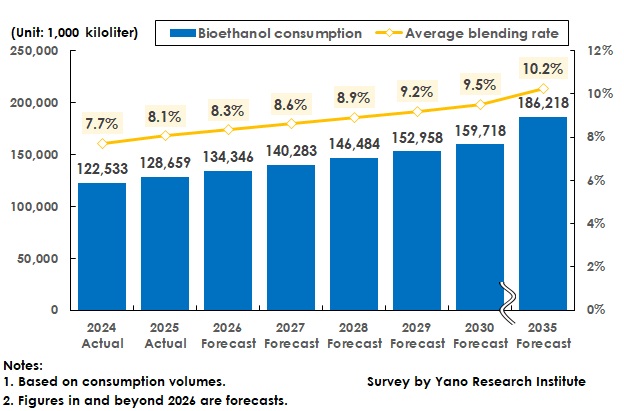
Global automotive bioethanol consumption is expected to reach 159.718 million kiloliters by 2030 and 186.218 million kiloliters by 2035. These figures represent increases of 24.1% and 44.7%, respectively, from 2025. However, the compound annual growth rate (CAGR) is expected to decline from 4.4% between 2025 and 2030 to 3.1% between 2030 and 2035. This decline is due to major countries reaching their target blending rates and the widespread use of BEVs bringing down petrol demand.
Future demand growth will depend on each country's policies, such as mandatory blending rate increases, low-carbon fuel regulations, and tax and subsidy programs. Due to the prevalence of E15 (a blend containing 15% ethanol), an increase in automotive bioethanol consumption is anticipated in the United States, the largest market. The country's consumption of 54.294 million kiloliters in 2025 will likely climb to 63.160 million kiloliters by 2035, marking a 16.3% increase. However, a decline in petroleum due to improved fuel efficiency in gasoline-powered vehicles and the popularity of BEVs will likely lead to moderate growth. Brazil is also expected to experience a 28.9% increase in automotive bioethanol consumption, climbing from 34.449 million kiloliters in 2025 to 44.405 million kiloliters by 2035 due to the mandatory increase in the blending rate to 30% and the growing availability of FFVs.
India is predicted to be the largest growth market, with automotive bioethanol consumption rising from 10.224 million kiloliters in 2025 to 27.898 million kiloliters by 2035, which is approximately 2.7 times larger. This growth is driven by the nationwide proliferation of E20 (a blend containing 20% ethanol), growing demand for petroleum in association with an increasing number of vehicles, and the deployment of high-density fuels and FFVs. Japan is expected to see a 4.4-fold increase in automotive bioethanol consumption, climbing from 837,000 kiloliters to 3.691 million kiloliters, due to its adoption of low-carbon petroleum and E20-compatible vehicles. Meanwhile, Vietnam and Indonesia have the potential to become new growth markets. In contrast, the EU, the UK, and China are expected to remain low-growth markets due to raw material regulations and BEV population growth. While the US and Brazil currently dominate the global automotive bioethanol market, other countries are expected to increase their presence as they grow their market shares. The total market share of these two countries is expected to decline from 69.0% in 2025 to 57.7% by 2035.
Research Outline
2.Research Object: Automotive-related companies and fuel companies
3.Research Methogology: Face-to-face interviews (including online interviews) by expert researchers, survey via telephone, and literature research
What is the Carbon Neutral Automotive Fuels Market?
Yano Research Institute conducted a study of businesses in the automotive and fuel industries that are striving to innovate in response to mandatory reductions in their carbon footprints.
In the context of the decelerated shift to battery electric vehicles (BEVs), switching to carbon-neutral fuel is another option for decarbonization. Synthetic fuels are regarded as promising in the long term. In the short term, however, biofuels are a more realistic choice. This research refers to carbon-neutral automotive fuels, including bioethanol, biodiesel, hydrogen, and synthetic fuels (e-fuels).
Bioethanol Consumption Forecast
This research refers to bioethanol consumption as the amount of bioethanol used as an automotive fuel. The average blending rate is calculated using petrol consumption among vehicles containing bioethanol as the denominator and bioethanol consumption among those vehicles as the numerator.
<Products and Services in the Market>
Carbon neutral automotive fuels: bioethanol, biodiesel, synthetic fuels, and hydrogen
Published Report
Contact Us
The copyright and all other rights pertaining to this report belong to Yano Research Institute.
Please contact our PR team when quoting the report contents for the purpose other than media coverage.
Depending on the purpose of using our report, we may ask you to present your sentences for confirmation beforehand.