No.4145
Digital Marketing Market in Japan: Key Research Findings 2026
Digital Marketing Market Show Robust Growth: Projected to Reach 478,900 Million Yen in 2026
Yano Research Institute (the President, Takashi Mizukoshi) has conducted a survey on the domestic digital marketing market, and found out the market overview, the trends of market players, and future perspective. This press release reveals the transition and forecasts of the size of CRM, MA, and CDP markets.
Market Overview
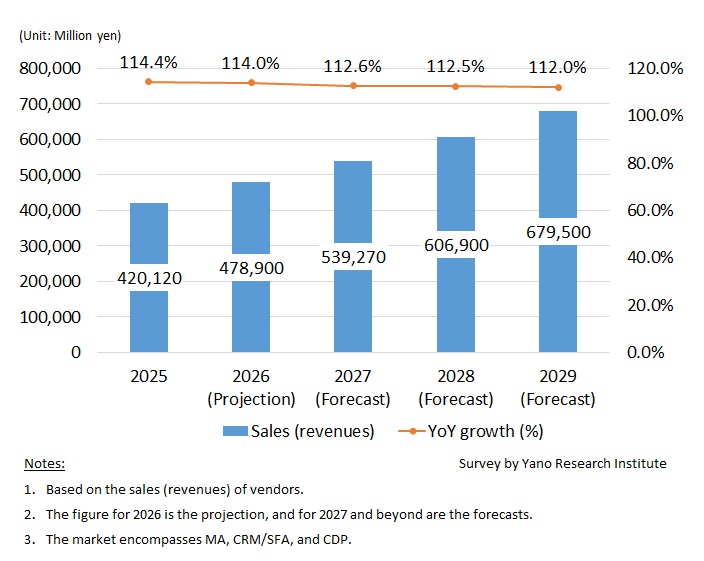
The market size of domestic digital marketing tools for 2025 is estimated at 420,120 million yen, based on the revenues of vendors. It is projected to reach 478,900 million yen in 2026, representing 14.0% growth from the preceding year.
Database readiness is currently a primary driver of market growth, fueled by enterprises seeking to leverage AI. As organizations recognize that the quality and scale of their data repositories directly dictate AI performance, the enrichment and maintenance of data have become critical priorities. High-quality customer data is the essential fuel that transforms AI into a competitive advantage. Consequently, enterprises are increasingly investing in digital marketing tools as foundational platforms to aggregate, organize, and activate customer insights, enabling them to deliver hyper-personalized sales initiatives and marketing campaigns.
This shift is accelerating market growth by addressing two key areas: attracting new buyers and overcoming historically low utilization rates among existing customers. While many organizations previously struggled to leverage their marketing technology to its full potential, database enrichment for AI deployment is now recognized as a strategic priority at management levels. Supported by advanced software features like AI-driven FAQs and intuitive user onboarding support, enterprises now have the necessary tailwinds to fully adopt and maximize these digital tools.
Noteworthy Topics
AI Agents Transforming Business of Digital Marketing Tools
Toward the end of 2024, digital marketing industry in Japan began questioning the sustainability of the SaaS business model*1. Driven by rapid advancements in generative AI and the rising penetration of AI agents, the conventional “per-seat (license) / month” is facing obsolescence as autonomous agents increasingly replace human tasks. In response, some vendors have already shifted toward usage-based pricing (calculated by data volume or API executions) or performance-based models tied directly to conversions.
Meanwhile, ensuring system connectivity and interface compatibility with AI agents has also emerged as a critical challenge. Because AI agents operate directly via API*2 or MCP*3, software tools that lack agent-compatible interfaces risk being excluded from enterprise procurement, regardless of how superior their standalone functionalities may be. Consequently, AI-agent connectivity is poised to overtake traditional UI user-friendliness as the primary evaluation criterion for digital marketing tools.
*1 SaaS (Software as a Service) is a cloud computing model where software is hosted by a third-party provider and accessed over the internet.
*2 API (Application Programming Interface) is a way for different software applications to communicate with each other using requests and responses.
*3 MCP (Model Context Protocol) is an open-source standard that provides a universal way to connect AI models to external tools.
Future Outlook
The digital marketing market is expected to expand, driven by growing demand for AI-ready data foundations among enterprises seeking to leverage AI. The addition of AI capabilities across a wide range of tools, together with the increasing adoption of AI agents, will enable organizations to make their sales and marketing activities more sophisticated and effective. As companies broaden and deepen their use of digital marketing tools, market growth is expected to accelerate.
For AI agents to deliver meaningful results, access to high-quality contextual information—including behavioral, transactional, and engagement data—is essential. As a result, digital marketing tools that accumulate and manage such data are well positioned to serve as critical data sources for AI-driven applications. However, the pace of AI agent adoption varies considerably depending on size and digital maturity of the company. While large enterprises are increasingly moving toward the deployment of autonomous AI agents, many mid-sized businesses and SMEs continue to face challenges related to tool implementation, adoption, and effective utilization. Given the wide variation in customer needs and levels of maturity, vendors must develop products, functionalities, and support services that are tailored to the specific customer segments they target.
Research Outline
2.Research Object: Vendors of digital marketing solutions (MA, CRM/SFA, CDP) and AI-based services in the domain of digital marketing
3.Research Methogology: Face-to-face interviews by our expert researchers (including online interviews), survey via telephone and email, and literature research
What is the Digital Marketing Market?
In this report, digital marketing tools refer to software and applications used by enterprises to execute and manage digital marketing activities. The digital marketing market covered in this report includes marketing automation (MA), customer relationship management (CRM), and customer data platforms (CDP). Market size is measured based on the revenues of vendors providing these solutions. The definitions of each solution category are provided below.
(1) Marketing Automation (MA):
MA software utilizes customer data attributes—such as activity logs, engagement rates, and demographic profiles—to systematically deploy targeted communication. By automating personalized outreach, MA facilitates scalable and highly efficient lead generation.
(2) Customer Relationship Management (CRM):
CRM systems centralize customer data to cultivate stronger engagement and drive long-term brand loyalty. For the purposes of this study, Sales Force Automation (SFA) is integrated as a core capability within the CRM framework.
(3) Customer Data Platform (CDP):
A CDP is a platform used to collect, integrate, and analyze customer data siloed across multiple channels.
<Products and Services in the Market>
MA, CRM (including SFA), CDP
Published Report
Contact Us
The copyright and all other rights pertaining to this report belong to Yano Research Institute.
Please contact our PR team when quoting the report contents for the purpose other than media coverage.
Depending on the purpose of using our report, we may ask you to present your sentences for confirmation beforehand.