No.4129
Logistics Technology Market for Truck Transportation in Japan: Key Research Findings 2026
Based on the Number of Implemented Bases, the Market Size for Berth Booking and Acceptance Systems Reached 6,300, Marking a 52% Year-Over-Year Increase
Yano Research Institute (the President, Takashi Mizukoshi) conducted a survey of the logistics technology market for truck transportation in Japan. The survey revealed the trends by segment, trends among market players, and future market outlook. In here discloses the results of analysis regarding berth booking and acceptance systems.
Summary of Research Findings
Though the logistics industry serves as a public infrastructure, it suffers from chronic driver shortages. Even worse, the industry’s transportation capabilities have decreased due to regulations limiting the overtime cap for drivers since April 2024. Against this backdrop, logistics technologies have been in the spotlight. These technologies use IT to streamline transportation and delivery processes, requiring fewer personnel and less time. In addition to optimizing truck dispatch planning and improving work efficiency through fleet management systems, these technologies digitize paper-based work data. This digitization enables logistics companies to visualize and analyze the entire transportation and delivery process, identifying areas for improvement. However, deployment of these technologies was limited to major companies due to shortages of IT talent and high development and implementation costs. In recent years, the deployment of these technologies among medium-sized companies has begun, as cloud-based, standard software packages have become available at affordable prices.
Additionally, the Revised Logistics Efficiency Act (officially, an Act to Partially Amending the Act on the Advancement of Integration and Streaming of Distribution Business and the Motor Truck Transportation Business Act) was enacted in April 2025, requiring shipping and logistics companies to make reasonable efforts to measure, record, and report the hours that truck drivers wait for and handle cargo. Starting in April 2026, the Act fully mandates this obligation for specific businesses, such as shipping companies that handle annual 90,000 tons or more of cargo. The Act accelerates market growth by promoting the adoption of logistics technologies.
Of the various truck-related logistics technologies researched, this article presents the results of an analysis of the market for berth booking and acceptance systems, which manage truck loading and unloading.
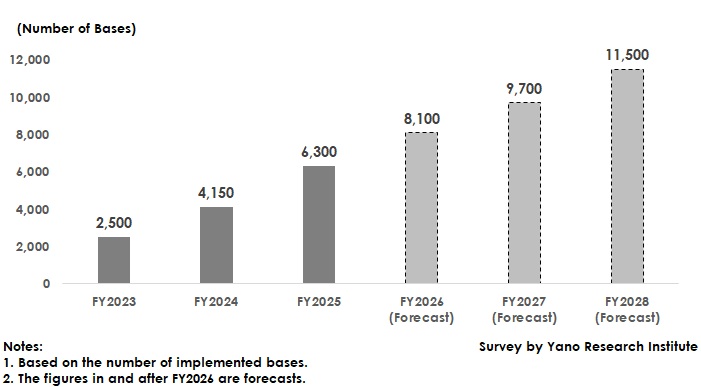
Based on the number of implemented bases, the market size of the berth booking and acceptance systems reached 6,300 in FY2025, marking a 52% year-over-year increase and maintaining a high growth rate. The market is projected to grow further, reaching 11,500 bases by FY2028.
This growth is driven by an increase in new deployments aimed at reducing drivers’ waiting time and alleviating their burdens. Additionally, major companies that have already implemented these systems are expanding them to other internal bases. The enactment of the Revised Logistics Efficiency Act has prompted shipping companies to deploy these systems for the first time, as well as increase the number of bases with implemented systems.
Deployment has mainly progressed among shipping companies that primarily receive cargo but will likely expand to companies that send cargo. This trend is expected to spur major companies with their multiple bases nationwide to implement these systems in their facilities. Implementation is also expected to increase among small- to medium-sized shipping companies as clients request it and the systems become the industry standard.
Noteworthy Topics
The Revised Logistics Efficiency Act and the Logistics Technology Market
The Revised Logistics Efficiency Act addresses the industry’s low transportation capabilities, caused by a recently implemented regulation that capped truck drivers’ overtime. Since April 2025, all shipping and logistics companies have been required to make reasonable efforts to streamline their processes. In April 2026, this reasonable effort requirement was upgraded to a stricter framework requiring businesses of a certain size to submit medium- to long-term plans and report regularly. Specifically, designated shipping companies and chain operators (i.e., shipping companies transacting 90,000 tons or more of cargo annually) must treat logistics as a business challenge and appoint a chief logistics officer (CLO).
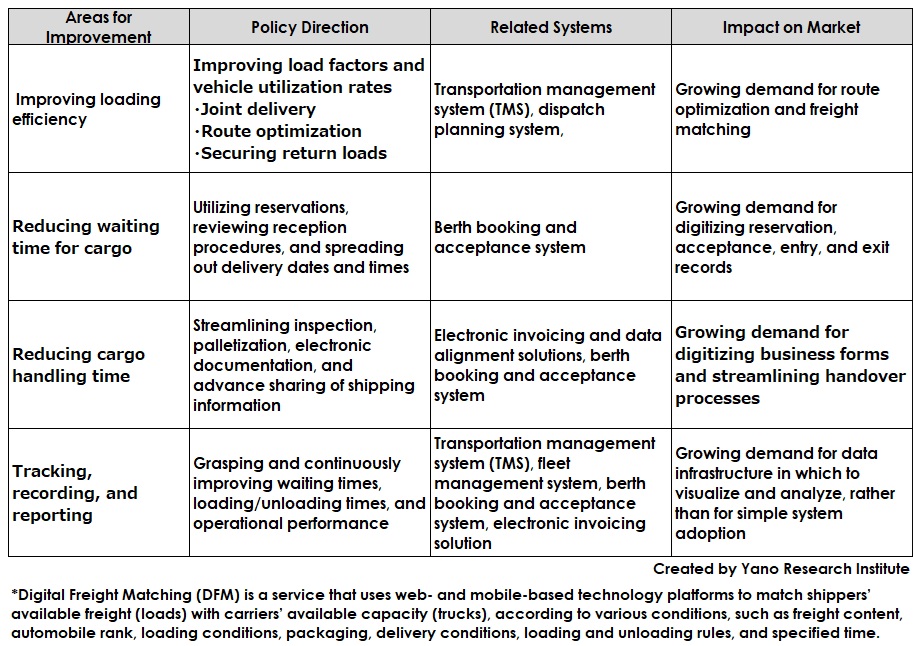
Rather than requiring only logistics companies to solve the logistics bottleneck, this regulation targets the entire supply chain to improve distribution and delivery processes. This includes shippers’ ordering and delivery practices, delivery terms, facility operations, freight handling, and information sharing. Among these work processes, improving load efficiency, reducing the time for drivers to wait until they load or unload cargo, and reducing the time for these drivers to handle cargo, can be achieved by sharing service status through data digitization within each relevant company in the supply chain. Therefore, logistics technology is essential to achieving these improvements. The key is for each logistics business to treat improvements to the entire logistics and distribution process as their own business challenges and address them constantly. These improvements cannot be achieved solely through system implementation at each site and business. In addition to system integration, businesses must determine which aspects of service performance to track in order to improve it and how much data to share with businesses that have different logistics systems for each distribution and delivery process.
Visualizing service performance data for each transportation and delivery process, as well as extended data sharing among businesses, will bring about changes. These changes will improve the quality of the entire logistics industry by making transportation and delivery more efficient, reducing driver wait and cargo handling hours, minimizing waste and mistakes with shared shipment information, and ensuring smooth and stable delivery operations. These changes are expected to further boost the logistics technology market.
Research Outline
2.Research Object: Businesses involving in Japanese logistics, which include transportation companies, shipping owners including manufacturers and wholesalers, and logistics technology companies
3.Research Methogology: Face-to-face interviews by our expert researchers, and literature research
What is the Logistics Technology Market for Truck Transportation?
This research defines the logistics technology market for truck transportation as systems and services that use advanced technologies, such as the cloud, artificial intelligence (AI) technologies, and the Internet of Things (IoT), for planning, implementing, recording, and managing the safe delivery of goods by truck. These systems and services include dispatch planning and fleet management systems and other transportation management systems (TMS), berth booking and acceptance systems, digital freight matching (DFM) services, electronic invoicing and data alignment solutions, safety management systems, and autonomous driving systems.
Of the logistics technology for the truck transportation segment, this article focuses on the analysis results for berth booking and acceptance systems. Berth booking systems allow trucks entering and exiting the distribution center to reserve a berth, which facilitates loading and unloading freight. Acceptance systems process trucks upon their arrival at a distribution center.
<Products and Services in the Market>
Transportation management systems (TMS), including dispatch planning and fleet management systems, berth booking and acceptance systems, digital freight matching (DFM) services, electronic invoicing and data alignment solutions, AI-powered optical character recognition (OCR) systems, safety management systems, and autonomous driving systems.
Published Report
Contact Us
The copyright and all other rights pertaining to this report belong to Yano Research Institute.
Please contact our PR team when quoting the report contents for the purpose other than media coverage.
Depending on the purpose of using our report, we may ask you to present your sentences for confirmation beforehand.