No.4071
Consumer Survey on Food E-commerce Purchases in Japan: Key Research Findings 2025
Mail Order Food Businesses Increase Presence Without Severe Damage from Rising Logistics Costs
Yano Research Institute (the President, Takashi Mizukoshi) conducted a consumer survey on the domestic food-ecommerce purchases. The survey revealed changes in the spending trend by service. In here shows some of analytic results.
Summary of Research Findings
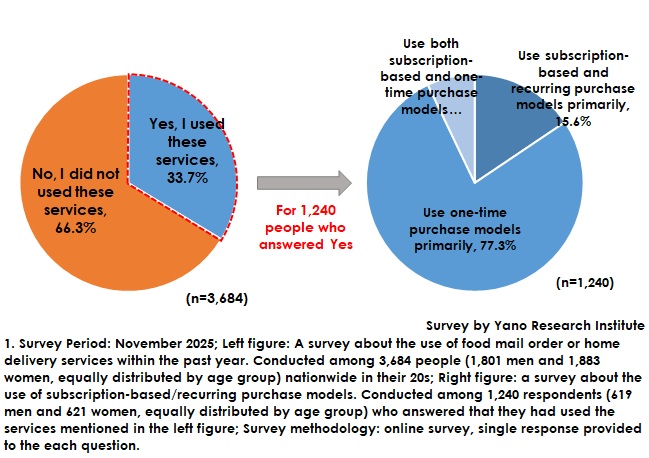
In the context of the recent diversification of food purchasing channels and the widespread adoption of e-commerce, we surveyed 3,684 people nationwide in their 20s and older in November 2025, regarding food e-commerce purchases. The participants, 1,801 men and 1,883 women, were distributed equally by age group. They were asked whether they had purchased food by mail order (including online and catalog-based orders) or used food home delivery services within the past year. Of those surveyed, 33.7% answered yes, while 66.3% answered no.
Of the 1,240 participants who answered yes (619 men and 621 women, distributed equally by age group), we asked about their use of subscription-based and one-time purchase models. 77.3% responded that they primarily use “one-time, as-needed services.” 15.6% answered that they primarily use subscription-based/recurring purchase models. Only 7.1% said that they use both subscription-based and one-time services.
Noteworthy Topics
Main Reasons for Using Mail Order Food/Food Home Delivery Services
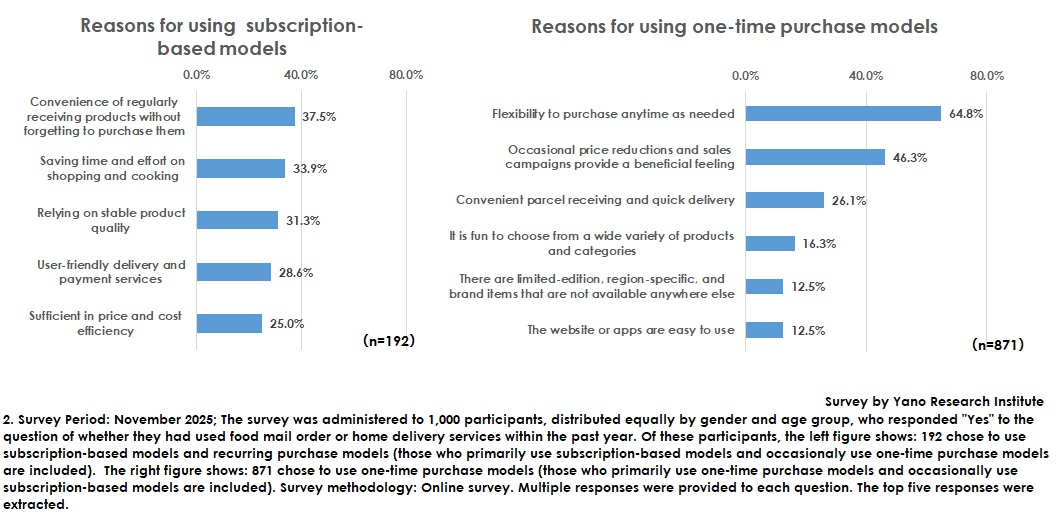
We conducted a main survey of 1,000 participants, equally distributed by gender and age group, who answered that they had purchased food by mail order (including online and catalog-based orders) or used food home delivery services within the past year. We categorized these services as subscription-based models or one-time purchase models. Respondents who primarily opted for subscription-based models referred to those who primarily used subscription-based models (including recurring purchase models) and occasionally used one-time purchase models. Those who primarily opted for one-time purchase models referred to individuals who primarily used one-time purchase models and occasionally used subscription-based models. The survey asked them about their respective reasons for choosing these models.
Of the respondents, 192 chose to use subscription-based or recurring purchase models. The top three reasons were "the convenience of regularly receiving products without forgetting to purchase them" (37.5%), "saving time and effort on shopping and cooking" (33.9%), and "relying on stable product quality" (31.3%).
In general, these models are appreciated for their prices and cost efficiency. However, the survey results revealed that users primarily value these models for reducing daily labor and ensuring a stable product supply. Users chose these models over the joy of selecting products as needed.
Meanwhile, 871 respondents opted for one-time purchase models. The main reason was “the flexibility to purchase anytime as needed” which stood out to account for 64.8% of responses. This was followed by “occasional price reductions and sales campaigns provide a beneficial feeling” (46.3%).
The survey results revealed that one-time purchase users value these models for their availability as needed. Additionally, the perceived price benefits prompted people to use these models. Unlike methodical recurring purchase models, one-time purchase models offer users flexibility. Users appreciate these models for their abilities to meet on-demand needs, facilitate package receiving, and ensure quick delivery.
Research Outline
2.Research Object: Men and women in their 20s and older nationwide (3,684 participants in the preliminary survey and 1,000 participants in the main survey. Participants were distributed equally according to gender and age group.)
3.Research Methogology: Online consumer survey
What is the Consumer Survey on Food E-Commerce Purchases?
In the context of diversifying food purchasing channels and the prevalence of e-commerce, Yano Research Institute conducted a survey of people in their 20s and older nationwide in November 2025 regarding food e-commerce purchases. A total of 3,684 people participated in the preliminary survey and 1,000 participated in the main survey. Participants were distributed equally by gender and age group. The survey revealed changes in spending trends by service. This paper discloses some of the analysis results.
The survey categorized the food e-commerce services as follows:
- Subscription-based and recurring-purchase models: Services that deliver food regularly. Service usage and payments are automatically renewed.
- One-time purchase models: Services that offer products as needed.
<Products and Services in the Market>
Subscription-based and recurring-purchase models: Co-ops (Pal System), Oisix, Radish Boya, Daichi wo Mamorukai, Bio Marche Delivery, Tabechoku Subscription, YOSHIKEI Subscription, Rakuten Subscription, and Amazon Subscription. One-time purchases: Amazon/Amazon Fresh, Rakuten, Yodobashi.com, auPay Market, Yahoo! Shopping, LOHACO, BicCamera.com, and food companies’ in-house shopping sites. Major retailers's online grocery stores are also included, such as AEON, Ito Yokado, Life, Yaoko Marketplace, Tokyu Store, Rakuten Mart (formerly Rakuten Seiyu Netsuper), and Seiyu.
Published Report
Contact Us
The copyright and all other rights pertaining to this report belong to Yano Research Institute.
Please contact our PR team when quoting the report contents for the purpose other than media coverage.
Depending on the purpose of using our report, we may ask you to present your sentences for confirmation beforehand.