No.3963
Hydrogen Energy-Powered Systems and Equipment Market in Japan: Key Research Findings 2025
The Hydrogen Application Market in Japan is Forecast to Reach 1.687 Trillion Yen by FY2050
Yano Research Institute (the President, Takashi Mizukoshi) conducted a survey of hydrogen energy applications in Japan. The survey revealed the market trends, activities by leading market players, and market outlook. This paper focuses on domestic hydrogen-energy powered equipment and systems.
Market Overview
In Japan, hydrogen energy has been used as a power source for systems such as home fuel cell cogeneration systems, also known as “Ene-Farm”, as well as for fuel cell vehicles (FCVs).
Since the government announced its goal of achieving “carbon neutrality" by 2050 in October 2020, hydrogen has garnered attention as a CO2-free fuel and its applications have broadened. Product developments are underway, which include fuel cell-powered machinery for business or industrial use. Technical developments for hydrogen combustion are also progressing in burners and other combustion equipment. Furthermore, the use of hydrogen energy is expanding in the steel industry and the mobility sector, including in commercial vehicles.
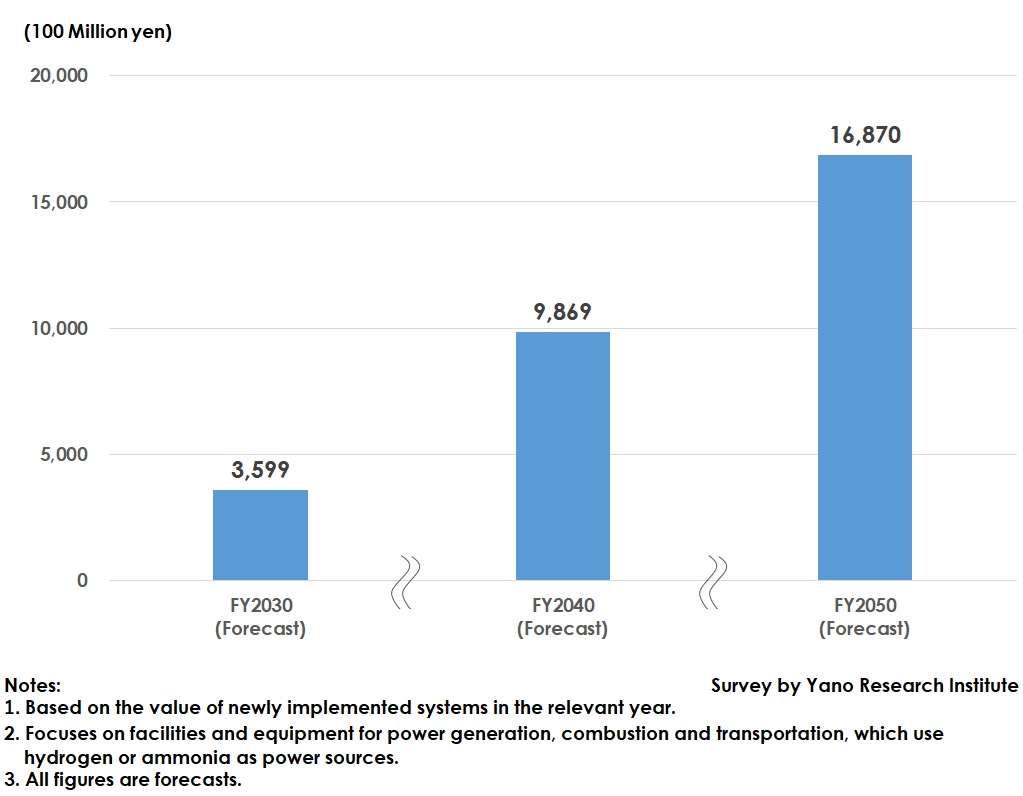
Based on the value of newly implemented systems in the relevant year, the market size of hydrogen-powered energy systems and equipment in Japan is expected to reach 359.9 billion yen by FY2030.
Noteworthy Topics
Hydrogen and Ammonia Power Generation
Hydrogen or ammonia power generation uses turbines that are rotated by steam or gas produced by combustion. Therefore, there are two types: steam power generation, which uses boilers, and gas turbine power generation. Power generation can also be classified by fuel combination. The two main categories are co-firing, which involves the combustion of fossil and non-fossil fuels, and the exclusive hydrogen or ammonia firing. Major electric power companies are planning and implementing demonstrations of fuel-combined and specific-fuel combustions at existing thermal power generation facilities.
Power generation using hydrogen or ammonia is expected to grow, as a major demand sector for these fuels. Ammonia power generation is likely to be implemented more quickly, starting with co-firing at launch. This is because ammonia already has a supply system established, unlike hydrogen. There are also ongoing demonstrations of ammonia co-firing power generation at a power generation facility remodeled from a coal-based thermal power plant.
Future Outlook
In the medium to long term, demand for hydrogen energy in Japan is expected to be driven by power generation from hydrogen and ammonia. Increased demand from the power generation sector will encourage the development of related infrastructure in stages. This infrastructure includes receiving and storage facilities in the districts surrounding hydrogen and ammonia power generation facilities. Accumulating diverse industrial demands centered on these facilities will ensure stable consumption volumes and reduce hydrogen energy procurement costs.
Given the potential for procuring greater volumes of hydrogen and lower hydrogen procurement costs in the 2030s than in the 2020s, the market size for hydrogen energy-powered systems and equipment is projected to grow in the medium to long term. It is forecast to reach 986.9 billion yen by FY2040 and 1.687 trillion yen by FY2050.
Research Outline
2.Research Object: Energy suppliers (including electric power companies, gas companies, and district heating providers), heavy machinery manufacturers, industrial gas companies, trading companies, plant engineering companies, construction companies, heavy electrical equipment manufacturers, industrial equipment manufacturers, machinery manufacturers, fuel cell manufacturers, etc.
3.Research Methogology: Face-to-face and online interviews by expert researchers, surveys via telephone and email, and literature research
What are Hydrogen Energy-Powered Systems and Equipment?
This research focuses on hydrogen energy-powered systems and equipment, which use hydrogen or ammonia as power sources. Examples include power generation facilities and machinery, combustion facilities and machinery, and transportation facilities and machinery.
Equipment and machinery that use hydrogen energy as the power source include:
Fuel cells for household, business, or industrial use, fuel cell vehicles (FCVs), fuel cell trucks, fuel cell buses, fuel cell hybrid railway vehicles, fuel cell ships, fuel cell forklifts, fuel cell cranes, equipment for hydrogen combustion and co-firing power generation, equipment specifically for ammonia combustion and co-firing power generation, hydrogen boilers, other hydrogen combustion equipment (including burners and water heaters), and ammonia fuel ships.
<Products and Services in the Market>
Hydrogen energy-powered equipment and systems (including power generation facilities and machinery, combustion facilities and machinery, and transportation facilities and machinery)
Published Report
Contact Us
The copyright and all other rights pertaining to this report belong to Yano Research Institute.
Please contact our PR team when quoting the report contents for the purpose other than media coverage.
Depending on the purpose of using our report, we may ask you to present your sentences for confirmation beforehand.