No.3977
Food Delivery Service Market in Japan: Key Research Findings 2025
Food Delivery Service Market Continues to Grow in FY2024 as Services Become Part of Consumers’ Daily Lives
Yano Research Institute (the President, Takashi Mizukoshi) has carried out a survey on the domestic food delivery service market and has found out the trends of eight categories by business form, the trend of market players, and future perspectives.
Market Overview
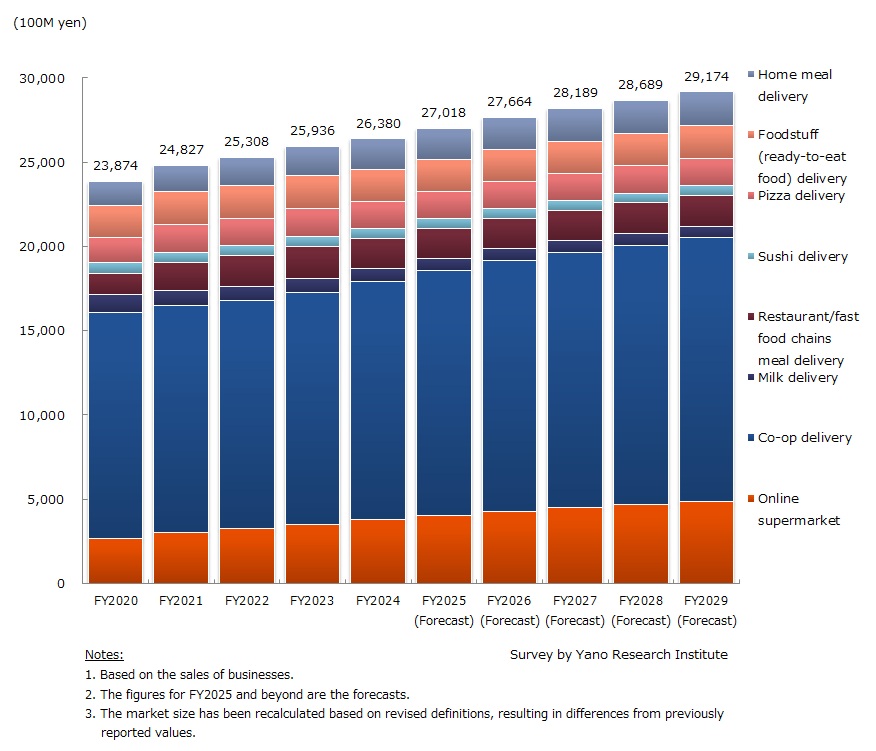
The food delivery service market (total values for 8 major categories) in FY2024 is estimated at 2,638 billion yen, up by 1.7% from the previous fiscal year. Although the growth rate after FY2020 has returned to pre-corona level, and despite the decline in food-related markets in general due to aging society with fewer children, the food delivery service market has remained stable.
Societal demands stemming from women’s empowerment, aging population, and falling birth rate, the food delivery services have become integral part of Japanese society. Following the upsurge in demand during FY2020 caused a concern for demand pullback in FY2021 and beyond, but the demand hovered at high level for many of the eight categories. Although notable recovery in dining industry in FY2024 has impacted some fields, retailers such as co-op home deliveries and online supermarkets have rooted in everyday life of consumers.
Noteworthy Topics
The Meal Kit Market
Meal kits—packages of pre-portioned ingredients for a specified number of servings—are recording strong sales. The mainstream offerings consist of pre-cut meat and vegetables accompanied by seasonings, catering to modern consumers who have limited time for shopping, preparation, and cooking, yet still seek meals that deliver a homemade feel.
Conventionally, meal kits have been categorized as one of foodstuff (ready-to-eat food) delivery services, but co-ops and online supermarkets have also started offering such products, with improved quality in wider variations including frozen meal kits. The main users are double-income households or households with children. However, growing popularity among aged households and single households has prompted vendors in making efforts to enhance products to meet the diversifying user needs.
While pursuing time-saving benefits, companies are embarking on meeting varying consumer needs through the development of frozen meal kits for further convenience and whole-food meal kits contributing to reducing food loss by utilizing what were previously discarded. Additionally, sales have been driven by meal kits produced by famous chefs and culinary professionals. Despite a slowdown stemming from the end of pandemic that propelled consumers to dine out more often, the meal kit (for delivery) market for FY2024 grew to 190 billion yen, based on the sales of businesses.
Future Outlook
Food delivery service market (total eight major categories) is forecasted to expand stably to reach 2,917.4 billion yen by FY2029, which represents 110.6% of FY2024 market size (based on the sales of businesses).
Against the backdrop of an aging population, a declining birthrate, women’s empowerment, and increasingly diverse lifestyles, demand for home delivery of food and meals has grown steadily. The industry has maintained its growth momentum, driven in large by the surge in demand during the COVID-19 pandemic, and food delivery has become firmly embedded in consumers’ daily lives.
The food delivery sector faces a range of structural challenges, including customer acquisition and retention, labor shortages in production and logistics, and the need to streamline operations. Addressing these issues will require long-term efforts. While advancing digitalization to improve operational efficiency, industry players must also strengthen in-person communication with customers to enhance the overall customer experience, for example, by offering value-added services such as customer safety monitoring and personalized products recommendations.
Research Outline
2.Research Object: Food/meal delivery service providers, fast food/restaurant chains, dairy products manufacturers, Co-ops, retailers, department stores, and other related companies and organizations
3.Research Methogology: Face-to-face interviews (including online) by specialized researchers, surveys via telephone/email, and questionnaire survey
The Food Delivery Service Market
The food delivery service market in this research refers to the market for the following eight categories:
1) Home meal delivery service, 2) Foodstuff (ready-to-eat food) delivery service, 3) Pizza delivery service, 4) Sushi delivery service, 5) Restaurant/fast food chains meal delivery, 6) Milk delivery service, 7) Co-op delivery service, and 8) Online supermarket. Note that the above categories indicate delivery of food, excluding daily necessities and sundries.
The market size has been recalculated based on revised definitions, resulting in differences from previously reported values.
<Products and Services in the Market>
Home meal delivery services, foodstuff (ready-to-eat food) delivery services, pizza delivery services, sushi delivery services, restaurant/fast food chains meal delivery, milk delivery services, Co-op delivery services, and online supermarkets
Published Report
Contact Us
The copyright and all other rights pertaining to this report belong to Yano Research Institute.
Please contact our PR team when quoting the report contents for the purpose other than media coverage.
Depending on the purpose of using our report, we may ask you to present your sentences for confirmation beforehand.