No.4231
Quantum Computer Market in Japan: Key Research Findings 2026
The Quantum Computer Market in Japan Is Likely to Reach 17 Billion Yen in 2026, and 309.8 Billion Yen in 2035
Yano Research Institute (the President, Takashi Mizukoshi) conducted a survey on the domestic quantum computer market. The survey revealed technological trends and the potential impact on various industries through 2035.
Market Overview
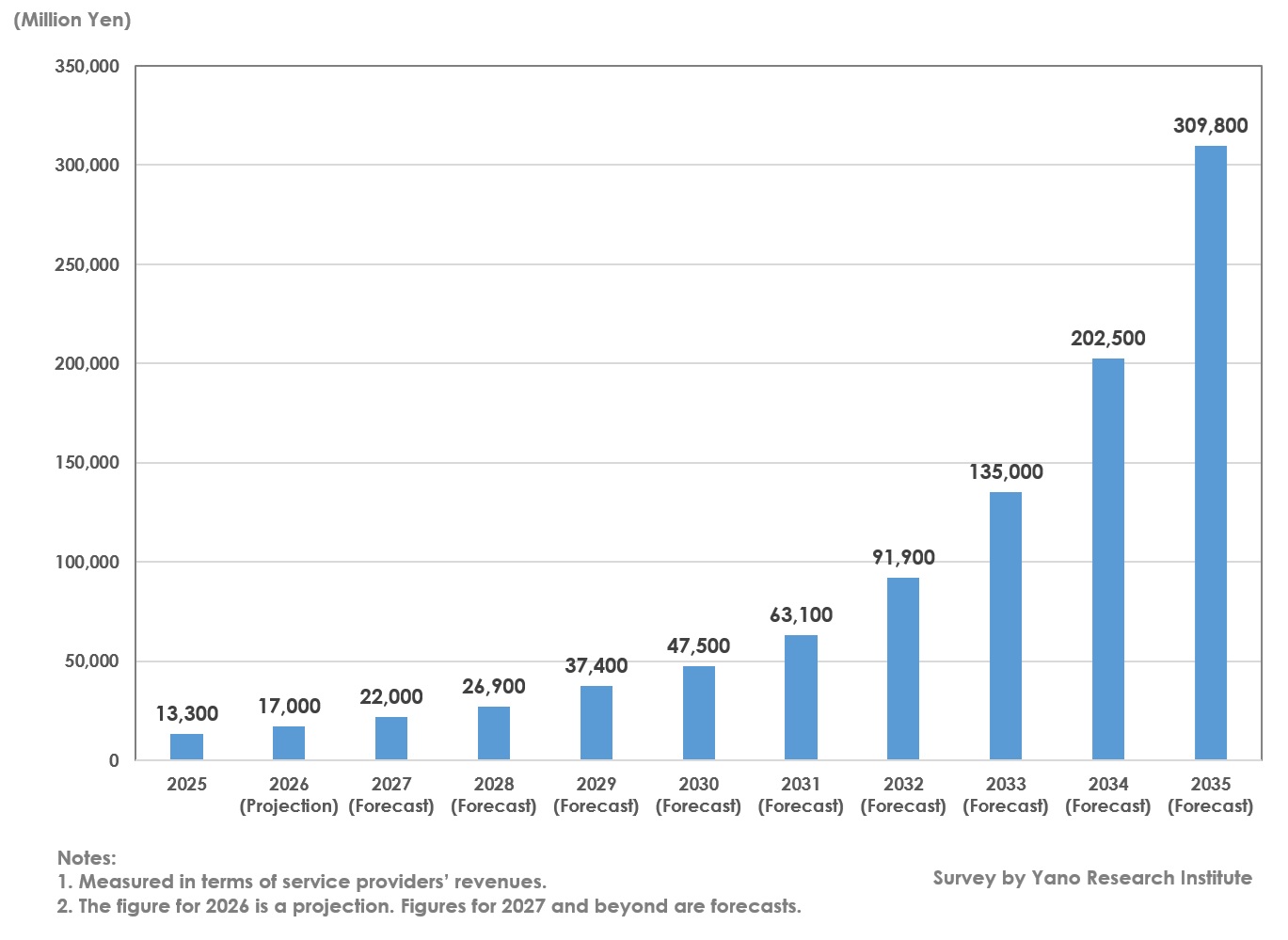
The quantum computing market in Japan is expected to reach 17 billion yen in 2026, measured in terms of service providers’ revenues. As in 2025, initiatives involving Ising machines continue to advance, particularly in the pharmaceutical, chemical, advertising, and transportation industries. Applications of gate-based quantum computing are also expanding beyond quantum chemistry—including configuration interaction (CI) calculations and new materials discovery—to areas such as quantum CAE and quantum finance.
From the perspective of user companies, a notable development is the emergence of a second wave of companies—the early adopters—in 2025–2026, following the innovators that began to emerge around 2020, along with the spread of quantum computing adoption across a broader range of industries.
Noteworthy Topics
Quantum Computing Adoption Expands to Early Adopters in 2025–2026, Following the Innovators
For gate-based quantum computing, vendors are seeing increased inquiries in 2025–2026, particularly in the emerging area of quantum CAE, alongside ongoing efforts in areas such as quantum chemistry pursued with a fault-tolerant quantum computer (FTQC)*1 in mind.
The first wave of quantum computer adopters (innovators) emerged around 2020, followed by a second wave (early adopters) in 2025–2026, with adoption spreading across a wider range of industries. Specifically, pilot projects are beginning to emerge in sectors such as energy and automotive. In the energy sector, initiatives have begun to explore the use of quantum computers in manufacturing highly efficient solar panels and in simulations for developing batteries for solar power generation systems. In the automotive sector, various initiatives are also emerging, including the simultaneous design of vehicle body structures for multiple models, the design of high-frequency circuits for integration into automotive components, and the use of quantum CAE in design.
Turning to Ising machines, efforts to apply them to combinatorial optimization problems across a variety of business contexts are gaining momentum. Despite numerous challenges, including data input/output issues, initiatives toward hybrid computing that combines Ising machines with gate-based quantum computers or high-performance computers (HPCs) are also expected to accelerate in the future.
*1) FTQC stands for Fault-Tolerant Quantum Computer, a general-purpose quantum computer with built-in error correction capabilities.
Future Outlook
The quantum computer market in Japan, based on service providers’ revenues, is projected to reach 22.0 billion yen in 2027, 47.5 billion yen in 2030, and 309.8 billion yen in 2035.
From 2027 to 2028, the range of industries exploring quantum computer applications is expected to expand rapidly, with various pilot projects expected to emerge. These include simulations of batteries for solar power generation systems and supply-demand balancing for virtual power plants (VPPs) in the energy sector, as well as anomaly detection and disease prediction for agricultural products in the agricultural sector.
For gate-based quantum computers in particular, efforts to develop new algorithms, including quantum algorithms for asset management, and improve existing algorithms are expected to intensify. While access to quantum computers via the cloud is common, the adoption of physical quantum computers for on-premises use is expected to become more widespread, primarily among national research institutions and university research institutions. Against this backdrop, the market is projected to reach 22.0 billion yen in 2027, equivalent to 129.4% of the previous year’s market size, and 26.9 billion yen in 2028, equivalent to 122.3% of the previous year’s market size.
From 2029 onward, gate-based quantum computers are expected to enter a transition period (2029 to around 2033), shifting from NISQ*2 to Early-FTQC*3. As this transition progresses, the results of experiments conducted using simulators and other tools in 2025 and 2026 are expected to underpin a small number of pilot projects. These include applications to multiple quantum CAE simulation methods using actual quantum computers, reaction simulations in pharmaceutical manufacturing, and, in drug discovery, pilot projects aimed at preventive and preemptive medicine that are expected to have a significant impact in the future.
As the shift from NISQ to Early-FTQC begins, pilot projects aimed at developing algorithms for Early-FTQC are expected to get underway in line with advances in hardware.
For gate-based quantum computers, pilot projects using Early-FTQC are expected to get underway in earnest in 2035. Initiatives with a significant societal impact are expected to emerge gradually, including preventive and preemptive medicine, as well as the exploration of new functional materials in quantum chemistry. The use of Ising machines is also expected to continue to expand.
On the technological front, advances in error-correction technology for FTQC are anticipated, along with significant progress in addressing data input/output issues between quantum computers and HPC systems to enable hybrid computing. Against this backdrop, the market size is projected to reach 309.8 billion yen in 2035.
*2) NISQ stands for Noisy Intermediate-Scale Quantum. It refers to gate-based quantum computers whose qubits are subject to noise and that cannot fully correct that noise.
*3) Early-FTQC stands for Early-Fault-Tolerant Quantum Computer. It refers to early-stage fault-tolerant quantum computers that implement partial error correction.
Research Outline
2.Research Object: Companies involved in quantum computing/computers in Japan and abroad
3.Research Methogology: Face-to-face and online interviews conducted by our expert researchers, surveys via telephone and email, and literature research
What is the Domestic Quantum Computer Market?
For the purposes of this study, quantum computers are defined as computing devices that manage quantum states and manipulate them according to specific rules to perform calculations using properties such as wave-particle duality, superposition, and quantum entanglement. The scope of the study includes both gate-based quantum computers and Ising machines specialized in combinatorial optimization problems, such as determining the optimal combination of airplanes, trucks, trains, and other modes of transportation to optimize transport routes.
By leveraging these properties, quantum computers can rapidly produce solutions to complex calculations, including those involving the processing of vast amounts of data that even conventional supercomputers cannot fully handle. Potential applications are therefore being explored across a wide range of fields, including pharmaceuticals, chemicals, finance, and academic research, for purposes such as discovering new drugs and treatments, developing novel materials, and managing assets more efficiently.
The market size is calculated based on service providers’ revenues and includes not only the hardware described above but also middleware and applications running on that hardware, as well as various services associated with its implementation, such as consulting and maintenance.
<Products and Services in the Market>
Hardware (gate-based quantum computer, Ising machines), middleware and applications, consulting services for implementation of quantum computing, and maintenance services
Published Report
Contact Us
The copyright and all other rights pertaining to this report belong to Yano Research Institute.
Please contact our PR team when quoting the report contents for the purpose other than media coverage.
Depending on the purpose of using our report, we may ask you to present your sentences for confirmation beforehand.