No.4192
The ERP Software Licensing Market in Japan: Key Research Findings 2026
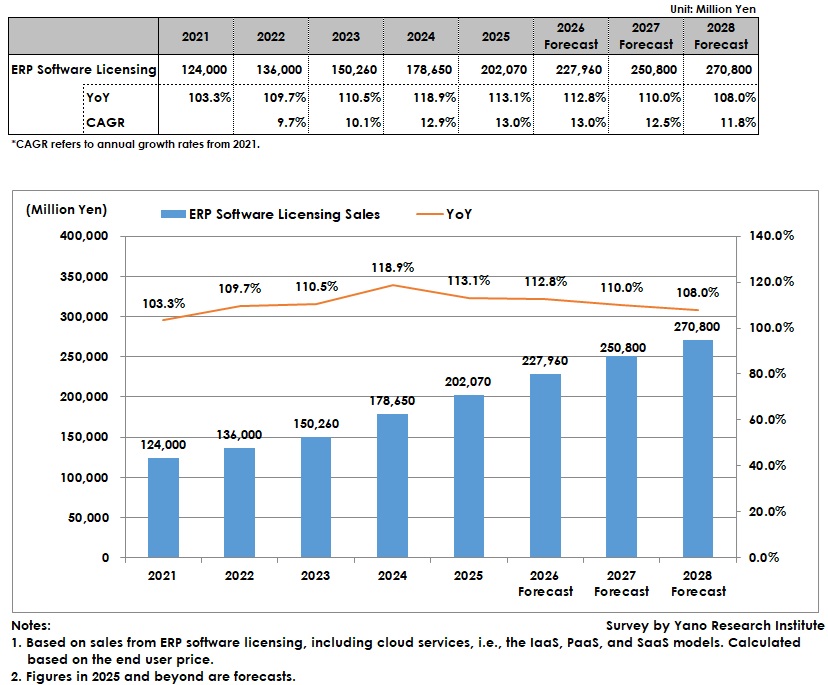
The ERP Software Licensing Market Reached 202.07 Billion Yen in 2025, Marking a 13.1% YoY Increase
Yano Research Institute (the President, Takashi Mizukoshi) surveyed the enterprise resource planning (ERP) software licensing market in Japan. The survey revealed trends among market participants and user companies, as well as market outlooks.
Market Overview
Compared to 2024, the year-over-year growth of the enterprise resource planning (ERP) software licensing market stabilized in 2025. This occurred due to subdued generative AI adoptions, as more companies decided to wait and see how AI agent products and billing models trend, and prioritized addressing the end of Windows 10 support. Nevertheless, the market grew by over 10% from the previous year, continuing the growth trend. The market was boosted by companies’ willingness to invest in IT to replace and renovate existing, obsolete systems with state-of-the-art technology, design, and structure at a timing when maintenance contracts expire. Consequently, the ERP software licensing market reached an estimated 202.07 billion yen in 2025, marking a 13.1% increase from the previous year.
Many user companies have started implementing software as a service (SaaS), in preparation for future AI integration. This reflects the growing prevalence of the fit-to-standard concept, in which companies adapt their business processes to align with system standards rather than heavily customizing the systems according to their unique work processes. Additionally, clean core adoption appears to be growing, ensuring that user companies’ ERP systems remain streamlined and efficient through fit-to-standard customization. In this context, the expansion of SaaS usage is anticipated.
Noteworthy Topics
Toward Autonomous Business Operations
The integration of ERP and AI agents is expected to advance to a practical stage. This development could enable key business systems to act as a “brain,” or a system of intelligence, which autonomously determines the direction and activities of the company based on accurate work data and a system of record (SOR). As ERP systems evolve, they will forecast the future, provide optimal suggestions based on accumulated information, and support management’s decision-making process. Therefore, vendors should provide products that can be implemented once processes have been standardized based on track records and tacit knowledge. This will allow AI agents to safely complete tasks. Additionally, products should allow humans to verify that AI has completed tasks according to the rules, thereby enabling humans to take responsibility.
However, not all products currently have AI agent features, and the maturity levels of AI agents vary by product. If multiple AI agents align in the future, allowing vendors to provide autonomous task implementation, or even fully autonomous products, vendor requirements will change from supporting system development to redesigning work processes themselves and assisting with decisions regarding which tasks to delegate to AI.
Future Outlook
Based on end-user prices, the ERP software licensing market is expected to reach 227.96 billion yen in 2026. This represents a compound annual growth rate (CAGR) of 13.0% from 2021 to 2026. The market is expected to continue thriving as companies innovate and migrate their systems. Market growth appears to be boosted by companies’ intentions to upgrade or migrate ERP platforms to utilize AI agents, in addition to companies' growing sales by acquiring new corporate partnerships and expanding the support area of existing partners.
In the short term, an increase in the number of industry-specific AI agents and AI assistants is anticipated. The key to utilizing AI lies in leveraging the business background and context accumulated in the ERP system. Therefore, AI that comprehends data and work processes will have a competitive edge.
Research Outline
2.Research Object: ERP and software as a service (SaaS) vendors
3.Research Methogology: Face-to-face and online interviews by specialized researchers and literature research
The Enterprise Resource Planning (ERP) Package Software Licensing Market
Enterprise resource planning (ERP) software is a type of packaged software used to build information systems that integrate key business processes, including financial accounting, HR & payroll, sales administration, and production management.
For this research, the ERP software licensing market size refers to sales from software licensing at ERP vendors and is calculated based on the end user price. Market size includes sales from cloud services, including the IaaS, PaaS, and SaaS models. Unlike traditional software packages, which exclude peripheral sales such as consulting, system integration, and maintenance service fees, cloud licensing sales include maintenance services.
<Products and Services in the Market>
ERP package software and SaaS
Published Report
Contact Us
The copyright and all other rights pertaining to this report belong to Yano Research Institute.
Please contact our PR team when quoting the report contents for the purpose other than media coverage.
Depending on the purpose of using our report, we may ask you to present your sentences for confirmation beforehand.