No.4176
Consumer Survey on Household Management & Daily Living Support Services in Japan: Key Research Findings 2026
Growing Adoption of Household Management & Daily Living Support Services
Yano Research Institute (the President, Takashi Mizukoshi) has conducted a consumer survey on household management and daily living support services in Japan. Target audience of the survey include both users and prospective users. The results are compared to the result of 2024 survey. This press release shares some of the findings.
Summary of Research Findings
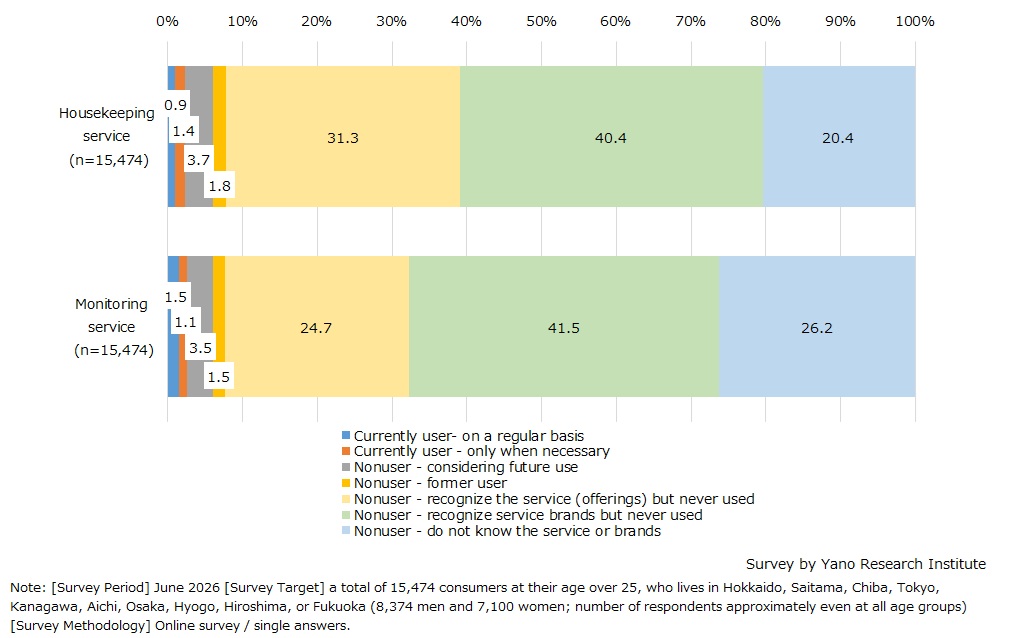
In June 2026, an online survey was carried out to a total of 15,474 general consumers at their age over 25, who lives in Hokkaido, Saitama, Chiba, Tokyo, Kanagawa, Aichi, Osaka, Hyogo, Hiroshima, or Fukuoka (8,374 men and 7,100 women; number of respondents approximately even at all age groups). This section highlights the trends on the adoption of housekeeping services and senior/child safety monitoring services.
The penetration rate* of housekeeping service was 2.3% (2024 survey: 1.9%). Although housekeeping services have traditionally centered on routine household chores such as laundry and cleaning, recent years have seen growing consumer interest in services that improve quality of life, such as meal preparation and home organization.
Adoption of safety monitoring services continued to grow, with the penetration rate rising from 2.1% in the previous survey to 2.6% in 2024. Service subscriptions are generally initiated by family members who wish to ensure the safety of senior relatives or children through remote monitoring. Survey results suggest that contractors of these services place a high value on the benefits they provide.
* The penetration rate combines respondents who are current users, either using the service on a regular basis or only when necessary.
Noteworthy Topics
Following the previous survey, we analyzed the relationship between the change in workstyle (pre- and post-COVID-19 pandemic up to date) *1 and the penetration of household management and daily living support services.*2
When the survey respondents are segmented by their primary work style, the proportion of office-based commuter (primarily working in the office) fell by 11.4 percentage points between the pre-pandemic period (before 2019; 65.7%) and the pandemic period (late 2019 to May 2023; 54.3%), while the proportion of home-based remote worker (primarily working from home) increased by 11.8 percentage points between the same period (from 5.2% to 17.0%). The commuter-to-remote-worker ratio stayed almost the same in the following periods—post-pandemic period (after the reclassification of COVID-19 to Category 5 infectious disease in May 2023 to April 2024), socio-economic activity normalization period (April 2024 to March 2026), and most recent period (after April 2026)—though commuters increased slightly and remote workers declined moderately. This implies that, while the development of remote work was merely out of necessity during the COVID-19 crisis, it has taken root in the Japanese society.
Meanwhile, the penetration of household management and daily living support services tends to be higher for the consumer segment that shifted from office-based commuting to remote work around the time of the pandemic than the segment that did not experience such a change in work style.
Although various factors may have influenced, all in all, the survey result suggests the impact of the change in workstyle on the adoption of household management and daily living support services.
*1. Respondents of the survey (15,474 total; 8,374 men and 7,100 women; number of respondents approximately even at all age groups) were asked about their work style in pre-pandemic period (before 2019), pandemic period (late 2019 to May 2023), post-pandemic period (after the reclassification of COVID-19 to Category 5 infectious disease in May 2023, up to April 2024), socio-economic activity normalization period (April 2024 to March 2026), and most recent period (from April 2026). For each time period, respondents selected the category that best described their employment status: “office-based commuter (primarily working in the office),” “home-based remote worker (primarily working from home),” or “unemployed (including those who had left their job).”
*2 Analysis compared consumers who shifted from office-based commuting to remote work with those who did not experience such a change in work style (n=11,531, excluding respondents who were unemployed or no longer working from the total sample of 15,474). The household management and daily living support services include housekeeping service, home security service, safety monitoring service, house-cleaning service (professional cleaner), furniture and home electric appliances rentals, laundry delivery and pickup service, emergency services, delivery lockers, and supermarket-on-wheels/grocery truck.
Research Outline
2.Research Object: A total of 15,474 general consumers at their age over 25, who lives in Hokkaido, Saitama, Chiba, Tokyo, Kanagawa, Aichi, Osaka, Hyogo, Hiroshima, or Fukuoka (8,374 men and 7,100 women; number of respondents approximately even at all age groups).
3.Research Methogology: Online survey
Consumer Survey on Household Management & Daily Living Support Services
In June 2026, an online survey was conducted to a total of 15,474 general consumers at their age over 25, who lives in Hokkaido, Saitama, Chiba, Tokyo, Kanagawa, Aichi, Osaka, Hyogo, Hiroshima, or Fukuoka (8,374 men and 7,100 women; number of respondents approximately even at all age groups). The survey was designed to analyze the trends regarding the current and potential a of household management and daily living support services (housekeeping service, home security service, safety monitoring service, house-cleaning service [professional cleaner], furniture and home electric appliances rentals, laundry delivery and pickup service, emergency services, delivery locker service, and supermarket-on-wheels/grocery truck).
<Products and Services in the Market>
Housekeeping service, home security service, safety monitoring service, house-cleaning service (professional cleaner), furniture and home electric appliances rentals, laundry delivery and pickup service, emergency services, delivery locker service, and supermarket-on-wheels/grocery truck
Published Report
Contact Us
The copyright and all other rights pertaining to this report belong to Yano Research Institute.
Please contact our PR team when quoting the report contents for the purpose other than media coverage.
Depending on the purpose of using our report, we may ask you to present your sentences for confirmation beforehand.