No.4159
Business Printer Market in Japan: Key Research Findings 2026
Overall Demand for Printers is Shrinking, With Demand for Office-Printers Declining Due to Progress in Digital Transformation, While Demand for Commercial and Industrial Printers Remaining Firm
Yano Research Institute (the President, Takashi Mizukoshi) conducted a survey of the global business printer market and the domestic office printer market. The survey revealed shipment volumes and values by printer type, application and market player trends, market share and trends, and outlook. This press release shares some of the findings.
Market Overview
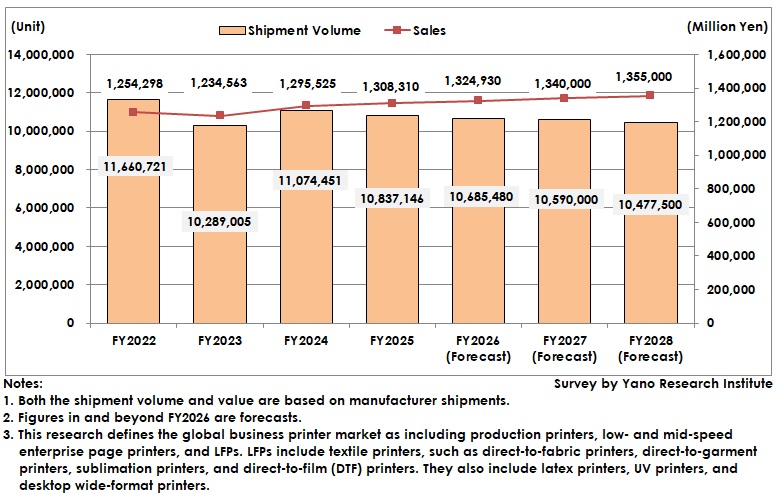
In FY2025, the global business printer market reached shipment volumes of 10,837,146 units, which represent 97.9% of the size in the previous fiscal year. In terms of value, shipments amounted to 1.308,310 trillion yen, which is equivalent to 101% of the preceding fiscal year.
By product segment, production printers reached a shipment volume of 93,781 units, which represent 101.0% of the previous fiscal year’s size. Their shipment value increased slightly to 646.72 billion yen, representing 103.0% of the previous fiscal year’s size. Large-format inkjet printers (LFPs) achieved a shipment volume of 334,030 units and a shipment value of 295.08 billion yen, representing 101.0% and 100.8%, respectively, of the previous fiscal year. Conversely, low- and mid-speed enterprise page printers, which account for a large portion of sales, declined to a shipment volume of 10,409,335 units, which is equivalent to 97.7% of the previous fiscal year. This indicates declining demand from offices, as they transition to paperless initiatives.
The domestic market reached a shipment volume of 1,250,500 units in FY2025, which was 99.2% of the previous fiscal year's size. Shipments of low- and mid-speed enterprise page printers declined to 522,500 units, equivalent to 97.2% of the previous fiscal year. Meanwhile, the shipment volume of multifunction printers (MFPs) declined slightly to 10,687 units, representing 98.9% of the previous fiscal year. However, the shipment value remained at 57.315 billion yen, representing 100.4% of the previous fiscal year's value. LFPs remained firm, achieving a shipment volume of 32,693 units and a shipment value of 20.490 billion yen, equivalent to 101.2% and 101.3%, respectively, of the previous fiscal year.
Noteworthy Topics
Production Printers Amid the Expansion of High-Speed Inkjet Printers and Accelerated Digital Shifts
Although electrophotographic printers still dominate the production printer market, inkjet printers are steadily gaining prominence.
In FY2025, electrophotographic production printers (both color and monochrome) accounted for 98.1% of total shipments in the global market, while inkjet printers accounted for only 1.8%. However, shipments of inkjet printers have been rising moderately due to their features, including a diverse variety of small-lot printing, variable printing that allows for different labels or content per page, color expressiveness, and quality comparable to offset printing. Offset printing involves creating printing plates and using them to print.
In the domestic market, the shipment volume of high-speed inkjet printers continued to increase in FY2025. This growth was driven by an increasing number of users who considered to convert from offset to digital printing, growing replacement demand for digital machines, especially for label printing, and growing demand for small-lot printing in soft packaging and other industrial printing areas. Environmental regulations have also fueled interest in digital printers because they eliminate the need for printing plate manufacturing processes and reduce CO2 emissions. The transition from analog to digital printing is likely to continue. Since analog printing still occupies a large share of the label printing market, there is significant potential for conversion to digital machines.
Future Outlook
Beyond FY2026, the global business printer market is expected to show clear differences by printer type. In FY2026, manufacturers are expected to ship 10,251,500 low- and mid-speed enterprise page printers, equivalent to 98.5% of the previous fiscal year's volume. This decline is due to waning demand from offices driven by paperless initiatives.
Meanwhile, shipments of production printers, centered on inkjet and label printing, are expected to grow moderately. Shipments of LFPs are expected to remain steady, particularly for eco-friendly products and UV printers, which can considerably reduce electricity consumption through instant ink curing.
In FY2026, the domestic production printer market is expected to decline, with a manufacturer shipment volume of 10,633 units, representing 99.5% of the previous year’s volume. However, the manufacturer shipment value is expected to remain flat at 57.573 billion yen, representing 100.5% of the previous year’s value. During the FY2026-2028 period, MFPs are expected to grow to around 101% of the previous year's size. This growth is driven by industrial reorganization and solution proposals that integrate MFPs more deeply with IT services, rather than considering them as simple printers.
In the medium term, factors that will sustain the market through FY2028 include stronger alignment of MFPs with IT and other services (assuming structural shrinkage of office printers); higher added value of production printers; and the expansion of applications and environmental responsiveness in LFPs.
The global business printer market is expected to continue its downward trend through FY2028 in terms of shipment volume. However, shipments in terms of value are expected to remain relatively stable due to the combination of high-end models, UV printers, and business support solutions. Rather than competing based on the hardware performance itself, maintaining or expanding the market relies on the ability to propose solutions, including workflow automation, AI utilization, environmental responsiveness, and application development.
Research Outline
2.Research Object: Printer manufacturers and vendors/dealers
3.Research Methogology: Face-to-face interviews by our expert researchers (including online interviews), survey via telephone and email
What are Business Printers?
For the purposes of this research, a business printer is defined as one used in an office, commercial/industrial printing setting. They include 1) production printers 2) low- and mid-speed enterprise page printers, 3) multiple-function printers (MFPs) or all-in-one machines, and 4) large-format inkjet printers (LFPs). LFPs include textile printers, such as direct-to-fabric printers, direct-to-garment printers, sublimation printers, and direct-to-film (DTF) printers. They also include latex printers, UV printers, and desktop wide-format printers.
This research defines the global business printer market as including production printers, low- and mid-speed enterprise page printers, and LFPs. Domestic business printers include the above three types plus MFPs.
<Products and Services in the Market>
Production printers, low- and mid-speed enterprise page printers, multiple-function printers (MFPs) and LFPs
Published Report
Contact Us
The copyright and all other rights pertaining to this report belong to Yano Research Institute.
Please contact our PR team when quoting the report contents for the purpose other than media coverage.
Depending on the purpose of using our report, we may ask you to present your sentences for confirmation beforehand.