No.4142
Fifteen Logistics Sectors in Japan: Key Research Findings 2026
The Market for Fifteen Logistics Sectors Predicted to Continue Expanding Due to Price Revisions, Though A Full Recovery in Freight Volume Yet to be Achieved
Yano Research Institute (the President, Takashi Mizukoshi) conducted a survey of the overall market for 15 logistics sectors, revealing trends by sector, trends among participating companies, and future outlooks.
Market Overview
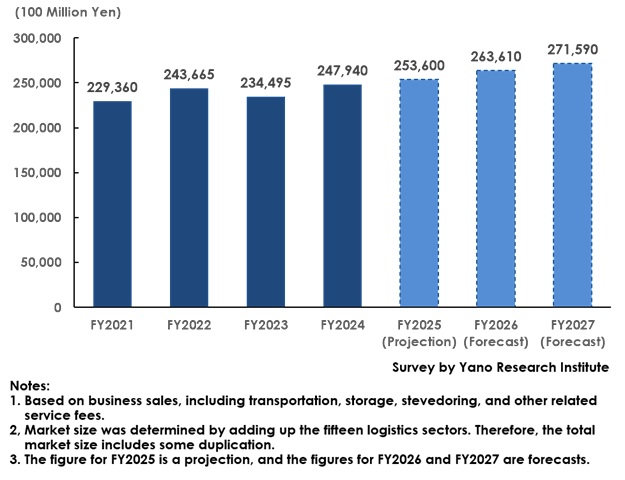
Based on business sales, the total market size of the fifteen logistics sectors amounted to 24.794 trillion yen in FY2024, including some duplication. This figure was equivalent to 105.7% of the previous fiscal year’s size. The market was boosted by third-party logistics (3PL) services, and the international logistics segment, including maritime transportation, freight forwarding, general harbor transportation, and air freight transportation. Higher international logistics costs increased the market size, as maritime transportation fees soared due to the increased use of the Suez Canal detour route amid deteriorating situations in the Red Sea and the continuously weaker yen. Domestic logistics has also contributed to market growth, as capped overtime work for truck drivers took effect in 2024, which prompted a review of fares and fees, as well as the clarification of ancillary service charges.
In FY2025, the total market size of the fifteen logistics sectors is expected to reach 25.360 trillion yen, equivalent to 102.3% of the previous fiscal year’s size. A decline from the previous fiscal year is anticipated in part of the forwarding and international maritime shipping due to a fall in reaction to surging maritime and air transportation costs, as well as the subdued sporadic demand. In the domestic segment, 3PL services are expected to contribute the most to the market size, alongside growth in general warehousing, refrigerated warehousing, home delivery services, rail freight forwarding and transportation, and lightweight freight delivery. However, a full recovery in freight volume has yet to be achieved. Market growth is primarily driven by transportation values, including increased transportation unit prices and exchange rates. The market size of the fifteen logistics sectors is expected to continue to increase.
Noteworthy Topics
Fair Freight Rates Promoted by the Revised Logistics Efficiency Law and Two Trucking Business Laws (Including the New Trucking Law), and Shippers’ Responses
The partially revised Logistics Efficiency Law, effective since April 2025, requires shippers, chain business operators, and logistics providers to make reasonable efforts on improving load efficiency and reducing waiting and handling times. Two trucking optimization laws, established in June 2025, prohibit paid transportation services without permission or registration. The laws also impose reasonable efforts to limit the number of subcontracting levels to two or fewer and regulate fares and fees below optimal prices. These revisions have prompted shippers to view logistics as their managerial challenges rather than as on-site issues.
The initial impact of these revisions on the logistics market may be the optimization of fare levels. Since every stakeholder is required to ensure that fares and fees are at least at the national optimal prices, these prices will likely rise to reflect the associated costs of energy, labor, vehicles, and security measures. Therefore, logistics costs for shippers will likely rise as well. Rather than unilaterally imposing price reductions on logistics companies, shippers are required to cooperate in improving transportation efficiency by reducing waiting and handling times, improving load efficiency, and utilizing shared deliveries. These efforts will reduce logistics costs for shippers, improve vehicle turnover rates, and streamline freight transportation from multiple shippers. This will increase revenues for logistics companies. The concept of logistics expenses must shift from being seen merely as costs to being seen as investments that support stable procurement and supply.
Future Outlook
In FY2026, the total market size of the fifteen logistics sectors is expected to reach 26.361 trillion yen, which is equivalent to 103.9% of the previous fiscal year’s size. The previously slow international logistics segment is expected to rebound and boost the overall market growth rate. Continued weakness in the yen and robust demand for car carriers and energy transportation will increase maritime transportation. Demand for high-value freight, including semiconductors, electronic components, medicines, and precision devices, is expected to remain strong in air transportation. Demand for general forwarding, including both maritime and air freight, is also expected to increase after slowing in the previous fiscal year. In the domestic segment, 3PL services will likely continue to drive the market. Shipper companies continue to demand supply chain visualization, such as streamlining logistics and identifying inventory levels and cargo locations. Although the growth of home delivery volumes has slowed, revised transportation fees are expected to gradually affect market prices, as well as cargo storage and handling prices in warehouses, including refrigerated ones. Consequently, thanks to reinstated international logistics and price revisions of domestic logistics, the market for the fifteen logistics sectors is expected to continue growing despite the fact that a significant increase in cargo volumes is not anticipated.
Research Outline
2.Research Object: Domestic leading logistics companies and organizations
3.Research Methogology: Face-to-face interviews (including online interviews) conducted by expert researchers and literature research
What are Fifteen Logistics Sectors?
This research focuses on fifteen logistics sectors. These sectors include the following services: 1) consolidated freight trunking transportation, 2) domestic home delivery, 3) international home delivery, 4) third party logistics (3PL) services, 5) maritime transportation (domestic and international voyages), 6) general harbor transportation, 7) air freight transportation, 8) freight forwarding (international voyages and air freight), 9) rail freight transportation, 10) rail freight forwarding, 11) lightweight freight delivery, 12) general warehousing, 13) refrigerated warehousing, 14) moving services, and 15) other logistics services.
The Market of Fifteen Logistics Sectors
This research determined the total market size by adding up the fifteen logistics sectors. Therefore, the total market size includes some duplication. Market size is calculated based on business sales, including transportation, storage, stevedoring, and other related service fees.
<Products and Services in the Market>
Consolidated freight trunking transportation, domestic home delivery, international home delivery, third-party logistics (3PL) services, maritime transportation (domestic and international voyages), general harbor transportation, air freight transportation, freight forwarding, rail freight transportation, rail freight forwarding, lightweight freight delivery, general warehousing, refrigerated warehousing, moving services, and other logistics services
Published Report
Contact Us
The copyright and all other rights pertaining to this report belong to Yano Research Institute.
Please contact our PR team when quoting the report contents for the purpose other than media coverage.
Depending on the purpose of using our report, we may ask you to present your sentences for confirmation beforehand.