No.4141
Secondhand Fashion Market in Japan: Key Research Findings 2026
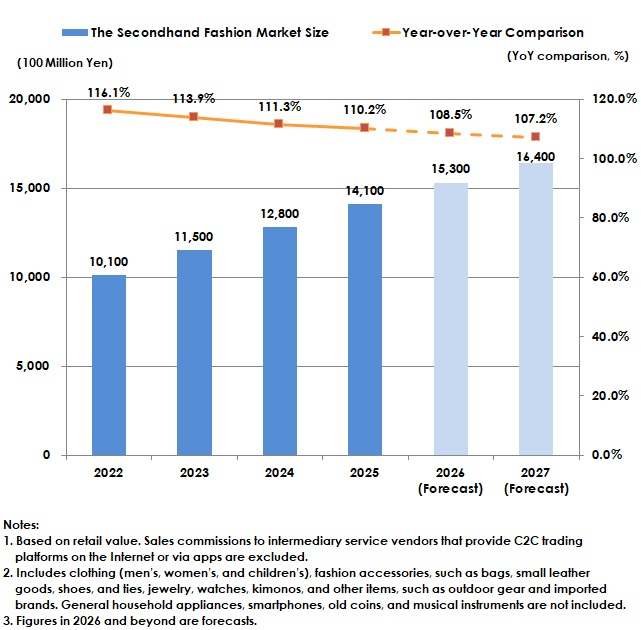
In 2025, the Secondhand Fashion Market Reached 1.41 Trillion Yen in Japan, Representing 110.2% of the Previous Year
Yano Research Institute (the President, Takashi Mizukoshi) conducted a survey of the secondhand fashion market in Japan. The survey revealed the trends in secondhand businesses in the apparel industry, trends by item, and future market outlooks. This article discloses the transition and forecast of market sizes.
Market Overview
Based on retail value, the secondhand fashion market in Japan was estimated at 1.41 trillion yen in 2025, which was equivalent to 110.2% of the size in the previous year.
This growth was driven by changes in consumer behavior. Increased commodity prices and social insurance burdens have prompted consumers to reevaluate their daily spending habits. In this context, buying used items has become a popular way to reduce fashion expenditure. Secondhand fashion, which involves selling products in good condition at lower prices than brand new ones, has become an attractive option for many consumers who prioritize cost effectiveness.
Meanwhile, buyers in the secondhand market could also be sellers. More consumers have started selling their unwanted belongings on consumer-to-consumer (C2C) trading platforms to supplement their income. The increased availability of secondhand items among general consumers creates a virtuous cycle that increases distribution volume and product variety, thereby attracting more buyers.
Noteworthy Topics
B2B2C Market Trends
The number of vintage stores is growing. Store operators purchase secondhand clothing directly from specialized companies to resell.
Similarly, the number of vintage stores operated by individuals using the C2B2C model is increasing. Each piece of vintage apparel sold at these stores is unique. Customers can obtain information about an item by visiting the store, feeling its texture, and speaking with store staff. This differentiates these stores from C2C thrifting transactions. The key is improving customers’ in-store experience that could encourage repeat visits.
Future Outlook
Based on retail value, the secondhand fashion market is expected to reach 1.53 trillion yen in 2026, which is equivalent to 108.5% of its size the previous year. Growth is expected to continue.
The production of apparel and other textile products creates environmental burdens, including greenhouse gas emissions, chemical material usage, and water consumption throughout the processes of material procurement, manufacturing, usage, and disposal. This production also causes the discharge of microplastics derived from synthetic fibers into the ocean. To become sustainable, the textile industry must transition from mass production, mass consumption and mass disposal to a circular economy.
In this context, the government plans to establish a system to circulate textile product resources, as outlined in the “Roadmap for Resource Circulation in Textile Products*,” released in June 2024. The roadmap and the “Fifth Basic Plan for Establishing a Recycling-Oriented Society,” approved by the Cabinet in Augst 2024, aim to reduce household clothing disposal by 25% by FY2030 compared to FY2020. To achieve this, the government is expected to promote the reuse of fashion items, which will boost the size of the secondhand fashion market.
*) Source: The website of the Ministry of Economy, Trade and Industry (Japanese) (https://www.meti.go.jp/shingikai/sankoshin/seizo_sangyo/textile_industry/pdf/20240625_2.pdf)
Research Outline
2.Research Object: Companies dealing in fashion items and/or secondhand apparel products
3.Research Methogology: Face-to-face interviews (including online) by expert researchers, and literature research
About the Secondhand Fashion Market
For the purposes of this research, the secondhand fashion market includes the following items: men’s, women’s, and children’s apparel; fashion accessories, such as bags, small leather goods, shoes, and ties; jewelry; watches; kimonos; and other items, such as outdoor gear and imported brands.
General household appliances, smartphones, old coins, and musical instruments are not included.
Market size is calculated based on retail value. Sales commissions to intermediary service vendors that provide C2C trading platforms on the Internet or via apps are excluded.
<Products and Services in the Market>
Men’s, women’s, and children’s apparel; fashion accessories, such as bags, small leather goods, shoes, and ties; jewelry; watches; kimonos; and other items, such as outdoor gear and imported brands.
Published Report
Contact Us
The copyright and all other rights pertaining to this report belong to Yano Research Institute.
Please contact our PR team when quoting the report contents for the purpose other than media coverage.
Depending on the purpose of using our report, we may ask you to present your sentences for confirmation beforehand.