No.4132
Seed & Seedling Market in Japan: Key Research Findings 2026
Seeds and Seedlings Market in Japan Sized at 228,200 Million Yen for FY2025
Yano Research Institute (the President, Takashi Mizukoshi) has conducted a survey on the market of seed and seedling market in Japan, and found out the trends by crop type, market player trends, and future perspective.
Market Overview
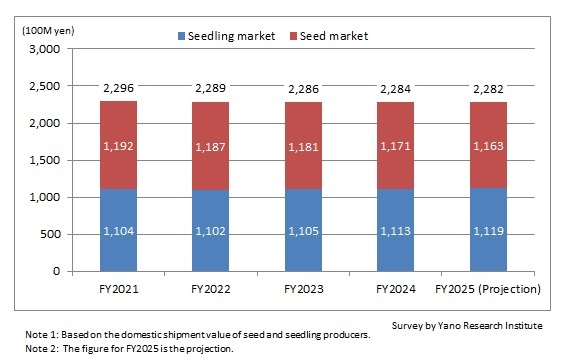
The seed and seedling market in Japan is sized at 228,200 million yen for FY2025, (99.9% of the preceding fiscal year), based on the domestic shipment value of seed and seedling producers.
In detail, the seed market size is estimated at 116,300 million yen, representing 99.3% of the previous fiscal year. The combination of an aging farmer population and a severe shortage of agricultural successors has posed major challenges for Japan’s agricultural sector. These trends have resulted in chronic farm labor shortages*1 and a shrinking cultivated area*2, ultimately constraining market growth. (Data source: *1: “Census of Agriculture and Forestry”, Ministry of Agriculture, Forestry, and Fisheries [MAFF]; *2: “Statistics on Cultivated Land and Planted Area”, MAFF)
On the other hand, the seedling market size is estimated at 111,900 million yen, which is 100.5% of the previous fiscal year.
The increased use of propagation methods and products, such as grafted seedlings*³, plug plants*⁴, and mericlones*⁵, has increased the demand for seedlings. These methods are used primarily for vegetable production and are intended to improve efficiency and stabilize crop yields. These methods underpin the growth of horticulture, particularly greenhouse horticulture, by increasing cultivation efficiency and improving uniformity.
Under the circumstances, strong growth of the seedling market is offsetting the decline of the seeds market.
*3 A grafted seedling is a young plant created by joining (grafting) a scion of a plant (desired variety) to a rootstock. Grafted seedling combines desirable fruit characteristics from the scion with disease resistance or vigor from the rootstock.
*4 A plug plant is a seedling grown in propagation tray with many small wedge-shaped cells (also called a cell-grown seedling). Currently, plug plants are used for vegetable and flower transplanting. Automatic transplanter contributes to increasing efficiencies in vegetable production.
*5 A mericlone is a genetically identical plant propagated from meristem tissue culture. By taking out a meristem in millimeter size from a new bud to propagate in a germfree incubator, plants with consistent quality can be generated in mass.
Noteworthy Topics
Technological Advancements in Plant Breeding, Entry of Non-Traditional Players into the Market
In the current seed and seedling market, plant breeding is evolving with the adoption of AI, data analytics, and genomics. Technological advancements have enabled researchers to identify genes associated with desirable traits, such as heat resistance and disease resistance faster, thereby accelerating the development of new breed which conventionally took decades.
Against the backdrop of these advancements in plant breeding science, in October 2019, Japan officially launched a mandatory notification system for genome-edited foods*6. This paved the way for commercial availability of gene-edited foods like the high-GABA tomato and Waxy corn (a type of corn that contains a high amount of amylopectin). Today, genetic engineering is expected to serve as a strategy to combat climate change, by adapting plants to severe environmental conditions like heatwave, increase crop yields, and enhance resistance to pests and diseases.
In addition, market entrance of non-agricultural companies was another highlight in the market. Efforts are made to develop new breed with high climate resistance and/or new machines for horticulturists. For example, in 2025, a Japanese car parts maker made a full-scale entry, utilizing sensing, AI, and robotics for developing a harvesting cart. Progress is also being made by other companies in the practical application of AI-powered digital breeding technologies, leading to greater efficiency in variety selection through the use of genomic information and cultivation data.
*6 Source: “Procedures for Providing Information regarding the Effects on Biological Diversity of Organisms Obtained through Genome Editing Technology”, MAFF
(https://www.maff.go.jp/j/syouan/nouan/carta/tetuduki/nbt_tetuzuki.html )
[The source above is in Japanese. English reference is available at the following:
https://www.maff.go.jp/j/syouan/nouan/carta/tetuduki/attach/pdf/nbt_tetuzuki-22.pdf]
Future Outlook
Looking ahead, Japan's seed and seedling market is unlikely to see significant growth, as a declining farming population*1 and shrinking agricultural land*2 continue to contract overall domestic production. Meanwhile, growing demand for seedlings—enabling labor savings and crop yield stabilization—is expected to offset the contraction of the seed market.
Adapting to climate change has become one of the market’s most pressing issues. Alongside the increase in frequency of extreme weather events, demand for varieties with heat tolerance, disease resistance, and other climate-resilient traits are rising. At the same time, labor shortages and the rise of smart agriculture are heightening the importance of varieties suited for mechanized harvesting and robotic automation.
Furthermore, top seed and seedling companies are expected to shift their focus to international markets. Vegetable seed demand is set to grow, particularly in Asia, where rapid population and economic growth drive a continuous need for food*7. Going forward, we believe it will be crucial for seed and seedling companies to develop comprehensive business strategy that combines the development of varieties adapted to local growing conditions and food cultures with a transfer of cultivation expertise, alongside the provision of digital agricultural solutions.
Amid the rapid changes of global climate, seed and seedling companies, major companies in particular, are expected to pivot their business focus to the creation of value-added products and overseas business. This involves development of varieties with high heat tolerance and disease resistance, as well as varieties producing vegetables and fruits suited for international transport.
*7 Data source: “World Population Prospects”, United Nations
Research Outline
2.Research Object: Seed and seedling companies, industry organizations, and government agencies
3.Research Methogology: Face-to-face interviews by our expert researchers (including online interviews), survey via telephone, questionnaire, and literature research
What is the Seed and Seedling Market?
In this research, the seed and seedling market encompasses seeds and seedlings for agricultural produce such as vegetables, fruits, grains, flowers, lawn grasses, and fodder. The market size is calculated using the domestic shipment value of seed and seedling producers.
<Products and Services in the Market>
Seeds and seedlings for agricultural produce (such as vegetables, fruits, grains, flowers, lawn grass, and fodder)
Published Report
Contact Us
The copyright and all other rights pertaining to this report belong to Yano Research Institute.
Please contact our PR team when quoting the report contents for the purpose other than media coverage.
Depending on the purpose of using our report, we may ask you to present your sentences for confirmation beforehand.