No.4111
Global Humanoid Robot Market: Key Research Findings 2026
Global Shipment of Humanoid Robots Forecasted to Reach 7.18 Million Units by 2035
Yano Research Institute (the President, Takashi Mizukoshi) has carried out the survey on the global humanoid robot market. The report identifies government policies and subsidy funds pertaining to humanoid robots in key countries, market player trends, trends by application, key technological trends, and future outlook. This press release shares the forecast on global humanoid robot shipments.
Market Overview
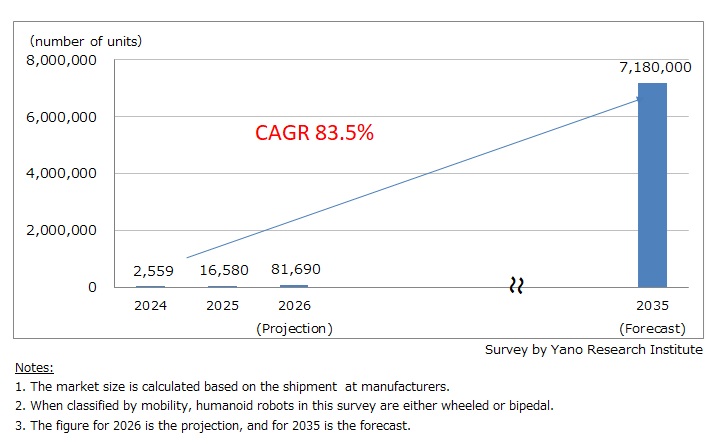
Global humanoid robot market is projected to grow at a CAGR of 83.5% between 2025 and 2035. Market growth is being driven by a rising number of enterprises—led by Chinese firms in development and American firms in commercial shipments—spearheading industrial deployment. Simultaneously, the use of humanoid robots is expected to broaden from industrial applications to domestic and personal use. On the technological front, sophisticated AI and sensors are boosting autonomy, while a diversifying supplier base helps drive down hardware costs. These factors, bolstered by significant government subsidies, are set to further catalyze global market expansion.
The global shipment of humanoid robots is estimated at 16,580 units in 2025, representing 647.9% of the preceding year. Analyzing the market by manufacturer origin, Chinese firms currently dominate, accounting for 84.8% of the total shipments. Bolstered by a structured regulatory framework, China now boasts over 200 manufacturers, whose large-scale projects are driving overall market expansion. Meanwhile, although their market shares remain modest at 7.4% and 5.9% respectively, European and American manufacturers have achieved over 300% year-on-year growth. This surge is fueled by their transition from the research phase toward PoC and full-scale implementation. In contrast, Japanese shipments were estimated at only 84 units, as a limited number of domestic players remain focused primarily on R&D and pilot testing.
In 2026, humanoid robot shipments are projected to reach 81,690 units, representing 492.7% of the previous year. This growth is underpinned by four primary factors: mass production by industry leaders such as Tesla, Figure AI, and 1X Technologies; the global expansion of Chinese firms; increased commercialization within the U.S.; and a rising number of Korean manufacturers.
Although China and the U.S. will drive shipment quantities, U.S. and European firms are projected to capture the bulk of the market's value. This creates a two-tier market: sophisticated, high-end models from the West serving their local regions, and cost-effective Chinese models dominating the rest of the world.
Noteworthy Topics
Dexterous Robotic Hands: The Key to Scale Robot Deployment
Humanoid robots are engineered with human-like forms to navigate complex environments and execute a wide array of versatile tasks. Realizing this potential requires advancements across several critical domains, including artificial intelligence, actuator technologies, dexterous manipulation, and battery efficiency. In particular, the integration of sophisticated AI—capable of real-time decision-making, situational adaptation, and natural language processing—allows these robots to perform intricate manual operations. Consequently, the development of dexterous hands has emerged as a focal point of innovation, serving as a core technology to replicate the flexibility, precision, and sensory feedback of the human hand.
Future Outlook
The global humanoid robot market is poised for significant expansion, driven by an increasing demand for automation in hazardous or demanding work environments. The growing influx of market participants and pilot deployments—bolstered by strategic government subsidies in key nations—is enhancing the practical feasibility of robot integration while broadening their potential applications.
This growth is further catalyzed by innovations in AI and robotics, economies of scale that reduce costs, the rising adoption of the Robot-as-a-Service (RaaS) model, and the establishment of robust regulatory frameworks. Consequently, humanoid robots are expected to transition beyond industrial settings into a diverse range of service-oriented roles.
The global shipment of humanoid robots is forecasted to reach 7,180,000 units by 2035 (based on the shipment quantity at manufacturers).
Research Outline
2.Research Object: Manufacturers of humanoid robots, manufacturers of peripheral devices and components, software vendors, robot rentals, Robotics as a Service (RaaS), private companies (users of humanoid robots), governmental institutions, universities, research institutions, academic societies, industry associations, etc.
3.Research Methogology: Face-to-face interviews by our expert researchers (including online interviews), secondary research
What is the Humanoid Robot Market?
In this survey, humanoid robots refer to robots in human-like structures equipped with locomotion ability, designed to operate in work environments built for humans. When classified by mobility, humanoid robots surveyed in this report are either “wheel drive (wheeled)” or “full-bodied (bipedal)”. Disembodied humanoid robot heads, robotic torsos, and robotic arms are excluded.
The global market size of humanoid robots is estimated based on the shipment quantity at manufacturers (in Japan, China, Americas, Europe, and other regions).
<Products and Services in the Market>
Humanoid robots
Published Report
Contact Us
The copyright and all other rights pertaining to this report belong to Yano Research Institute.
Please contact our PR team when quoting the report contents for the purpose other than media coverage.
Depending on the purpose of using our report, we may ask you to present your sentences for confirmation beforehand.