No.4086
Questionnaire Survey for Japanese Municipalities on Workout Promotion Initiatives: Key Research Findings 2026
Municipalities’ Workout Promotion Initiatives Are Primarily Exercise Classes and Events
Yano Research Institute (the President, Takashi Mizukoshi) conducted an online questionnaire survey of health and fitness promotion departments in 157 municipalities nationwide. The survey results were analyzed to determine the status of municipalities in implementing health promotion projects and workout promotion projects, as well as their collaboration with private fitness businesses. This article discloses some of the results of the analysis.
Summary of Research Findings
In the context of Japan’s social problems of escalating healthcare and long-term care costs due to an aging population and declining birth rates, preventive medicine, preventive medicine has become more important than ever. Preventive medicine aims to prevent the onset and progression of diseases. In response, the government is collaborating with municipalities, health insurance societies, and private companies to address health maintenance and promotion, as well as lifestyle improvement.
Against this backdrop, a questionnaire survey was conducted from January to February 2026, targeting the health and fitness promotion departments of 157 municipalities nationwide. The results were analyzed to determine the status of municipalities in implementing health and workout promotion projects, as well as their collaboration with private fitness businesses. This article reveals some of the results of the analysis.
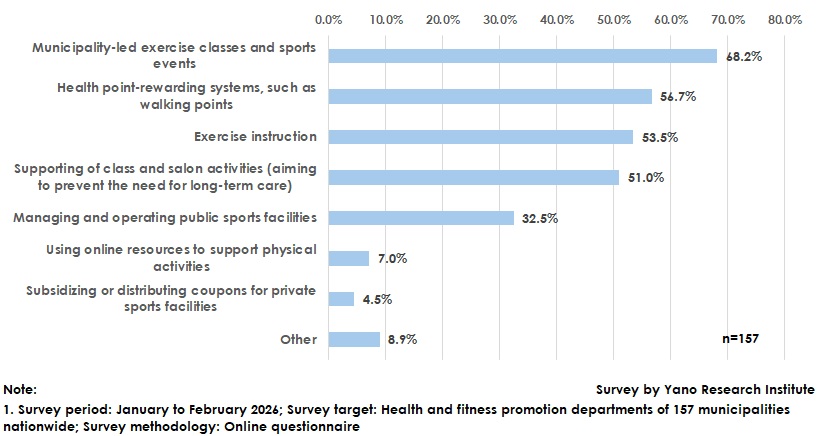
When asked to select from a list of responses about the specific exercises and physical activities they were promoting as their initiatives, 68.2% of respondents chose “municipality-led exercise classes and sports events.” This indicates that most municipalities were operating their projects by themselves, which is a traditional approach to implement initiatives.
The second most popular response was “health point-rewarding systems, such as walking points,” accounting for 56.7% of respondents. Point rewarding is an effective and widespread way to motivate participants. However, this motivation could be temporary. It is a challenge for municipalities to verify whether this motivation leads to behavior modification and makes it a habit for participants. Almost half of the respondents (51.0%) chose "supporting of class and salon activities (aiming to prevent the need for long-term care).” This suggests that many municipalities addressed the projects by achieving both: creating places where locals could develop a sense of belonging and by promoting exercise.
Meanwhile, not many respondents chose “using online resources to support physical activities” (7.0%) or “subsidizing or distributing coupons for private sports facilities” (4.5%). Although online utilization has grown since the pandemic, it has not become a staple in municipalities’ workout promotion initiatives. Collaborating with private companies to increase citizens’ exercise opportunities is still in its early stages due to budgetary constraints. For municipalities that address health maintenance, promotions, and lifestyle improvement, they need to measure effectiveness through quantitative data to secure budgets. Therefore, if private companies can demonstrate that they can sufficiently reduce medical and nursing care costs, municipalities can secure the budget to implement these initiatives, and to a wider extent.
Noteworthy Topics
The Greatest Challenge for Municipalities to Promote Workout Is “Not to be Able to Increase Participants.” They Expect Collaboration with Private Companies Will Attract Participants
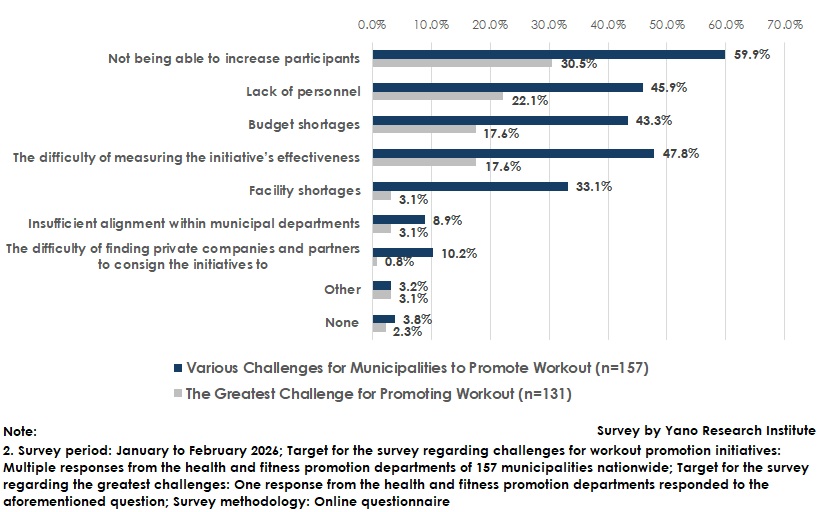
When asked to select from a list of responses about various challenges (multiple responses allowed) and the greatest challenge (one response allowed), 59.9% of respondents selected “not being able to increase participants” as one of the challenges, and 30.5% selected it as the greatest challenge. These figures suggest that increasing participants was both the most popular response and the most fundamentally challenging issue for workout promotion initiatives. This issue stemmed from municipalities’ unclear target settings for these initiatives. The initiatives appealed only to citizens who were already health-conscious or those interested in municipality publications, failing to reach target working-age citizens or those without workout habits. To solve this problem, municipalities should clearly define their target audience and plan suitable initiatives for them. They also need to reevaluate their communication strategy, including how they convey information.
The second most popular response regarding the various challenges was “the difficulty of measuring the initiative’s effectiveness,” which was selected by 47.8% of respondents. However, this was the third most popular response for the greatest challenge, alongside “budget shortages,” with both being selected by 17.6% of respondents. 45.9% of respondents selected “lack of personnel” as one of the challenges, and 22.1% selected it as the greatest challenge. These responses indicate structural constraints within municipalities.
The survey revealed that many municipalities are mired in labor and budget shortages in daily operations, while also recognizing the difficulty of measuring effectiveness. Nevertheless, the inability to measure effectiveness deters municipalities from validating improvements to initiatives, leaving them unable to secure budgets due to a lack of evidence.
Meanwhile, only 10.2% of respondents selected “the difficulty of finding private companies and partners to consign the initiatives to” as one of the challenges, and only 0.8% selected it as the greatest challenge. Attracting participants and addressing internal municipal challenges, such as the constraints from labor shortages and a lack of data to support budgetary effectiveness, seemed to be prioritized over finding the right partners.
Research Outline
2.Research Object: Health and fitness promotion departments of 157 municipalities nationwide
3.Research Methogology: Online questionnaire survey
Questionnaire Survey for Japanese Municipalities on Workout Promotion Initiatives
This questionnaire survey was conducted from January to February 2026, targeting health and fitness promotion departments of 157 municipalities nationwide. The survey results were analyzed to determine the status of municipalities in implementing health promotion projects and workout promotion projects, as well as their collaboration with private fitness businesses. This article discloses some of the results of the analysis.
<Products and Services in the Market>
Health promotion and preventive healthcare services through exercise and physical activity; training guidance and health programs provided through collaboration among medical institutions, insurance companies, and local governments; functional training and exercise classes aimed at preventing the need for long-term care and frailty; and self-pay exercise services (specialized stretching facilities) designed to improve physical function and alleviate discomfort.
Published Report
Contact Us
The copyright and all other rights pertaining to this report belong to Yano Research Institute.
Please contact our PR team when quoting the report contents for the purpose other than media coverage.
Depending on the purpose of using our report, we may ask you to present your sentences for confirmation beforehand.