2026/10/26
Autonomous Bus Pilot Projects Gain Momentum: A Digital Mobility Nation Must Be Realized Soon
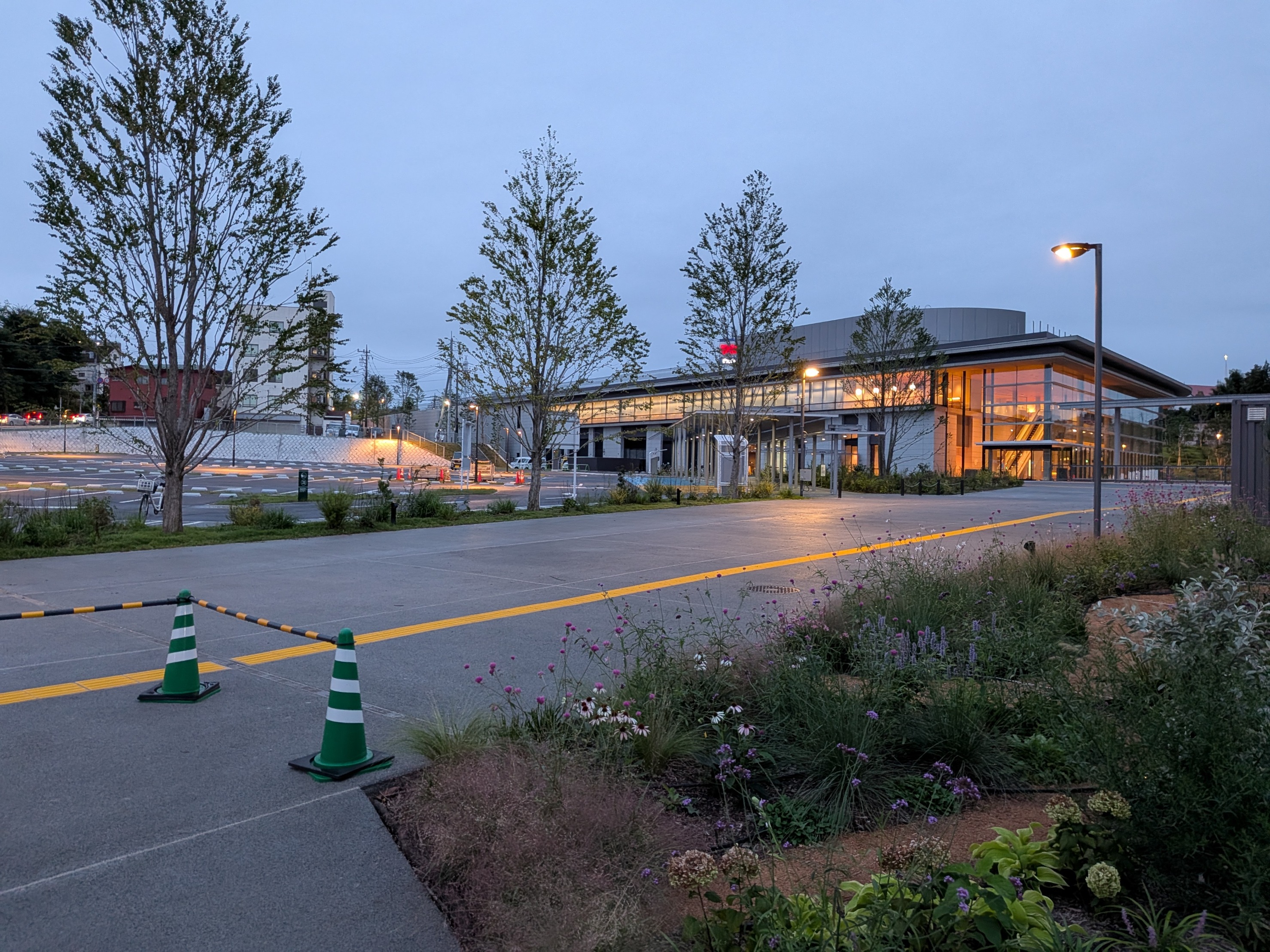
Photo: SOTO no MORI before opening. Photo by the author.
Recently, initiatives led by local governments to put autonomous buses into practical service have been gaining momentum. On October 2, a group of organizations including Tsukuba City, the University of Tsukuba, Kanto Railway Co., and the KDDI Group started a Level 2 autonomous bus service on the “University of Tsukuba Loop” route, which connects Tsukuba Station on the Tsukuba Express (TX) line with the University of Tsukuba campus. On the same day, Toyooka City, Hyogo Prefecture, also announced plans to launch a demonstration service using autonomous buses in the Kinosaki Onsen hot spring resort area starting in November. The buses will run three times a day on weekdays, connecting JR Kinosaki Onsen Station with the resort district. Kanematsu Corporation is responsible for planning and coordinating the project, while Zentan Bus Co. will operate the service using the ROii (Roy), a compact bus manufactured by South Korea’s Autonomous A2Z Corporation.
On June 16, the Digital Agency announced the “2040 Proposal to Realize a Digital Mobility Nation with Autonomous Driving,” an implementation plan that sets the goal of achieving the following: “autonomous driving firmly established throughout Japan as a mobility infrastructure available to everyone by 2040.” The plan also sets technical and numerical targets, working backward from this goal. It lays out a series of interim goals to be achieved in stages: establishing a revenue model in regions selected for early implementation by fiscal year 2027; expanding implementation from individual municipalities to intermunicipal cooperation by fiscal year 2028; achieving advanced integration between major transportation networks and local transit systems by fiscal year 2029; and extending autonomous driving nationwide, including in sparsely populated areas, by fiscal year 2030. The ultimate goal is to establish autonomous driving as an indispensable part of social infrastructure.
Furthermore, on September 17, the Japan Automobile Manufacturers Association, Inc. (JAMA) announced a policy identifying “zero traffic fatalities” and “freedom of mobility” as the ultimate goals of autonomous driving. Under this policy, the national and local governments and the industry will work together to advance infrastructure technologies, develop social infrastructure, and implement measures to promote market penetration. Because artificial intelligence (AI) is a key technology for autonomous driving, the United States and China, both leaders in AI, have taken the lead in this field. Japan, however, has fallen significantly behind in putting autonomous driving into practical use. Yet the rapid evolution of generative AI, its widespread adoption, and the expansion of its applications may have increased the possibility that Japan can make up lost ground all at once. It is hoped that these evolutional developments will help build new social infrastructure and foster new industrial competitiveness.
Meanwhile, on October 3, Hachioji City opened SOTO no MORI, a large complex facility developed on the site of a former medical prison. (The name SOTO no MORI refers to Hachioji’s historical silkworm farming and weaving industries.) In partnership with Tokyo University of Technology, the city also launched a pilot project to test autonomous buses running between JR Hachioji Station and the new facility.
As it happens, this is the area where my family home used to be, and the other day I took a walk around the facility before it opened. The kendo dojo where I once trained, the park where we, a group of mischievous kids, fought with another group to decide who was boss, and the path I hurried home along after playing until I was worn out—all were gone without a trace. Yet, strangely enough, I did not feel any sense of sadness. The time I spent there in those days must still be embedded somewhere in the place. I hope the pilot project succeeds in revitalizing the community.
Takashi Mizukoshi, the President
This Week’s Focus, October 4 - October 8, 2026