No.4264
AI Use in the Employment Services Market in Japan: Key Research Findings 2026
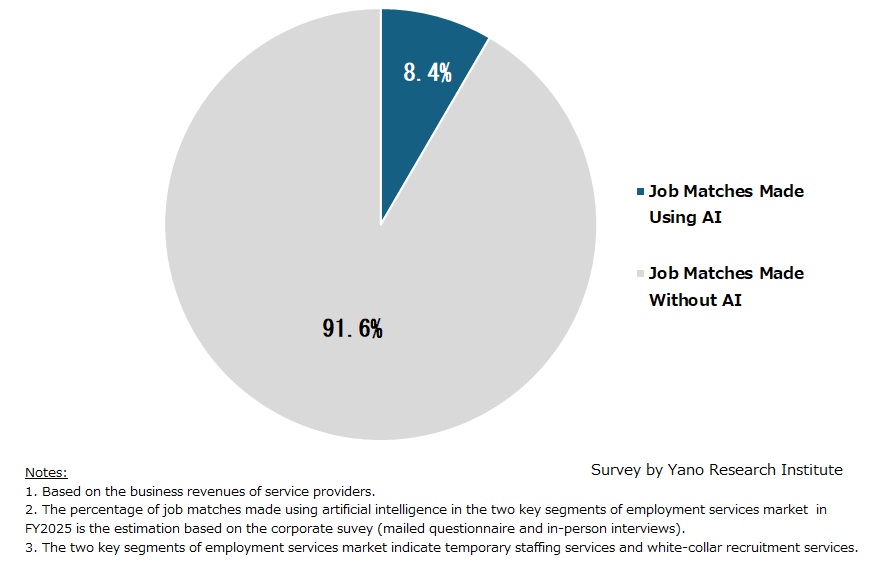
8.4% of Job Matches in Two Key Segments of the Employment Services Market Made Using AI in FY2025
Yano Research Institute (the President, Takashi Mizukoshi) has conducted a corporate survey to explore the current status, challenges, and prospects in the use of AI in the two key employment services segments, the temporary staffing and the white-collar recruitment. This press release presents the percentage of job matches made using AI across the two market segments in FY2025.
Summary of Research Findings
In FY2025, an estimated 8.4% of job matches*1 across the two key employment services segments—temporary staffing and white-collar recruitment—were made using artificial intelligence (AI).
In June and July 2026, Yano conducted a corporate survey to 32 temporary staffing services and 29 white-collar recruitment services on the use of AI. According to the result, six out of ten temporary staffing service providers utilize AI primarily for streamlining internal job operation, such as the editing of job offers and creation of collaterals and other documents. Less than 10% of them use AI for job matching.
In contrast, almost half of the white-collar recruitment service providers use AI, with 20% of them—including large-scale companies—utilizing AI for job matching. Additionally, AI is also used in supporting job seekers, particularly for the creation of resumes and preparation for job interviews.
In FY2026, the percentage of job matching using AI in the two key employment services segments (temporary staffing services and white-collar recruitment services) is projected to reach 11.4% (+3.0 percentage points from the previous fiscal year). *2 The percentage is expected to rise as the enterprises across two segments indicated the intention to use AI in job matching.
*1 The percentage of job matches made using AI indicates the ratio of service providers that made candidate selection using AI-based analysis. The use of AI for any other operations, such as the creation of marketing collaterals, are excluded.
*2 The forecast is based on a rapid-growth scenario in which advances in AI technology and declining implementation costs accelerate adoption across the industry and expand its use in job matching. It also assumes no significant changes to AI-related regulations or institutional frameworks.
Noteworthy Topics
AI Use Shifts from Operational Efficiency to Enhancing the Value of Service Offerings
In-person interviews conducted as part of the corporate survey indicate that AI is used primarily to streamline internal operations across seven employment service segments: temporary staffing services, white-collar recruitment services, job information services, freelance platforms, gig worker staffing services, direct sourcing services, and graduate recruitment services. Companies are also beginning to use AI for job matching, the development of interview preparation tools, and job posting compliance reviews, reflecting a growing focus on enhancing their appeal to both job seekers and corporate clients.
However, AI adoption presents challenges across these segments, including the financial investment, organizational structures, and systems needed for implementation, as well as governance frameworks to manage risks associated with the use of personal information.
Research Outline
2.Research Object: Temporary staffing services, recruitment services, and other employment services (job information services, freelance platforms, gig worker staffing services, direct sourcing services, and graduate recruitment services)
3.Research Methogology: Mailed questionnaire (including in-person interviews to leading companies) and literature research
What Are The Two Key Segments of The Employment Services Market?
Japan's employment services market has two key segments: temporary staffing and white-collar recruitment.
The temporary staffing segment comprises companies licensed by the Ministry of Health, Labour and Welfare (MHLW) to dispatch workers. Its market size is measured by the combined business revenues of these companies, regardless of the types of workers they dispatch or the industries they serve.
The white-collar recruitment segment comprises companies licensed by the MHLW to provide fee-based employment placement services that specialize primarily in white-collar roles, including clerical, sales, managerial, and IT positions. Its market size is measured by the combined business revenues of these companies.
<Products and Services in the Market>
Temporary staffing business, white-collar recruitment business
Published Report
Contact Us
The copyright and all other rights pertaining to this report belong to Yano Research Institute.
Please contact our PR team when quoting the report contents for the purpose other than media coverage.
Depending on the purpose of using our report, we may ask you to present your sentences for confirmation beforehand.