No.4161
Uniform Rental Services Market in Japan: Key Research Findings 2026
Fiscal 2023 Uniform Rental Services Market Expanded Slightly by 0.3% YoY
Yano Research Institute (the President, Takashi Mizukoshi) carried out a survey on the uniform rental market in Japan, and has found out the current situations, competitive landscape, and future perspective.
Market Overview
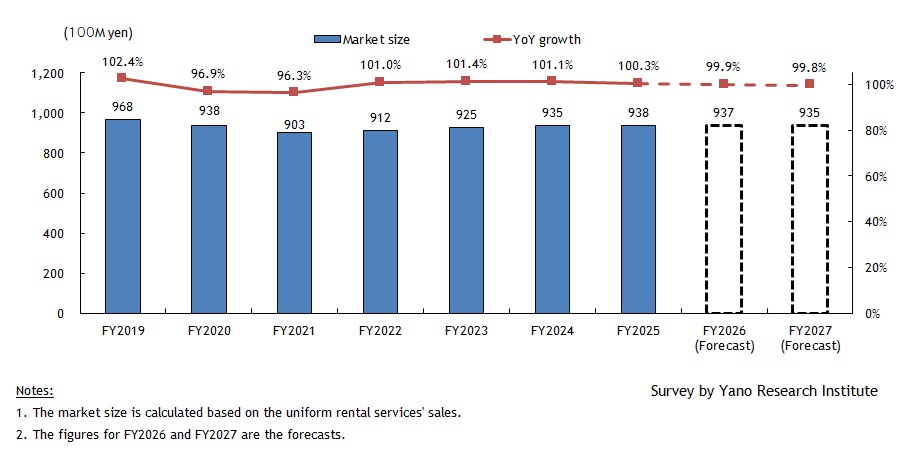
The uniform rental service market size in FY2025 showed marginal growth at 0.3% growth year-over-year to 93,800 million yen, based on the uniform rental companies’ sales.
Market volatility was high over the past several years. Driven by rising demand associated with the Tokyo Olympics and Paralympics and the growth of inbound tourism, market conditions remained generally favorable until FY2020, when the outbreak of COVID-19 significantly disrupted the market. However, as economic activity normalized beginning in FY2022, the market demonstrated resilience, achieving gradual growth for four consecutive fiscal years.
Future Outlook
The uniform rental service market size in FY2026 is projected to decrease to 93,700 million yen (99.9% of FY2025 levels) and 93,500 million yen in FY2027 (99.8% of FY2026 forecast levels).
Contraction in the labor force directly impacts the uniform rental market, given that service models primarily operate on a monthly per-user subscription basis. In light of Japan’s medium- to long-term decline in work population, market contraction appears inevitable.
Conversely, there is a consistent, multi-year shift from outright purchase to rentals. As chronic labor shortages impede companies’ ability to dedicate resources to uniform procurement, inventory tracking, and laundering upon employee turnover, clients find rental services an attractive alternative, allowing low initial capital expenditure and streamlined administration. Due to this shift, despite toughening market landscape, the uniform rental services market maintains the same level for years.
Following the implementation of mandatory HACCP-based sanitation management for all food business operators on June 1, 2021, demand for HACCP-compliant work uniforms has continued to support growth in the uniform rentals segment. In contrast, other sectors face intense competition and increasingly saturated markets. As a result, uniform rental providers are under pressure to enhance value-added services and improve business efficiency through streamlined operating models.
Against a backdrop of rising material and fuel costs, market growth will largely be determined by uniform rental providers' ability to balance price competitiveness with strong profit margins.
Research Outline
2.Research Object: Uniform rental companies, uniform manufacturers, etc.
3.Research Methogology: Face-to-face interviews by our expert researchers (including online interviews), surveys via telephone & email, questionnaire, and literature research
What is the Uniform Rental Services Market?
In this research, uniform rental services indicate the providers of uniforms that meet the specific needs of clients on rental basis. In addition to the delivery and cleaning of the uniforms, they undertake management of uniforms, including free-of-charge repairing, etc. Clients serviced are chiefly general offices, medical institutions, nursing homes, welfare facilities, construction/civil engineering companies, food manufacturers (food, confectioneries), industrial sector (machinery factories, steel mills, etc.), food services (restaurants, etc.), retailers, hotels, and amusement sector.
<Products and Services in the Market>
Uniform rental services (clerical/office uniforms, medical uniforms, nursing home workwear, welfare facility uniforms, construction worker uniforms, civil engineer uniforms, food/confectionery factory uniforms, uniforms for HACCP system-oriented pharmaceutical manufacturers and food factories, workwear for industrial sector [such as machinery factories and steel mills], food service uniforms, retail uniforms, hotels & hospitality uniforms, and workwear for amusement sector)
Published Report
Contact Us
The copyright and all other rights pertaining to this report belong to Yano Research Institute.
Please contact our PR team when quoting the report contents for the purpose other than media coverage.
Depending on the purpose of using our report, we may ask you to present your sentences for confirmation beforehand.