No.4137
Global Human Sensory Emulation (Tactception, Gustation, and Olfaction) Market: Key Research Findings 2026
Global Human Sensory Emulation Market Projected to Grow at a CAGR of 27% Between 2025 and 2035
Yano Research Institute (the President, Takashi Mizukoshi) surveyed the global human sensory emulation market (tactception, gustation, and olfaction) to determine its size and identify trends by product/technology, and the trends of key market players.
Market Overview
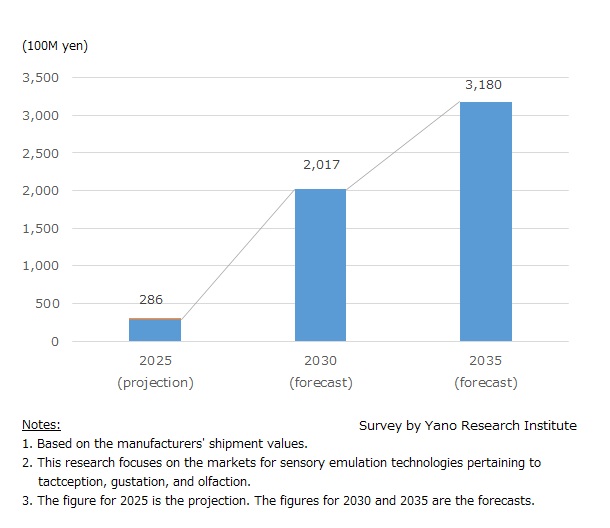
The global human sensory emulation (tactception, gustation, and olfaction) market is projected to attain 28.6 billion yen in 2025, based on the manufacturer shipment values.
Haptics—encompassing tactile, kinesthetic, and pressure sensing—is the primary driver of the market. This technology recreates realistic touch sensations using sensors that detect user interactions and actuators that generate tactile feedback. While vibration actuators for smartphones remain the largest application, haptic technologies are rapidly expanding into automotive, medical, factory automation, and collaborative robot (cobot) applications.
In 2025, haptic robotics emerged as a core technology for automation and remote operation, particularly in labor-intensive industries facing chronic workforce shortages, such as construction, manufacturing, and nursing care.
On the other hand, taste and olfactory sensor technologies are advancing in unique ways, although they represent only a fraction of the global sensory sensing market. Taste sensors are gaining traction in the food and beverage industry as a means of digitizing flavor and preserving artisanal expertise. Because original flavors can be difficult to reproduce without detailed recipes and standardized procedures, taste sensors enable flavor quantification and the transfer of tacit knowledge through data.
Despite ongoing challenges in component analysis and commercial viability, olfactory sensors are seeing wider practical use in nursing care, healthcare, and everyday settings to improve operational efficiency. Example of commercial application include mattress toppers equipped with feces odor sensors (allowing nurses to identify patients requiring immediate care in real time) and odor sensors for railway station restrooms (specifying which restrooms need cleaning).
Noteworthy Topics
Taste Sensors Poised for Broader Adoption
Taste sensing is gaining traction as a technology for quantifying and visualizing taste, particularly in the food industry, where it supports digital transformation and AI-driven flavor and texture analysis. T This advancement has been enabled by the development of taste sensors that replicate the function of human taste buds, allowing the five basic tastes—sweet, umami, salty, sour, and bitter—to be measured objectively.
For instance, food manufacturers use taste sensors to quantify product flavor and visually compare taste profiles with competing products using radar charts. By converting flavor and texture into quantifiable data, these sensors facilitate quality standardization, objective product benchmarking, and product development without relying solely on human sensory evaluation.
Looking ahead, taste sensors have the potential to become a transformative technology not only in the food and food service industries but also in a broader range of applications.
Future Outlook
Taste (gustation) and smell (olfaction) are closely linked, driving the development of multisensory technologies that integrate both modalities. Such solutions are increasingly being introduced for the food, cosmetics, and pharmaceutical industries, where human sensory evaluation remains a critical component of product development.
At present, the expertise and empirical knowledge of trained sensory evaluators remain the most reliable and economically viable means of assessing product quality, and multimodal sensors have yet to match human performance. However, as shortages of skilled professionals intensify and the transfer of tacit knowledge becomes more difficult, companies are accelerating R&D in human sensory emulation technologies while incorporating these technologies into product development. Under the circumstances, commercialization of human sensory emulation technology is poised to advance, and thereby the global human sensory emulation market (tactile, taste, and olfactory) is expected to grow to 31.8 billion yen by 2035.
Research Outline
2.Research Object: Businesses pertaining to magnetic, ultrasonic, mechanic/physics sensors, manufacturers of taste/olfactory sensors and sensor elements
3.Research Methogology: Face-to-face interviews by our expert researchers (including online interviews), survey via telephone or email, and literature research
What is the Global Human Sensory Emulation Market?
Human sensory emulation is a technology for replicating five senses of humans. This research focuses on the markets for sensory emulation technologies pertaining to tactception, gustation, and olfaction, and the global market size is calculated based on the manufacturer shipment values.
The coverage of tactception (touch), gustation (taste), and olfaction (smell) sensor technologies are as follows:
<Tactception / Haptics >
In this report, the tactile sensors encompass tactile/kinesthetic sensors, pressure sensors, vibration actuators, soft actuators, electrostatic actuators, and mid-air haptic devices.
Haptics is a technology that generates realistic tactile sensations through the use of sensors, which detect user interactions, and actuators, which produce or transmit tactile feedback.
<Gustation / Taste>
The taste sensor is an artificial taste sensor modeled after the human tongue. It uses a specialized membrane made from polyvinyl chloride, plasticizers, and various lipids. The sensor mimics the mechanism of taste buds on the human tongue, enabling the five basic tastes—sweet, umami, salty, sour, and bitter—to be quantified as voltage changes in the electrical signals.
<Olfaction / Smell>
The olfactory sensor is a device consisting of an array of non-specific electronic sensors and a pattern recognition system, which identifies odor through pattern recognition of odor molecules instead of measuring odor intensity. In this report, the olfactory sensor market excludes devices for measuring odor intensity, gas detector (gas leak alarm, breathalyzer), and gas chromatograph (GC) or instrument alike, which separates gas compounds for analyzing purposes.
<Products and Services in the Market>
Haptics, taste sensor, olfactory sensor, sensor elements, consumables, services, consulting services
Published Report
Contact Us
The copyright and all other rights pertaining to this report belong to Yano Research Institute.
Please contact our PR team when quoting the report contents for the purpose other than media coverage.
Depending on the purpose of using our report, we may ask you to present your sentences for confirmation beforehand.