No.4133
Dysphagia-Friendly, Mastication-Friendly, and Frailty-Prevention Food Market: Key Research Findings 2026
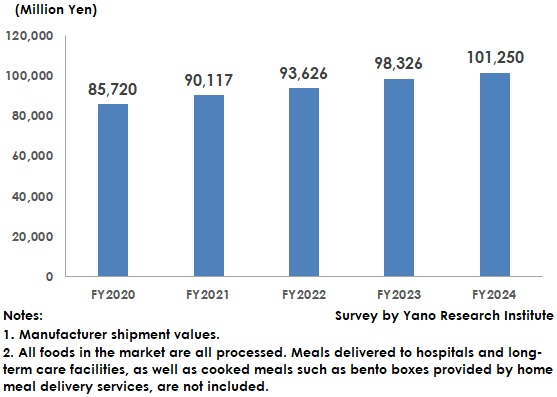
The Total Market for Dysphagia-Friendly, Mastication-Friendly, and Frailty-Prevention Foods Reached 100 Billion Yen in FY2024
Yano Research Institute (the President, Takashi Mizukoshi) conducted a survey of the domestic market of dysphagia-friendly, mastication-friendly, and frailty-prevention food market. The survey revealed market trends by segment, trends among market players, and the future market outlook.
Summary of Research Findings
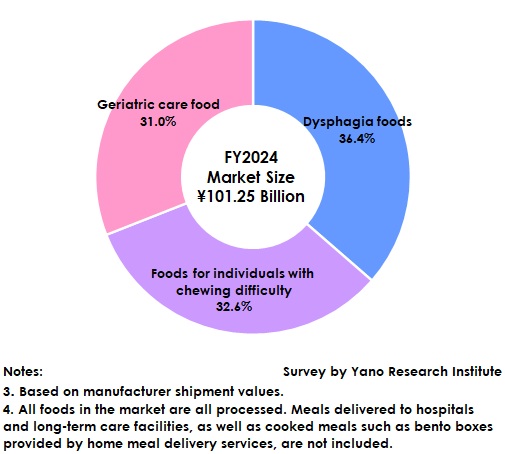
This article refers to food intended for the elderly or individuals with difficulty swallowing or chewing as "dysphagia-friendly" and "mastication-friendly," respectively. It also defines "frailty-prevention food" as nutrient-rich food intended for seniors who lack proper nutrition due to small appetites. This type of food aims to prevent the need for long-term care. In FY2024, the dysphagia-friendly food segment reached 36.86 billion yen, which was a 0.7% increase from the previous fiscal year. The mastication-friendly food segment reached 33.03 billion yen, an increase of 4.3%. The frailty-prevention food segment reached 31.36 billion yen, also an increase of 4.3%.
Market growth was driven by a rapidly aging society, an increasing number of elderly individuals in need of support and care (*), shortages of medical and long-term care professionals, and increased home care and treatment. Improving quality of life (QOL) for the elderly and patients requires support for both proper nutrition and maintaining an appetite. Dysphagia foods, mastication-friendly foods, and frailty-prevention foods support these goals, and these markets are growing.
Demand for labor-saving foods is surging due to kitchen staff shortages in hospitals and long-term care facilities, rising labor costs, and growing dependence on meal delivery services. The increasing popularity of fully prepared frozen foods that can be served directly after thawing and heating, or even thawed naturally or under running water, reflects this trend. These “reheat and serve” meals reduce the workload in various settings.
In home care settings, meals purchased online or through mail-order catalogs are valued for their convenience. They meet the needs of individuals, including those who buy in bulk. Additionally, products that can be stored at room temperature for extended periods have become popular for everyday use and disaster preparedness.
*) Source: Long-Term Care Insurance Business Status (Annual Report) 2023 by the Ministry of Health, Labor, and Welfare.
Noteworthy Topics
Dysphagia-Friendly Foods, Mastication-Friendly Foods, and Frailty-Prevention Foods Will be the Foundation for Medical and Long-Term Care
In the future, the total market for dysphagia-friendly, mastication-friendly, and frailty-prevention foods is expected to grow. This growth will result in a greater variety of products, higher sales volume, expanded usage opportunities, and a changing perception of these foods. Traditionally, these foods were considered highly specialized items used primarily in hospitals and long-term care facilities. However, they have the potential to be used by individuals receiving or providing care at home, as well as by the general public for daily nutrition. They could also be used as emergency food stockpiles and as labor-saving foods in facility operations.
As attention turns to nutrition, frailty, and sarcopenia, frailty-prevention foods are enhancing their preventive features to promote healthy life expectancy. Both dysphagia- and mastication-friendly foods must improve in taste and appearance. They must stimulate appetite through visual appeal, taste, nutritional design, and user-friendliness. All these foods should be developed not only in terms of safety but also in terms of whether they will stimulate continued appetite.
Meanwhile, challenges remain regarding their use among general consumers, including those receiving or providing long-term care at home. These challenges include inadequate product descriptions on packages and at the point of sale, as well as difficulty selecting products. Future market growth depends on creating purchaser-friendly environments in mail order systems, retail outlets, and meal services, by collaborating with medical and long-term care professionals and developing easy-to-understand product labels. The total market for these foods exceeded 100 billion yen by FY2024. Further growth is expected in the medium to long term, as these foods will support the daily diets of the elderly population.
Research Outline
2.Research Object: Manufacturers of dysphagia-friendly, mastication-friendly, and frailty-prevention foods
3.Research Methogology: Face-to-face interviews by expert researchers, survey by telephone, and literature research
What is the Market for Dysphagia-Friendly, Mastication-Friendly, and Frailty-Prevention Foods?
This research defines dysphagia-friendly food as processed food intended for elderly individuals or patients with swallowing difficulties. Mastication-friendly food is processed food intended for individuals who have difficulty chewing, such as the elderly or patients. Frailty-prevention food is defined as processed food supplemented with sufficient nutrients to prevent the elderly from requiring long-term care. Market size is based on manufacturer shipment values. Meals delivered to hospitals and long-term care facilities, as well as cooked meals such as bento boxes provided by home meal delivery services, are not included.
<Products and Services in the Market>
Dysphagia-friendly foods include jellied foods, gelling agents, dessert bases, and jellies that replenish water. Mastication-friendly foods include softened, chopped, ground, or milled foods, and other foods that maintain their shape and jellied foods. Frailty-prevention foods include high-protein and high-vitamin foods, and low-calorie foods.
Contact Us
The copyright and all other rights pertaining to this report belong to Yano Research Institute.
Please contact our PR team when quoting the report contents for the purpose other than media coverage.
Depending on the purpose of using our report, we may ask you to present your sentences for confirmation beforehand.