No.4120
Car Rental & Car Sharing Services Market in Japan: Key Research Findings 2026
Domestic Car Rental Market and Car Sharing Services Market Projected to Reach 1.20 Trillion Yen and 0.18 Trillion Yen by 2030, Respectively
Yano Research Institute (the President, Takashi Mizukoshi) has recently announced the release of a market report “Car Rental & Car Sharing Services Market 2026”, exploring the market’s current status, market trends, and future perspective.
Market Overview
According to the All Japan Rent-a-Car Association (ARA), the number of rental vehicles as of the end of March 2025 (FY2024) hit a record high of 1,168,522 units, up 6.6% from the previous fiscal year. Passenger car rental has grown steadily since 2022, driven by a resurgence of overall tourism including the return of inbound tourists, and fleet right-sizing at enterprises. Demand for trucks and special purpose vehicle rentals, which are largely used by construction industry engaged in public and private works, grew against the backdrop of reconstructions following the Noto Peninsula Earthquake and other natural disasters, as well as construction for the Osaka-Kansai Expo and semiconductor foundries and large-scale manufacturing facilities particularly in Kyushu region.
Meanwhile, the number of car sharing fleets reached 74,887 units* as of the end of March 2025 (FY2024), representing 12.0% increase from the previous fiscal year. Alongside the consumer shift to “access over ownership”, demand growth has been witnessed since the data aggregation started in 2022.
(*The number of vehicles used for car sharing is the estimate by Yano Research Institute, based on the data of the Foundation for Promoting Personal Mobility and Ecological Transportation.)
Noteworthy Topics
Average Rental Costs: Car Rental 11,304 Yen / Car Sharing Service 6,652 Yen
In March 2026, Yano Research Institute conducted a consumer survey on car rentals and car sharing. Target audience was domestic consumers, male and female, in their age between 20 and 69. According to 11,352 respondents who have used car rental, that average cost of car rental was \11,304. Meanwhile, according to 1,860 respondents who have used car sharing services, the average cost of car sharing was \6,652.
Furthermore, according to 500 respondents (multiple answers) randomly picked from users of each service, primary purpose for car rental was occasional events like trips and leisure, while for car sharing service also included much shorter trips such as grocery shopping. The gap between the average cost for car rental and car sharing stems most likely from this difference in purpose of use.
Amidst the resurgence of tourism demand, optimal fleet allocation that aligns with customer segment and usage is essential for market expansion.
Future Outlook
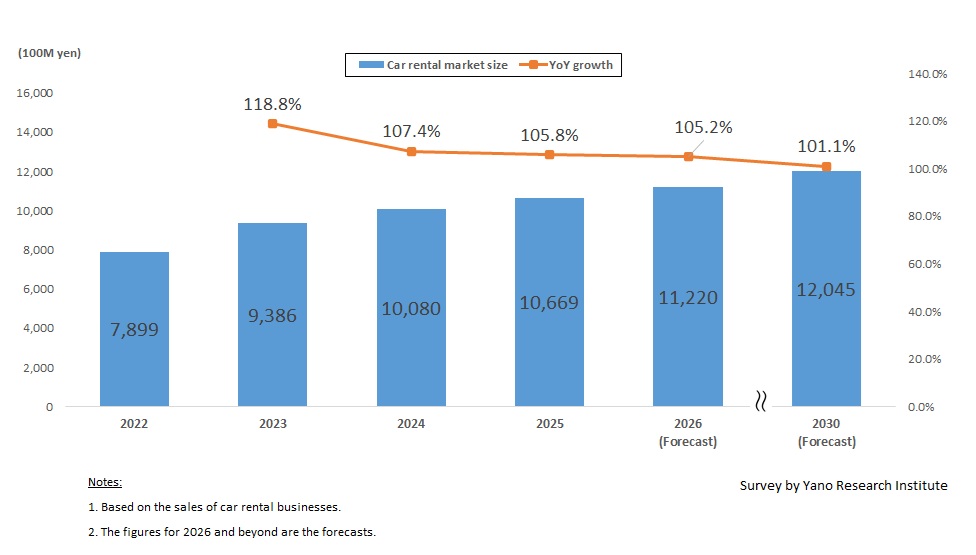
Demand for car rentals grew in tandem with the surge in the number of foreign tourists to Japan, fleet right-sizing at enterprises, and “access over ownership” among consumers. Coupled with the price rise due to price hike for raw materials and labor costs, the market size for car rentals is sized at approximately 1 trillion yen in 2025 and is expected to reach 1.2 trillion yen by 2030.
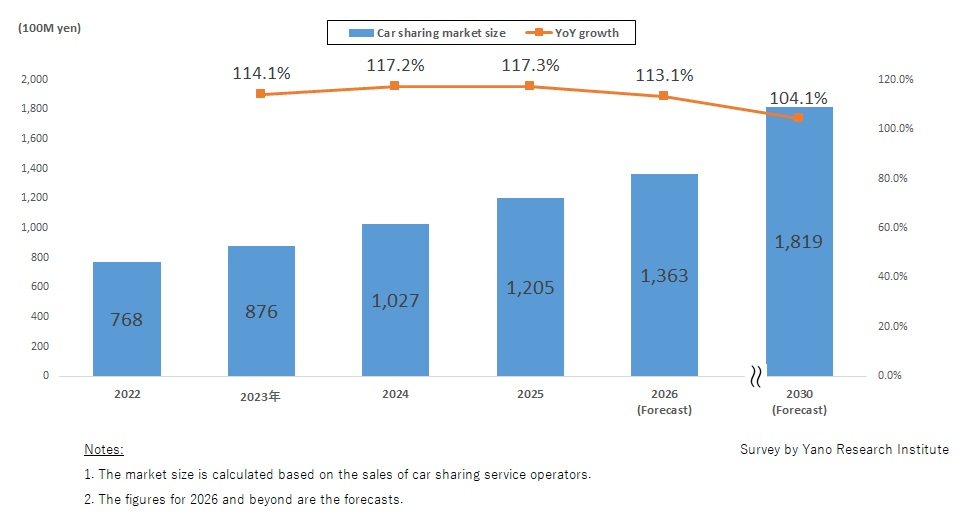
The car-sharing services segment is further supported by the growing “access over ownership” trend and rising demand among corporate customers. The market size is valued at approximately 0.12 trillion yen in 2025 and is projected to reach 0.18 trillion yen by 2030.
Research Outline
2.Research Object: Car rentals, car sharing services, car rental platforms, car sharing platform services, and users of car rentals and car sharing services
3.Research Methogology: Face-to-face interviews with key enterprises, online consumer survey
What is the Car Rental & Car Sharing Services Market?
【Car Rental】
Car rental in Japan is a paid service where businesses licensed to provide Private Car Rental Business (by applicable District Transport Bureau) allow customers to use vehicles without ownership. The market size of car rental is estimated based on the number of vehicles for car rentals, which is aggregated by the Ministry of Land, Infrastructure, Transport and Tourism (MLIT). These vehicles encompass passenger cars, light vans, buses, trucks, and special purpose vehicles (tank lorries, garbage trucks, etc.)
【Car Sharing】
Car sharing is a membership-based vehicle rental service, where users use fleets at “car sharing stations”, which are located in designated residential or commercial areas like coin parking. While car sharing service is also provided solely by the businesses licensed to provide Private Car Rental Business, it differs from car rental in that car sharing stations are basically unmanned and pricing is designed for shorter trips, typically set per quarter of an hour.
In this research, the car sharing services market excludes C2C(P2P) car sharing platforms.
<Products and Services in the Market>
[Car rental] passenger cars, light vans, buses, trucks, and special purpose vehicles; [Car sharing] passenger-car sharing services; excluding C2C car sharing platforms
Published Report
Contact Us
The copyright and all other rights pertaining to this report belong to Yano Research Institute.
Please contact our PR team when quoting the report contents for the purpose other than media coverage.
Depending on the purpose of using our report, we may ask you to present your sentences for confirmation beforehand.