No.4082
Baby-Related Businesses in Japan: Key Research Findings 2026
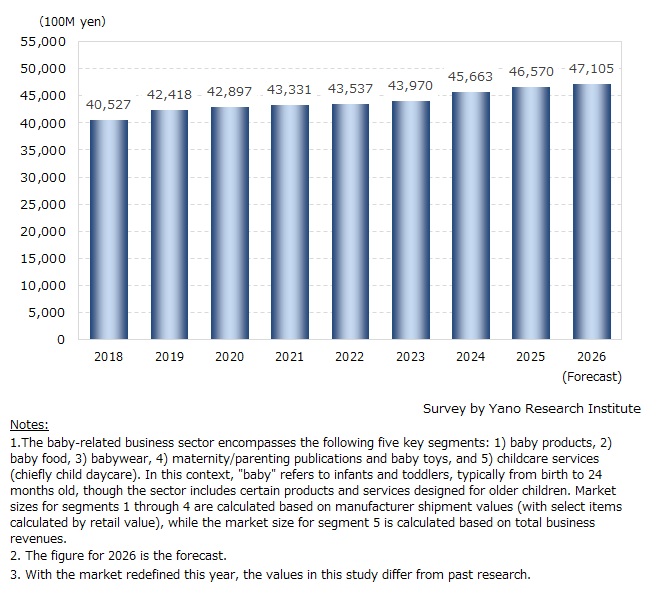
Domestic Baby-Related Businesses Sized at 4.657 Trillion Yen in 2025 (Up 1.2% YoY)
Yano Research Institute (the President, Takashi Mizukoshi) has conducted a survey on the domestic businesses in the market for early childhood care/products and maternity products, and found out the market trend by segment, the trends of market players, and summarized future outlook.
Market Overview
The market size of baby related businesses in Japan (as a total of five key segments) in 2025 is estimated at 4.657 trillion yen, which represents 2.0% increase from the previous year. While declining birthrate*1 is impacting overall demand, market growth is underpinned by the expansion of babycare services (primarily child daycare). In detail, year-over-year growth was witnessed in two segments (babycare services and publications/toys) while other three segments diminished.
Babycare services segment (child daycare) sustained marginal growth. Despite a headwind from declining enrollment, the segment was buoyed by government birthrate initiatives and public subsidy programs. In the publication and toy categories, sales of parenting publications and infant/toddler toys remained steady, anchored by the enduring popularity of long-selling picture books and established titles. Demand for educational toys was particularly robust, driven by a strong parental focus on early cognitive development and products that facilitate parent-child bonding.
In contrast, the baby products segment—including food and clothing—experienced an overall downward trend. While price hikes temporarily boosted revenue for certain items, the broader segment was heavily impacted by a contracting customer base driven by the declining birthrate.
*1 Source: Vital Statistics, Ministry of Health, Labour and Welfare
Noteworthy Topics
Impact of Price Increases
Revenue growth in selected segments was fueled by retail price increases in response to rising input costs.
In the baby product category, the market for paper baby diapers has experienced volatility over the past five years. Although shipment volumes have dropped since 2020*2, shipment value recovered in 2024 and is projected to post modest growth in 2025.
Despite the ongoing impact of declining birthrates, the market for baby bottles and replacement nipples expanded in 2025. This growth was driven by price increases implemented by leading manufacturers, alongside higher unit prices for premium, function-rich products. Meanwhile, demand in the toys category has remained relatively stable, supported by heightened parental emphasis on early childhood cognitive development. Retail prices across this segment have also trended upward in response to rising material costs.
Looking ahead, further price increases are anticipated in 2026 due to escalating materials, manufacturing, and logistics costs. As a result, certain segments are expected to continue demonstrating value growth.
*2 Source: Production Trends Statistics, Ministry of Economy, Trade and Industry
Future Outlook
Going forward, the outlook for the five key baby-related segments remains weak, as the declining birthrate*1 and contracting child population*1 continue to constrain the market. Modest growth is expected over the next few years, largely driven by the babycare service segment (child daycare), which benefits from public subsidies and government initiatives addressing the declining birthrate crisis. However, long-term prospects remain uncertain as declining daycare enrollment creates persistent headwinds for the industry.
The primary challenge for baby-related businesses in Japan lies in mitigating the risks of a shrinking customer base. To address this, companies are focusing on developing premium products to stimulate new domestic demand, and/or expanding their overseas operations—a strategy most likely to be led by large enterprises.
Research Outline
2.Research Object: Businesses in early childhood care/products and maternity products
3.Research Methogology: Face-to-face interviews (including online interviews) by our expert researchers, telephone interviews, email interviews, and secondary research
The Baby-Related Businesses
The baby-related business sector encompasses the following five key segments: 1) baby products, 2) baby food, 3) babywear, 4) maternity/parenting publications and baby toys, and 5) childcare services (chiefly child daycare). In this context, "baby" refers to infants and toddlers, typically from birth to 24 months old, though the sector includes certain products and services designed for older children. Market sizes for segments 1 through 4 are calculated based on manufacturer shipment values (with selected items calculated by retail value), while the market size for segment 5 is calculated based on total business revenues.
<Products and Services in the Market>
1) Baby products: Baby bottles/replacement nipples, baby tableware, paper baby diapers, skincare products, baby bed/beddings, baby strollers, highchairs/infant seats, baby swings, child safety seats (booster seats), baby carriers 2) Baby food: Baby formula, baby food 3) Baby clothes: babywear, baby shoes, maternity clothing 4) Publications & toys: maternity/baby magazines, picture books, books and toys for early cognitive development, baby toys for infants, toddlers, and newborns 5) Babycare services (child daycare)
Published Report
Contact Us
The copyright and all other rights pertaining to this report belong to Yano Research Institute.
Please contact our PR team when quoting the report contents for the purpose other than media coverage.
Depending on the purpose of using our report, we may ask you to present your sentences for confirmation beforehand.