No.4062
Stablecoin Market in Japan: Key Research Findings 2026
Domestic Stablecoin Market Surge to 14.7 Trillion Yen-Level
Yano Research Institute (the President, Takashi Mizukoshi) has surveyed the stablecoin market in Japan and evaluated the future outlook.
Market Overview
A stablecoin is a type of crypto tokens whose value is designed to be stable, typically through a peg to a fiat currency.
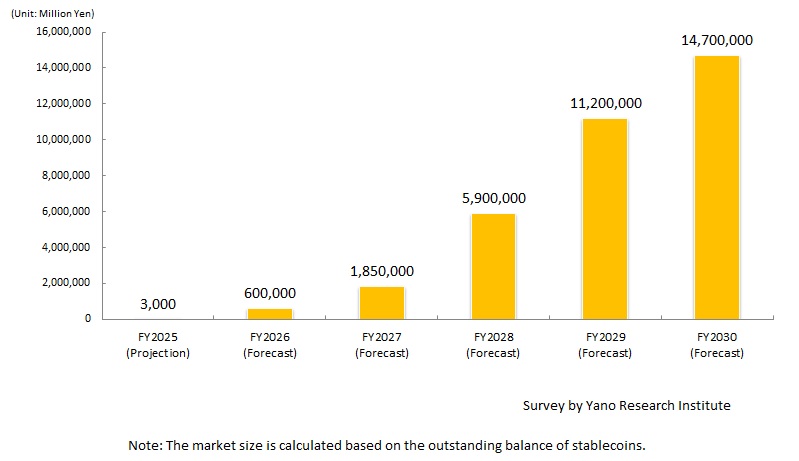
The size of the stablecoin market in Japan (based on the outstanding balance) is projected to attain 3,000 million yen in FY2025. Forecasts for FY2030 suggest an expansion to 14.7 trillion yen on this same basis. When aggregated with the projected market size tokenized deposits, it is poised to reach 30 trillion yen.
The Amended Payment Services Act (PSA) of 2023 defined stablecoin as "Electronic Payment Instrument" (EPI) and established a comprehensive legal framework for stablecoin ecosystem. Overall, the Japanese system reflects the government policy, which prioritizes stablecoin’s reliability as payment instrument; in other words, a primary objective of officially legalizing stablecoin is to “ensure as a means of payment equivalent to cash”, not for investment or asset management.
There is a growing momentum for stablecoin in Japan since JPYC Inc., the Fund Transfer Service Provider, issued a first yen-collateralized stablecoin in October 2025. Anticipation for the launch of trust-based (bank-backed) stablecoins are much awaited.
Noteworthy Topics
Programmable Money
Beyond traditional B2B settlements and cross-border remittances, use case of stablecoin is expected to expand in B2C payments and payroll, particularly through the implementation of programmable money.
Programmable money is digital currency with embedded logic or conditions that automate financial execution when predefined triggers are met. As AI systems evolve into AI Agents, these agents will require “financial capabilities” that enable them to execute transactions on their own. In this context, stablecoins as programmable money have the potential to be put into practical use as an economic infrastructure that allows AI agents to purchase data, access computing resources, and pay for other services in real time.
Practical use of stablecoin as programmable money is expected to proceed quickly in investment and asset management field, such as the case where investment performance parameters—such as expected returns and risk tolerance—are preset prior to selecting the optimal investment targets or automating investments while capping the amount. This is the enhancement of conventional AI investing. Programmable money enables AI Agent to take more integrated approach in investment and asset management.
Future Outlook
Stablecoins are more than just an alternative currency for traditional trade; they are the enabler of a "new commercial stream." The use of stablecoins as programmable money for investment and asset management will expand the market substantially.
By FY2026, the use of stablecoins for AI payments is projected to become viable, facilitating instant, reliable fund transfers 24/7/365. Against this background, the stablecoin market size is expected to surge in FY2026. The primary user base for programmable money will consist of institutional and individual investors. In this ecosystem, stablecoins issued by FTSP will serve as a key currency, excelling in flexibility and compatibility with smart contracts (self-executing digital agreements with terms written directly into code). In contrast, B2B and B2C payment adoption will require more time for full implementation; they are expected to represent less than 10% of the total market even by FY2030.
The rise of stablecoins will bring structural changes to conventional banking. Looking ahead, traditional business models based on commission revenue and deposits will transform as the financial sector increasingly adopts blockchain technology. From a medium- to long-term perspective, onchain finance will be predominant in the industry.
FY2026 will be the year when practical use cases and business models for stablecoins are fully explored, marking a turning point toward an ideal growth scenario.
Research Outline
2.Research Object: Stablecoin issuers and companies related to stablecoin
3.Research Methogology: Face-to-face interviews by our expert researchers, complementary literature research
A stablecoin is a type of crypto tokens designed to maintain a consistent value, typically by being pegged to a fiat currency.
In June 2023, the Japanese Financial Services Agency (FSA) implemented an amended Payment Services Act (PSA). The legislation formally defined stablecoins as "Electronic Payment Instrument" (EPI) and established a comprehensive regulatory framework for issuers (including Fund Transfer Service Providers; FTSP) and intermediaries.
There are three types of stablecoins based on their stabilization mechanism: fiat-collateralized, crypto-collateralized, and algorithmic. Fiat-collateralized stablecoin maintains a 1:1 peg to a fiat currency and is backed by cash or cash-equivalent reserves.
Here, the stablecoin market size forecasts are calculated based on the outstanding balance of stablecoins (total supply minus total redemptions). Note that numbers refer only to the stablecoin market in a narrow sense (i.e., excluding tokenized deposits).
<Products and Services in the Market>
Stablecoin, stablecoin issuance services
Published Report
Contact Us
The copyright and all other rights pertaining to this report belong to Yano Research Institute.
Please contact our PR team when quoting the report contents for the purpose other than media coverage.
Depending on the purpose of using our report, we may ask you to present your sentences for confirmation beforehand.