No.4040
Health Food Market in Japan: Key Research Findings 2026
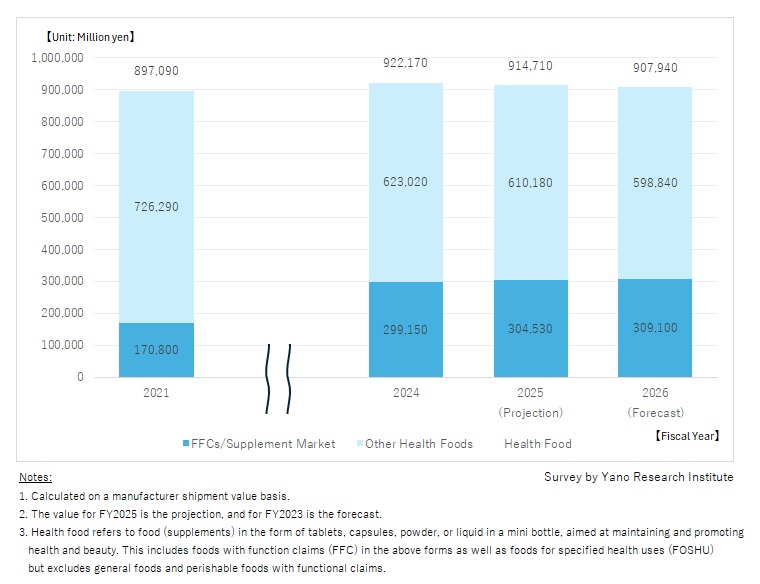
FY2025 Health Food Market Size Projected to Decline 0.8% YoY to 914,710 Million Yen
Yano Research Institute (the President, Takashi Mizukoshi) surveyed the markets of health foods and foods with functional claims in Japan and found out the trends by segment, the trends of market players, and perspectives.
Market Overview
The health food market in Japan is estimated at 922,170 million yen in FY2024 and is projected to be 914,710 million yen in FY2025, down 0.8% year on year. In FY2024, although the red yeast rice issue that came to light in March 2024 dealt a significant blow to lifestyle disease prevention measures, particularly cholesterol-lowering supplements, demand shifted toward forms closer to general food products, such as powders, resulting in a slight overall increase.
From the perspective of distribution channel trends, Direct-to-Consumer (D2C) segment accounts for a significant share of the health food market. However, direct sales (door-to-door sales) continue to decline due to an aging sales force and difficulties in acquiring new customers. Similarly, the traditional mail-order business model faces challenges as the “single-product” approach (selling one flagship item via catalog/TV) loses its former momentum.
In contrast, the online sector—including both domestic and international e-commerce platforms—is showing robust growth. Additionally, startups leveraging contract manufacturing (OEM) are actively entering the market through online-first strategies. This momentum in the online sector is expected to continue for the foreseeable future.
Among offline channels, drugstores remain the most dominant. Although the trade area per store is shrinking due to intense competition—and rising construction costs are making new openings difficult—the total number of stores continues to grow. Several factors are driving this sector's success: aggressive customer acquisition (expanding food sections at competitive prices), the addition of in-store pharmacy services, "dominant" regional rollout strategies, and active M&A activity. As a result, health food sales within drugstores are increasing.
General food retailers (supermarkets and convenience stores) also show strong performance. Convenience stores are essential for "single-serve" bottled products, such as anti-hangover supplements and energy boosters. Supermarkets are effective at driving impulse purchases of health foods alongside daily groceries.
In contrast, specialty health food retailers (such as organic grocers) are declining, particularly in regional areas, due to fierce competition with drugstores and online platforms. Furthermore, other channels—including the service sector—are seeing sluggish sales. This is attributed to an end of pullback in demand following the COVID-19 pandemic and the fact that new product merchandising has reached a plateau at these sectors.
Noteworthy Topics
Trends of Foods with Functional Claims by Category
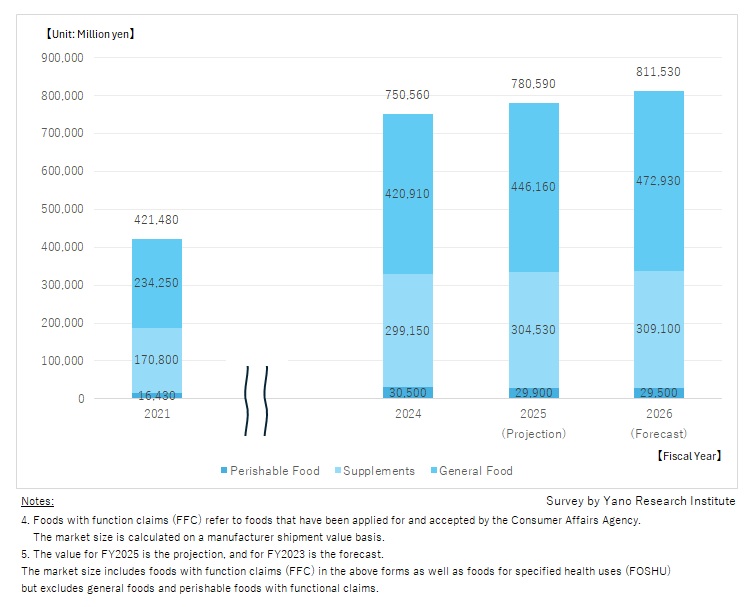
Although the red yeast rice scandal in 2024 severely impacted the Foods with Function Claims (FFC) market—particularly supplements for reducing cholesterol to prevent lifestyle-related diseases—overall market growth was supported by strong sales of other established FFC products.
However, the subsequent tightening of FFC regulations led many businesses to withdraw their notifications from the Consumer Affairs Agency (CAA), while other products were suspended. Furthermore, increased price sensitivity among consumers (due to rising costs since the latter half of FY2024) has weakened new customer conversion rates. This has forced companies, especially mail-order vendors, to reduce their advertising expenditure. As a result, a slowdown in the FFC market is expected.
In perishable food segment, stricter regulatory environment has prompted many agricultural producers to withdraw their CAA notifications to avoid rising compliance costs while climate change has negatively affected crop yields. Consequently, the total FFC market size is forecasted to decline in FY2025.
Future Outlook
The red yeast rice scandal, coupled with increased price sensitivity and rising logistics costs, has led to a decline in supplement subscriptions. However, overall demand for health foods continues to be driven by growing health consciousness, rising demand for immune-support products, and a heightened interest in health and beauty among younger consumers. Consequently, the total market is expected to sustain moderate growth.
Research Outline
2.Research Object: Health food manufacturers and distributors (including general food manufacturers and pharmaceutical manufacturers), health food organizations, and the authorities concerned
3.Research Methogology: Face-to-face interviews (including online) by expert researchers, telephone interviews, mailed or emailed questionnaires, and literature research
What is the Health Food Market?
In this research, health food refers to food (supplements) in the form of tablets, capsules, powder, or liquid in a mini bottle, aimed at maintaining and promoting health and beauty. The market size is calculated on a manufacturer shipment value basis. Note that the health food market includes Foods with Function Claims (FFC) in the above forms as well as Foods for Specified Health Uses (FOSHU) but excludes general foods and perishable foods with functional claims.
What are Foods with Function Claims?
Foods with function claims (FFC) refer to foods that have been applied for and accepted by the Consumer Affairs Agency. The market size is calculated on a manufacturer shipment value basis. FFCs are categorized into dietary supplements (those in the form of a tablet, capsule, powder, or liquid in a mini bottle), general foods, and perishable foods.
<Products and Services in the Market>
Green Juice (Aojiru), collagen, multivitamin, glucosamine, protein, enzyme, vitamin C, DHA/EPA, black vinegar/spiced vinegar, etc.
Published Report
Contact Us
The copyright and all other rights pertaining to this report belong to Yano Research Institute.
Please contact our PR team when quoting the report contents for the purpose other than media coverage.
Depending on the purpose of using our report, we may ask you to present your sentences for confirmation beforehand.