No.4026
Healthcare Startups in Japan: Key Research Findings 2026
Approximately 40% of Healthcare Startups Altered Their Exit Strategy, Which Led to Diversification
Yano Research Institute (the President, Takashi Mizukoshi) conducted a corporate questionnaire to healthcare startups in Japan and found out their current status and future perspectives. This press release denotes some of our findings from the questionnaire.
Summary of Research Findings
A corporate questionnaire was conducted among 122 domestic healthcare startups from October to December 2025. This survey covered their focus areas, the status of support received, and their current business management, including business outlook. This press release discloses some of the survey results.
When asked about their primary business domain, 36.1% of respondents selected "Drug discovery (including vaccines),” the most popular response. The next three most popular responses were “Prevention” (products and services primarily aimed at preventing specific diseases, preventing severe cases, or enabling early detection), accounting for 23.8%, “Information technology (IT) or artificial intelligence (AI),” and “Medical equipment,” accounting for 23.8%, 21.3%, and 20.5%, respectively. Respondents were able to select multiple responses from a list of options.
Noteworthy Topics
Approximately 40% of Healthcare Startups Altered Their Exit Strategy
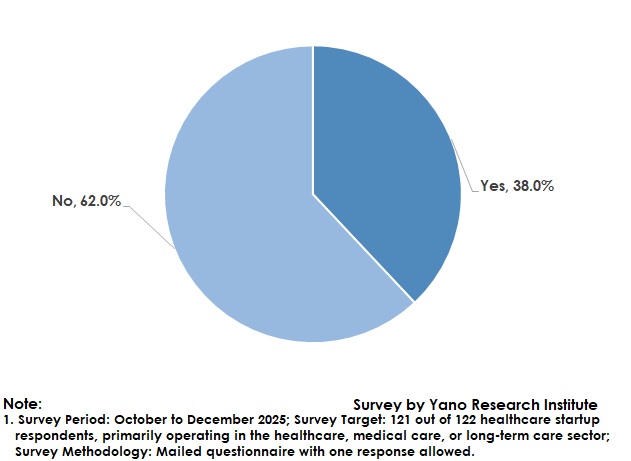
Of the 121 respondents from 122 companies, 38% answered “yes” to the question of whether they had experienced any alterations in their exit strategies since their inception. This suggests that approximately 40% of healthcare startups have changed their exit strategies. The question allowed single response.
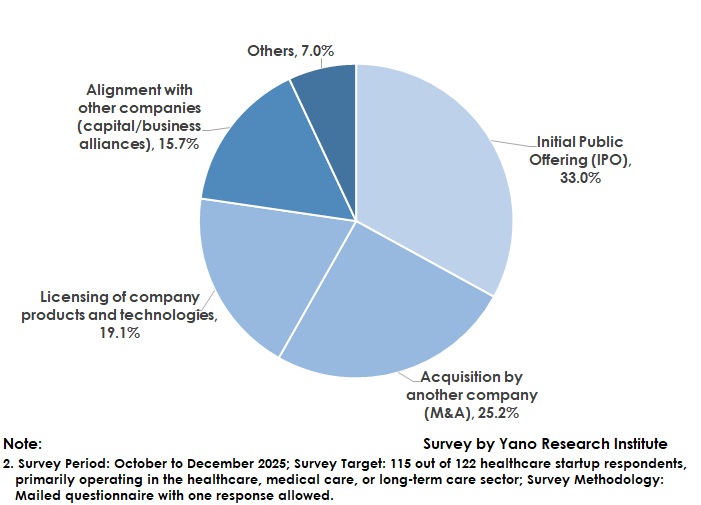
When asked about their current exit strategy, 115 out of 122 companies responded. The most popular response was “Initial Public Offering (IPO)” accounting for 33.0% of responses, followed by “acquisition by another company (M&A)” accounting for 25.2%.
The challenges facing startups have long been recognized, such as overreliance on IPOs. This survey revealed that healthcare startups have sought various exit strategies tailored to their business operations and environment, which led to diversification.
Research Outline
2.Research Object: Domestic startups in the business domain of healthcare or medical care ("healthcare startups")
3.Research Methogology: Face-to-face interviews by our expert researchers (including online interviews), mailed questionnaire, and literature research
What are Healthcare Startups?
This survey defines healthcare startups as newly established businesses whose business domain is primarily in healthcare or medical care sector (referred to collectively as "healthcare" in Japan), or in the long-term care sector. The definitions of startups and so-called “venture companies,” a term used only in Japan in relation to venture capital, vary. This survey defines these terms as follows:
Startups: Companies that have operated for 10 years or less since establishment and aim for rapid growth and expansion by receiving funding.
Small-to-medium enterprises (SMEs): Companies whose businesses are small to medium that aim for stable and steady growth through self-funding or debt financing, regardless of the years since establishment.
“Venture companies”: Of the above startups and SMEs, companies that have been in business for about 20 years.
Healthcare startups: Of the above “venture companies,” those whose primary business domain is healthcare, medical care, or long-term care.
This survey is a corporate questionnaire conducted among 122 healthcare startups from October to December 2025. The survey covered their focus areas, the status of support received, and their current business management, including business outlook. This press release discloses some of the survey results.
<Products and Services in the Market>
Healthcare, medical care, and long-term care products and services provided by healthcare startups.
Published Report
Contact Us
The copyright and all other rights pertaining to this report belong to Yano Research Institute.
Please contact our PR team when quoting the report contents for the purpose other than media coverage.
Depending on the purpose of using our report, we may ask you to present your sentences for confirmation beforehand.