No.4140
Personal Healthcare Services Market Market in Japan: Key Research Findings 2026
Personal Healthcare Services Are Developed to Offer Seamless Coverage from Healthcare to Medical Scopes
Yano Research Institute (the President, Takashi Mizukoshi) conducted a survey of the personal healthcare services market in Japan. The survey revealed trends by services, trends among market participants, and future market outlook.
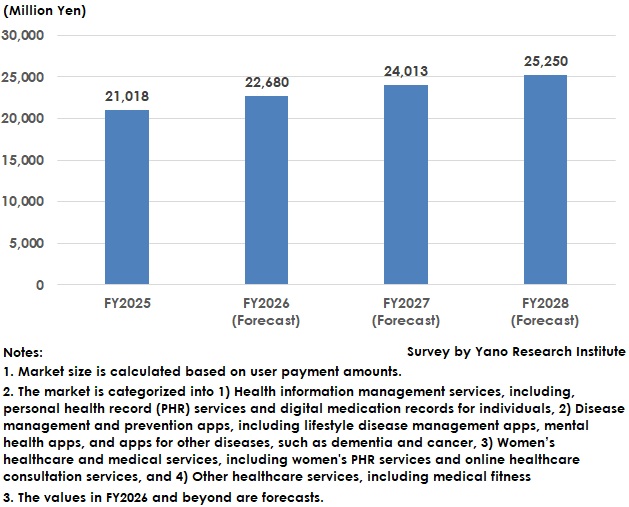
Market Overview
A personal health record (PHR) refers to a person's health and medical data throughout their lifetime, as well as the scheme to manage and leverage that data, which is agreed upon by the person. PHR services are typically free and can connect to health instruments, such as blood pressure monitors and women’s thermometers, as well as wearable devices and smartphone apps with pedometers. The data collected can be stored in the cloud, improving information accuracy and convenience.
In recent years, PHR service providers have developed gaming features for their applications to encourage continued use. These efforts include rewarding users with points (incentives) when they open their apps, record their diet and medication, and log their number of steps and distance walked. Users can compete for these points. Some apps allow users to interact with app characters. Paid PHR services use AI to provide personalized, optimal services to each user. These services include providing specialized information and offering specific services, such as support for activities related to conceiving a pregnancy, losing weight, and strength training, and health and medication consultations. Some services offer packages of multiple healthcare apps and services. These services have evolved to encompass not only health but also medical care, and this trend is likely to continue.
In addition to offering services to individuals, many PHR service providers offer PHR services to municipalities and enterprises, anticipating a certain level of demand. Demand from enterprises is particularly high because PHR services have been added to the requirements for companies to be certified as a “Health Management Excellence Corporation.”
Noteworthy Topics
Disease Management and Prevention Through DTx and Apps Are Drawing Attention
This research defines disease management and prevention apps as those healthcare apps designed for the management, prevention, and early detection of diseases. These apps are not medical device apps. Disease management and prevention apps include lifestyle disease management apps and mental health apps. Market participants are planning to develop mental health apps as digital therapeutics (DTx) rather than healthcare apps. If these apps are approved as medical devices and covered by insurance, their developers and providers can generate revenue. This could attract attention as a new monetization method. However, due to the recent operational environment, app providers are divided between those that continue to develop by leveraging partnerships and those that focus on non-software-as-a-medical-device (SaMD) apps, which are not medical devices. Nevertheless, plans to transition to DTx are emerging in healthcare apps other than the disease management and prevention apps covered in this research.
Meanwhile, lifestyle disease apps are likely to generate revenue primarily through the B2B2C model. In this model, companies, health insurance associations, and municipalities provide apps to consumers. Some use cases are observed at health insurance associations for health guidance support services, driven by government incentive policies aimed at controlling medical costs and preventing the progression of lifestyle diseases and diabetes.
Future Outlook
Given the growing interest in preventive medicine in an aging society, the demand for personal healthcare services is expected to increase. Going forward, AI-powered, personalized services that are optimized for each customer, as well as packages combining multiple services, are expected to attract certain customers. The trend of services covering from healthcare to medical care is likely to continue.
Research Outline
2.Research Object: Personal healthcare service market participants
3.Research Methogology: Face-to-face interviews (including online interviews) by our expert researchers and literature research
What is the Personal Healthcare Services Market?
This research categorizes the personal healthcare services market into four segments:
1) Health information management services, including personal health record (PHR) services and digital medication records for individuals;
2) Disease management and prevention apps, comprising lifestyle disease management apps, mental health apps, and apps for other diseases, including dementia and cancer;
3) Women’s healthcare and medical services, including Women's PHR services and online healthcare consultation services;
4) Other healthcare services, including medical fitness.
Market size is calculated based on user payment amounts. Please note that the market sizes for digital medication records and apps for other diseases have not been calculated.
Note that this research defines disease management and prevention apps as those healthcare apps (non-medical device apps) designed for the management, prevention, and early detection of diseases. Apps intended solely for general health management or weight loss are excluded. Furthermore, only apps available to individual consumers are included; those intended exclusively for businesses or insurance providers are excluded.
<Products and Services in the Market>
Personal health record (PHR) services and digital medication records for individuals, lifestyle disease management apps, mental health apps, women’s PHR services, women’s online healthcare consultation services, and medical fitness services
Published Report
Contact Us
The copyright and all other rights pertaining to this report belong to Yano Research Institute.
Please contact our PR team when quoting the report contents for the purpose other than media coverage.
Depending on the purpose of using our report, we may ask you to present your sentences for confirmation beforehand.