No.4013
Nutritional Formulas, Liquid Foods, and Nutritional Supplements in Japan: Key Research Findings 2026
Labor Shortages Fuel the Use of Labor-Saving Products for Nutritional Formulas and Liquid Foods
Yano Research Institute (the President, Takashi Mizukoshi) conducted a survey of the domestic market for nutritional formulas, liquid foods, and nutritional supplements. The survey revealed trends by product segment, trends among market players, and the future market outlook.
Market Overview
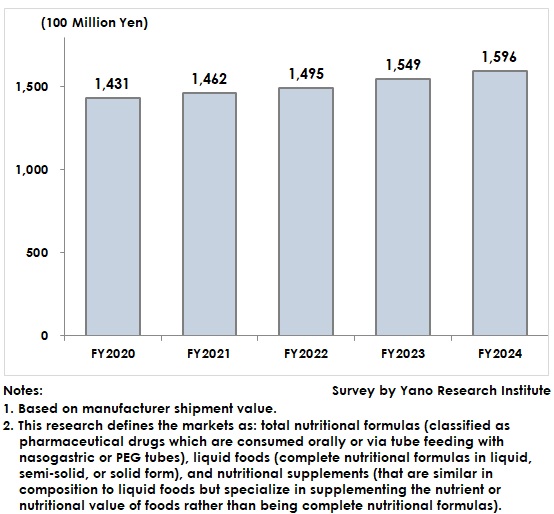
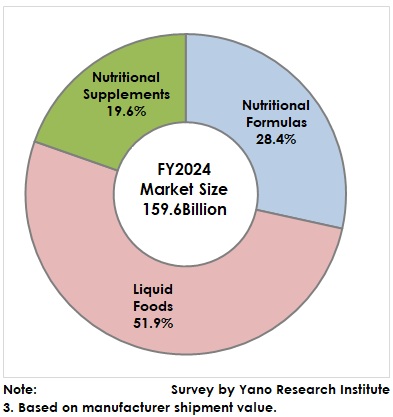
Based on manufacturer shipment value, the total market for nutritional formulas, liquid foods, and nutritional supplements reached 159.6 billion yen in FY2024, a 3.0% increase from the previous fiscal year. The breakdown is as follows: nutritional formulas reached 45.4 billion yen, up 6.6% year over year, liquid foods reached 82.88 billion yen, up 0.8%, and nutritional supplements reached 31.36 billion yen, up 4.3%.
The growth of the nutritional formula market was driven by high-concentration products, which provide efficient nutritional support in small doses. These products primarily met the demand of home care recipients who preferred oral consumption. Semi-solid nutritional formulas for gastrostomy patients were also popular due to their shorter administration time.
The liquid foods market experienced increase in unit selling prices due to higher prices stemming from rising costs of raw materials and energy. However, sales volumes slowed due to stricter budget management in hospitals and elderly care facilities. Nevertheless, severe labor shortages in medical and long-term care facilities have led to a shift toward products that contribute to work efficiency, such as refill-free, high-concentration, and small-dose products.
Similar trends were seen in the nutritional supplement market, where jelly-type or high-concentration products were preferred to reduce cooking and care labor. In conjunction with price revisions, this increased the market size. Overall, market growth is supported by value-added products that address the needs of frail older adults and reduce labor requirements.
Noteworthy Topics
Inpatient Diet Therapy Fee Raised for Two Consecutive Years
For the first time in nearly thirty years, the inpatient diet therapy fee increased for two consecutive years. The standard amount for this fee remained unchanged until June 2024 when it increased by 30 yen per meal. Then, it increased again by 20 yen per meal in April 2025. These increases were caused by deteriorating income in the hospital meal sector due to rising food and utility costs. This revision will directly impact the economies of hospital and elderly care facility operations.
The calculation amount for cases where only liquid foods are provided has also increased. However, the reduced calculation provision for using commercially available liquid foods has not been abolished. This continues to affect the cost balance and choice between pharmaceutical nutritional formulas and commercially available liquid foods.
Considering the relationship with the overall market for nutritional formulas, liquid foods, and nutritional supplements, this revision significantly alters the external environment that directly affects the budget for purchasing these items. Public price increases, which complement the rise in meal costs, will influence hospitals and elderly care facilities to decide whether to accept price pass-through and adopt value-added products, such as high-concentration or refill-free products. Healthcare and nursing settings are under pressure to reduce costs while improving work efficiency. This system revision will be a key factor in future product selection.
Future Outlook
The total market for nutritional formulas, liquid foods, and nutritional supplements is expected to grow slightly beyond 2025, with forecasted growth in nutritional formulas and supplements and a slight increase in liquid foods. The market will grow overall due to an increasing number of home care recipients and an aging population.
The nutritional formula market is expected to grow through FY2029, due to insurance coverage benefits among home care recipients and the increased availability of concentrated products.
The liquid food market is expected to experience declining usage and price competition among generic products. However, these losses will likely be offset by sales of products intended for oral consumption and value-added products. Consequently, the market is forecast to grow slightly, with an annual growth rate of around 1%.
The nutritional supplement market is projected to continue growing at the rate of 2% to 3%, due to solid demand for products that counter malnutrition among the elderly.
Research Outline
2.Research Object: Manufacturers of nutrition formulas, liquid foods, and nutrition supplements
3.Research Methogology: Face-to-face interviews by our expert researchers (including online interviews), survey via telephone, and literature research
What are the Markets of Nutritional Formulas, Liquid Foods, and Nutritional Supplements?
This research defines the markets as follows:
- “Nutritional formulas” refer to foods containing balanced mixtures of macronutrients including carbohydrates, proteins, and fats, as well as minerals, vitamins, and other nutrients. These formulas are classified as pharmaceutical drugs in the form of liquid or powder and are consumed orally or via tube feeding with nasogastric or PEG tubes.
- “Liquid foods” are complete nutritional formulas in liquid, semi-solid, or solid form that contain a balanced mixture of energy, macronutrients, minerals, vitamins, and other nutrients. They are also consumed orally or via tube feeding with nasogastric or PEG tubes.
- “Nutritional supplements” refer to foods that are similar in composition to liquid foods. However, they specialize in supplementing the nutrient or nutritional value of foods rather than being complete nutritional formulas. They are consumed orally.
Market sizes are calculated based on manufacturer shipment value.
<Products and Services in the Market>
Nutritional formulas, liquid foods, and nutritional supplements
Published Report
Contact Us
The copyright and all other rights pertaining to this report belong to Yano Research Institute.
Please contact our PR team when quoting the report contents for the purpose other than media coverage.
Depending on the purpose of using our report, we may ask you to present your sentences for confirmation beforehand.