No.3991
Corporate Survey on the Use of Generative AI & AI Agent in Japan: Key Research Findings 2026
Generative AI Adoption Accelerated, Use of AI Agent Still Niche
Yano Research Institute (the President, Takashi Mizukoshi) conducted a corporate survey on the use of generative AI and AI agent in Japan, and analyzed the future business development and outlook. Here, we share some of our findings.
Summary of Research Findings
Series of generative AI service releases from 2022 have been drawing attention in business landscape, prompting adoption by domestic companies. From late June to early September of 2025, a corporate survey was conducted to 500 domestic private companies in the business of process manufacturing, assembly manufacturing, services, distribution, and finance. The goal was to find out their status regarding generative AI.
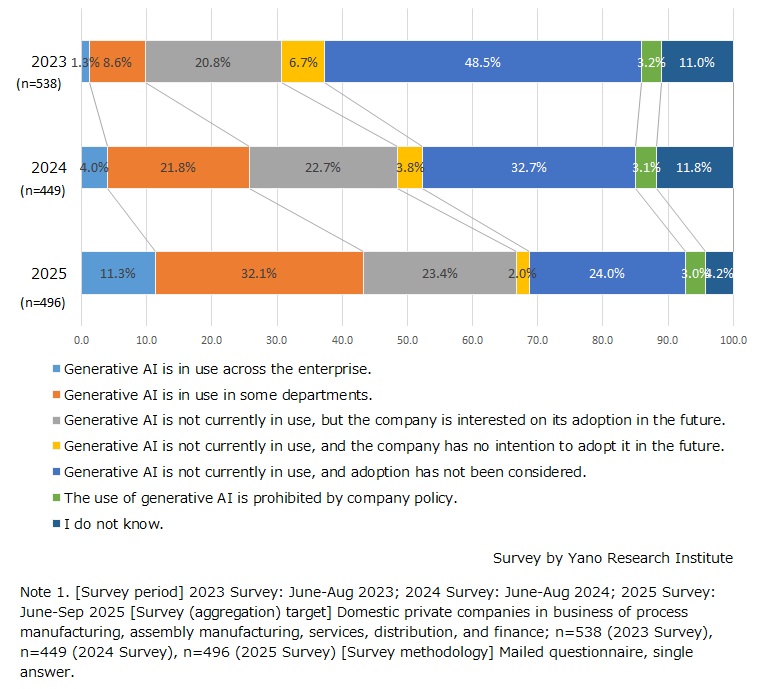
Out of 496 companies that responded (single answer), 11.3% said “generative AI is in use across the enterprise”, and 32% said “generative AI is in use in some departments.” Compared to the results of 2024 Survey (n=449) that indicated generative AI is in use at 25.8% of companies surveyed—with “generative AI is in use across the enterprise” and “generative AI is in use in some departments” accounting for 4% and 21.8% of the respondents, respectively—2025 Survey revealed a significant increase of 7.3 percentage points for the former and 10.3 percentage points for the latter. Overall, while there are differences in the degree of use, generative AI is now used by 43.4% of the companies.
Furthermore, the 2025 Survey shows that 23.4% of respondents reported that generative AI is not currently in use, but adoption is under consideration. Taken together with the proportion of companies already using generative AI, this points to the potential for generative AI adoption to reach 80–90% of companies in the coming years.
The use of generative AI rapidly expanded in the last two years. In 2023 Survey (n=528), less than 10% were using generative AI (only 1.3% said “generative AI is in use across the enterprise”, and 8.6% said “generative AI is in use in some departments”). Generative AI is being adopted at an exceptionally rapid pace compared with other recent IT technologies.
The survey revealed that companies are increasingly incorporating generative AI into their business operations, positioning it as a means to improve operational efficiency amid labor shortages caused by a declining population.
Noteworthy Topics
AI Agent Adoption Gap: 60% Interest vs. 3% Implementation
In the early days of generative AI following the debut of ChatGPT, applications were general (such as idea generation and text creation), which were intended to gain public recognition of generative AI. To make applications of generative AI more suitable for business, Retrieval-Augmented Generation (RAG)—a technique of referencing external data to generate answers—has advanced. Additionally, efforts to fine-tune AI to specific industries and business types are in progress.
Early adopters are inclined to sophisticated use of generative AI. In response, AI service vendors are beginning to shift their focus from conversational AI to agentic AI that complete multi-step tasks autonomously.
In our survey, we defined AI agent as “an AI possessing a level of autonomy to achieve complex goals”. While the definition of AI agents has not been standardized, it is fair to say that 2025 marks the year of rapid emergence of AI agents and related services.
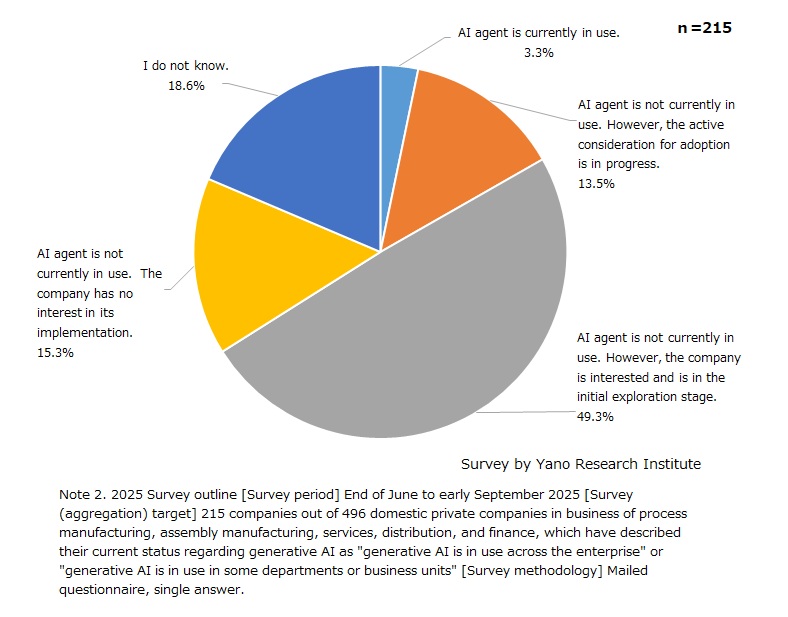
While development of AI services advances, user companies are yet to leverage them. In the 2025 Survey, we asked 215 companies using generative AI about AI agents (single answer). The results showed that only 3.3% are currently in use of AI agent, indicating its limited penetration. The result showed that while vendor companies are actively promoting services with agent function and validating viability of AI agents through proof-of-concept, users adopting the services are still limited to advocative early adopters, while most companies remain in the phase where they are getting accustomed to the use of conversational AI.
Nonetheless, the 2025 Survey results also revealed that more than 60 percent of respondents have forward-looking perceptions toward the adoption of AI agents, with 13.5% saying the active consideration for adoption is in progress and 49.3% saying the company is interested and is in the initial exploration stage. This suggests that AI agents may be introduced gradually.
Research Outline
2.Research Object: Private companies (user companies), companies in business pertaining to generative AI
3.Research Methogology: Face-to-face interviews by expert researchers, surveys via telephone/email, and corporate survey, and literature research.
What is the Corporate Survey on the Use of Generative AI and AI Agent?
From late June to early September of 2025, the survey was conducted to 500 private companies in Japan that are in the business of process manufacturing, assembly manufacturing, services, distribution, and finance. The goal was to find out their current status regarding generative AI and AI agent and analyze their future business development and perspectives. This press release shares the current status regarding generative AI and AI agent.
In this study, generative AI is defined as a computer system capable of generating various types of content through data learnt. An AI agent is defined as an AI possessing a level of autonomy to achieve complex goals.
<Products and Services in the Market>
Consulting services pertaining to generative AI and AI agent implementation, education services pertaining to generative AI and AI agent, support services for generative AI and AI agent implementation, foundational model development, generative AI and/or AI agent-embedded solutions, operation and maintenance of provided generative AI and AI agent solutions, providing environment for using generative AI and/or AI agent, generative AI platforms, AI agent platforms
Published Report
Contact Us
The copyright and all other rights pertaining to this report belong to Yano Research Institute.
Please contact our PR team when quoting the report contents for the purpose other than media coverage.
Depending on the purpose of using our report, we may ask you to present your sentences for confirmation beforehand.