No.4042
Solar Power Market in Japan: Key Research Findings 2025
Domestic Installed Solar Power Capacities Projected to Achieve 6,570MW by FY2040
Yano Research Institute (the President, Takashi Mizukoshi) conducted a survey of the domestic solar power market (new installations). This press release highlights the forecast for installed solar power capacity through FY2040.
Market Overview
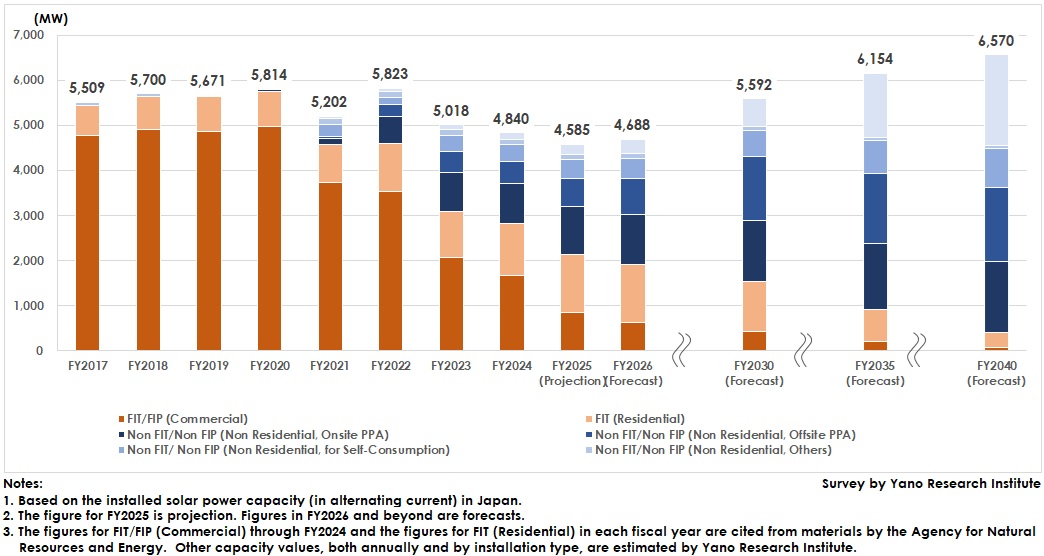
In FY2025, the estimated domestic installed solar power capacity reached 4,585 MW (in alternating current [AC]). From the 2010s to the beginning of the 2020s, Japan has strived to develop and spread renewable energy sources, including photovoltaic power by implementing the feed-in tariff (FIT) program.
However, FIT-based solar power installation capacity continued to decrease due to declining electricity selling prices.
Meanwhile, power purchase agreement (PPA) *1-based installations that do not rely on FIT programs have increased.
The decarbonation trend and rising electricity costs have driven the implementation of onsite power purchase agreement (PPA), which led the non-residential, onsite PPA installation capacity to reach 1,050 MW (projection). This is estimated to account for approximately 23% of the total capacity.
Offsite PPA capacity has also increased, as more energy consumers prioritize environmental values. The capacity of non-residential offsite PPA installations is projected to reach 638 MW, accounting for approximately 14% of the total.
*1) A Power Purchase Agreement (PPA) is a program in which a PPA provider uses its own funds to build a renewable energy facility. The provider then owns, operates and maintains the installation and supplies the generated power to demanders at a long-term fixed price. Since the power system is owned by a third party rather than the demanders, this model is called the third-party ownership. Many PPAs due long-term such as 20 years, during which demanders pay for electricity and environmental value at fixed price.
Noteworthy Topics
Shrinkage of Large-Scale Grounded Solar Power Installations and Expansion of Rooftop Installations
In Japan, the environment for newly introduced large-scale ground-based solar power plants is becoming severer than ever, due to stricter legislation for facility development and municipal ordinance enactments.
Building solar power plants in newly developed forests is extremely difficult. Future installations will likely occur on former golf course sites or other lands that require minimal additional development.
Meanwhile, the government is encouraging installations that can easily be integrated into communities, such as rooftop installations.
The seventh Strategic Energy Plan, determined by the Cabinet, outlines policies for actively utilizing the potential of rooftop installations.
Rooftop installations are expected to increase due to reduced installation costs and municipal mandates for these installations on new buildings.
Future Outlook
The domestic installed solar power capacity is forecast to reach 6,570 MW by FY2040, in alternating current (AC). Total installation capacity is expected to upturn in FY2026 and beyond, as the installations that do not rely on the FIT scheme, such as onsite and offsite PPAs, are likely to grow.
The full introduction of perovskite solar cells in the 2030s will drive the entire market.
Conversely, FIT-based solar power capacity is expected to decline. By FY2040, FIT- and FIP-based solar power installations, regardless of residential or commercial, will have a capacity of 405 MW. This accounts for approximately 6% of the total capacity.
Research Outline
2.Research Object: Solar panel businesses, engineering, procurement, and construction (EPC) businesses, solar power generation companies, electricity retailers, Power Purchase Agreement (PPA) service providers, and other solar-power related businesses
3.Research Methogology: Face-to-face interviews (including online interviews) by our specialized researchers, survey via telephone, and literature research
About Installed Solar Power Capacity
The installed solar power capacities under feed-in tariff or feed-in premium programs through FY2024 are quoted from materials by the Agency for Natural Resources and Energy. Other capacity values, both annually and by installation type, are estimated by Yano Research Institute.
About Onsite and Offsite Power Purchase Agreement (PPA)
The onsite power purchase agreement (PPA) refers to an agreement where a PPA provider constructs renewable power installations such as solar power systems on rooftop or on the property of an energy demander. The demander, after having offered the land, can directly use electricity generated from the installation through the onsite network built between the power system and the building.
The offsite PPA, on the other hand, refers to an agreement for the electricity demander to use power from a renewable power plant built outside of the demander’s property through the power transmission and distribution network. In the offsite PPA, a PPA provider sells renewable electricity via an electricity retailer to the demander, so that the power demander needs to pay not only for electricity itself, but also for consignment charge for power transmission as well as commission fee for the power retailer.
<Products and Services in the Market>
Solar power new installation market
Published Report
Contact Us
The copyright and all other rights pertaining to this report belong to Yano Research Institute.
Please contact our PR team when quoting the report contents for the purpose other than media coverage.
Depending on the purpose of using our report, we may ask you to present your sentences for confirmation beforehand.